Black-throated Blue Warbler (Plate 148)
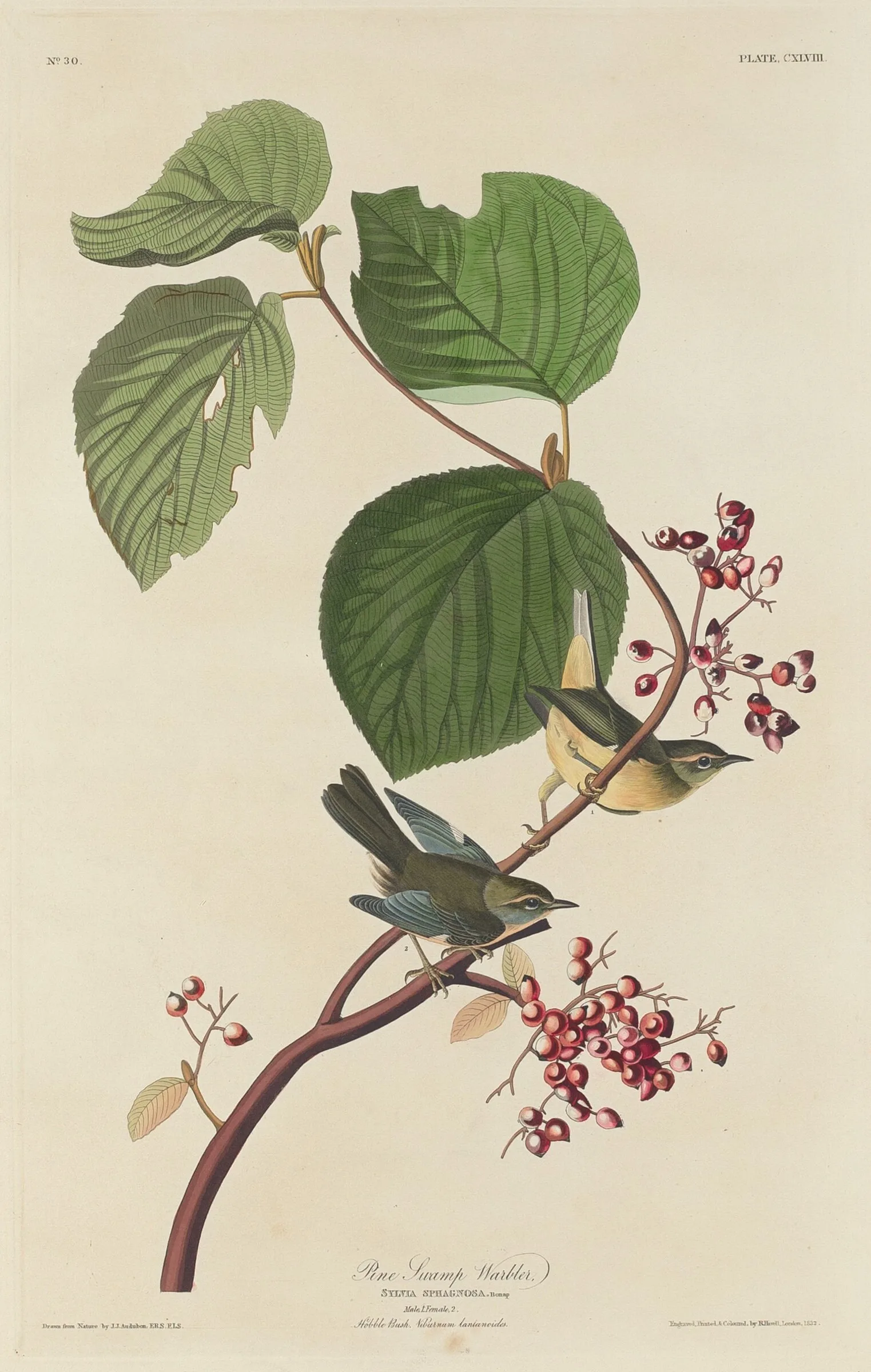
Audubon's “Pine Swamp Warbler”, The Birds of America, plate CXLVIII
Click or press Enter to enlarge
Open the full-resolution image (2408 px, National Gallery of Art)
| Plate | 148 (CXLVIII) |
|---|---|
| Audubon's name | Pine Swamp Warbler |
| Modern name | Black-throated Blue Warbler (female) |
| Scientific name | Setophaga caerulescens |
| Status | Least Concern |
| Engraved by | Robert Havell, after Audubon's watercolor |
| Date | 1832 |
| Medium | Hand-colored engraving and aquatint on Whatman wove paper |
| Plants and setting | Hobblebush (Viburnum lantanoides) |
| Collections | Songbirds |
| This impression | National Gallery of Art, Washington, 1945.8.148; Gift of Mrs. Walter B. James |
About this plate
Plate 148 shows two plain olive-brown warblers with a pale eyebrow and a small white spot on the wing, perched on hobblebush, Viburnum lantanoides. Audubon's plant note describes its large round leaves and berries that turn from red to black. He labelled the birds male and female.
Audubon used Bonaparte's name Sylvia sphagnosa for what he believed was a separate species, the Pine Swamp Warbler. No such species exists. The birds are female Black-throated Blue Warblers, Setophaga caerulescens, whose dull plumage looks nothing like the blue, black and white male shown in plate 155. The small white wing patch, sometimes called a pocket handkerchief, is the key mark the two sexes share.
The Black-throated Blue Warbler breeds in the understorey of mature hardwood and mixed forest in southeastern Canada, the Great Lakes, New England and the Appalachians, and winters mainly in the Greater Antilles. It is listed as Least Concern.
Audubon wrote that he saw the birds in numbers on the Florida Keys near Key West in April, and that one was caught in a house on Indian Key. He found them in New Jersey and Pennsylvania in May, and drew this pair and found their nest in the Great Pine Forest of Pennsylvania. He saw many near Eastport, Maine, but none beyond Grand Manan on his way to Labrador.
In Audubon's words
In the early part of May, I have found it in New Jersey, as well as in Pennsylvania, particularly in the Great Pine Forest, where I drew a pair of them, and found their nest. During my progress eastward, I saw them frequently. In the State of Maine, I found them exceedingly abundant near Eastport, and on the other islands in that vicinity; but there their progress appeared to have stopped, for I did not see one of them beyond the Island of Grand Manan, while on my way to Labrador.
John James Audubon, Ornithological Biography, vol. 2 (1834), “The Pine Swamp Warbler”. Read the full chapter.



