Saltmarsh Sparrow (Plate 149)
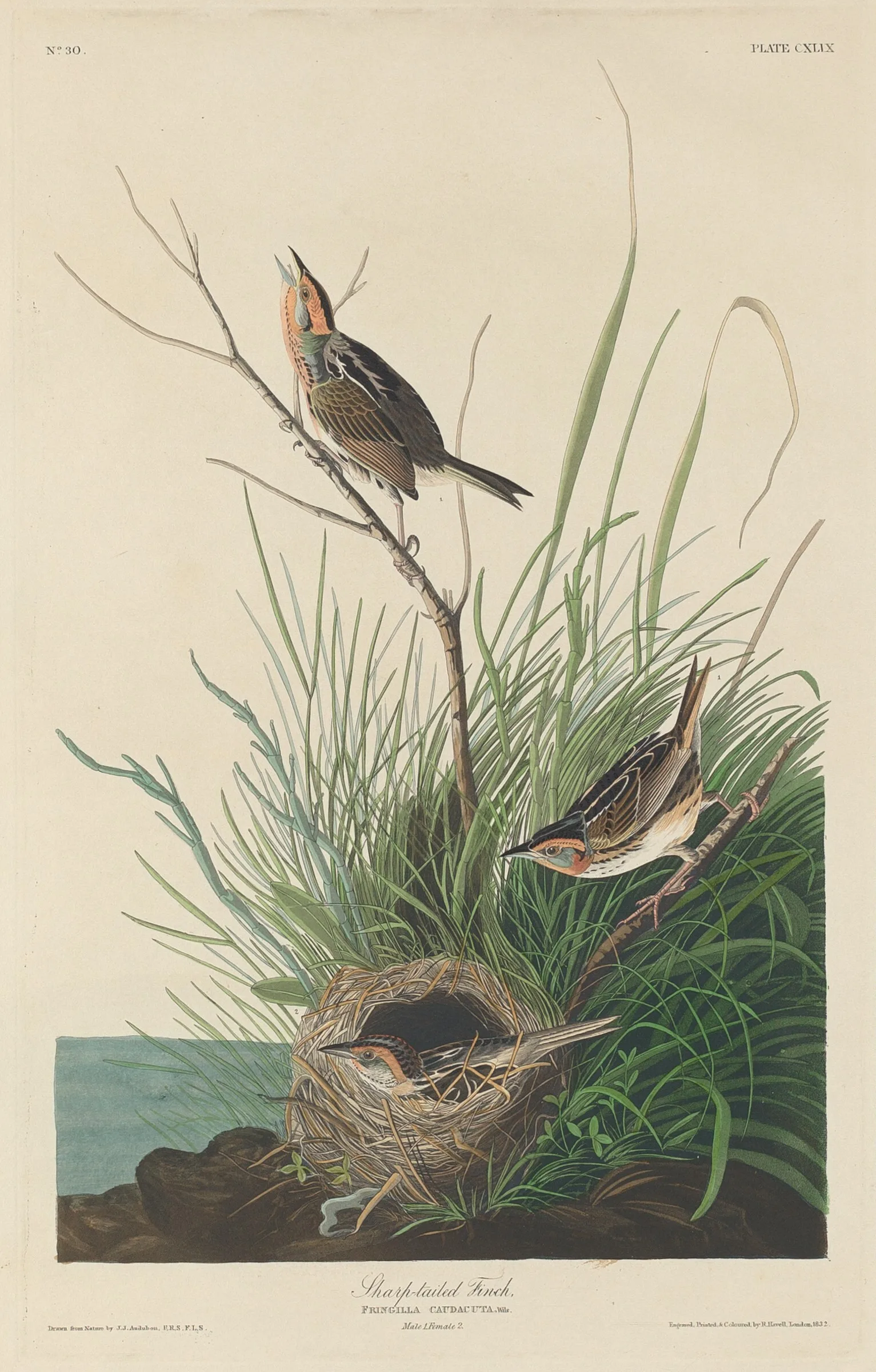
Audubon's “Sharp-Tailed Finch”, The Birds of America, plate CXLIX
Click or press Enter to enlarge
Open the full-resolution image (2400 px, National Gallery of Art)
| Plate | 149 (CXLIX) |
|---|---|
| Audubon's name | Sharp-Tailed Finch |
| Modern name | Saltmarsh Sparrow |
| Scientific name | Ammospiza caudacuta |
| Status | Endangered |
| Engraved by | Robert Havell, after Audubon's watercolor |
| Date | 1832 |
| Medium | Hand-colored engraving and aquatint on Whatman wove paper |
| Plants and setting | Salt-marsh grasses around a ground nest |
| Collections | Songbirds |
| This impression | National Gallery of Art, Washington, 1945.8.149; Gift of Mrs. Walter B. James |
About this plate
Plate 149 shows a male and a female Sharp-tailed Finch with their nest on the ground in salt-marsh grass. Audubon wrote that the nest is placed a few feet from the high-water mark, in a spot that looks like part of a newly mown meadow.
Audubon used Wilson's name Fringilla caudacuta. The species was long called the Sharp-tailed Sparrow. In 1995 it was split into two species, the Saltmarsh Sparrow of the Atlantic coast and Nelson's Sparrow of inland marshes and northern coasts. Both winter in the salt marshes of the Southeast, so Audubon's winter birds from South Carolina could have included either. The bird is now placed in the genus Ammospiza.
The Saltmarsh Sparrow breeds only in tidal marshes from Maine to Virginia and winters from New Jersey to Florida. Rising sea levels and higher tides flood its nests, and its population has fallen steeply. The IUCN lists it as Endangered, and some studies predict it could vanish within decades.
Audubon wrote that thousands spent the winter with Seaside Sparrows in the salt marshes near Charleston, South Carolina, resorting to the sedges at low tide and to the banks of the rice fields when the tide came in. He noted that they walk on floating weeds as easily as on land, eat small shellfish, shrimps and seeds, and fly with the tail held low.
In Audubon's words
These Finches keep so much about the water, that they walk upon the floating weeds as unconcernedly as if on land, or on any drifting garbage raised from the mud at high tides; they congregate and feed together, and doubtless are constant companions until the spring, when these species separate for the purpose of breeding. The Sharp-tailed Finch is rather silent, a single tweet being all that I have heard it utter. In spring their attempts to sing can hardly be said to produce a series of notes that can be dignified by the name of song. They feed on the smaller species of shell-fish, on shrimps, and aquatic insects or crustacea, as well as on the seeds of the grasses growing on the grounds which they inhabit.
John James Audubon, Ornithological Biography, vol. 2 (1834), “The Sharp-tailed Finch”. Read the full chapter.



