Red-eyed Vireo (Plate 150)
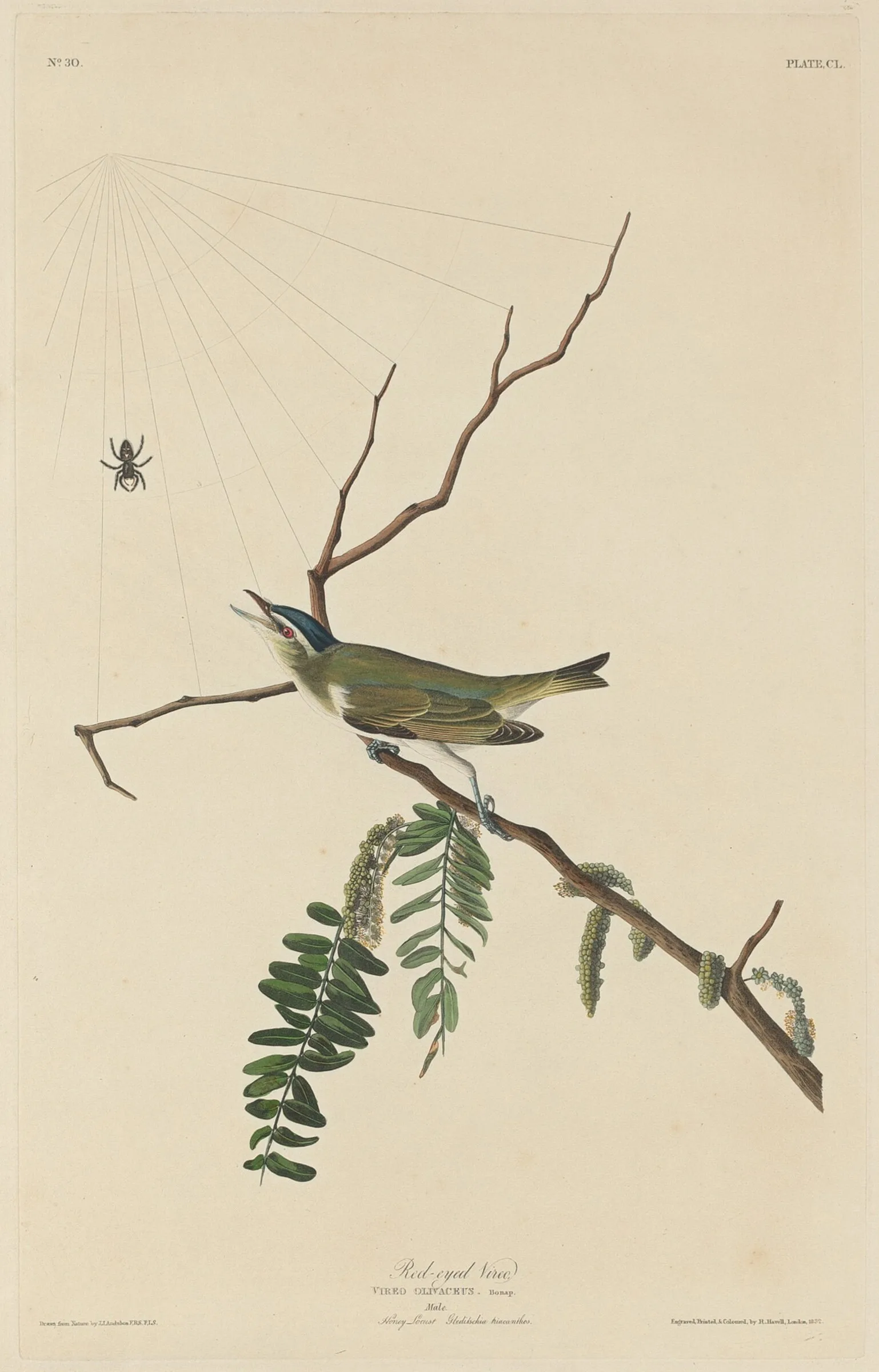
Audubon's “Red-Eyed Vireo”, The Birds of America, plate CL
Click or press Enter to enlarge
Open the full-resolution image (2407 px, National Gallery of Art)
| Plate | 150 (CL) |
|---|---|
| Audubon's name | Red-Eyed Vireo |
| Modern name | Red-eyed Vireo |
| Scientific name | Vireo olivaceus |
| Status | Least Concern |
| Engraved by | Robert Havell, after Audubon's watercolor |
| Date | 1832 |
| Medium | Hand-colored engraving and aquatint on Whatman wove paper |
| Collections | Songbirds |
| This impression | National Gallery of Art, Washington, 1945.8.150; Gift of Mrs. Walter B. James |
About this plate
Plate 150 shows a single male Red-eyed Vireo, olive above and white below, with a grey cap, a white eyebrow bordered in black and a red iris. Audubon noted that young birds have brown eyes that do not turn red until the next spring, and that he once shot birds with one red eye and one brown.
Audubon used Bonaparte's name Vireo olivaceus, which is still current. The chapter opens with a careful comparison of vireos and flycatchers. Audubon pointed out that vireos glean insects from leaves by hopping along branches, rarely sally out like flycatchers and rarely drink from open water. These differences hold up, and vireos are now placed in their own family.
The Red-eyed Vireo is one of the most abundant breeding birds of eastern and northern North American forests and winters in the Amazon basin. It sings through the heat of the day all summer. One male in Ontario was recorded singing more than 22,000 songs in a single day. It is listed as Least Concern.
Audubon wrote that the bird inhabits all of the country's forests, sings for hours from the inner top branches of tall trees, and is among the earliest singers in spring and the latest in autumn. He heard it in winter in southeastern Florida. He also noted that it is often made to raise the young of the Brown-headed Cowbird.
In Audubon's words
The Red-eyed Flycatcher is an inhabitant of the whole of our forests. Now you hear its sweet, unaffected, musical, loud and free warble, from the inner top branches of a tall tree, for hours at a time, and even during the hottest part of the day; again, you may count each note that it utters, the little vocalist resting as it were to enjoy the sounds of its own music; next moment all seems hurry and bustle;—it raises its voice, and chants on with great volubility, so loudly that one might think the little creature intent on drowning all other sounds. The darker the woods, the more cloudy the day, the more unremitting are its exertions.
John James Audubon, Ornithological Biography, vol. 2 (1834), “The Red-eyed Vireo”. Read the full chapter.



