Turkey Vulture (Plate 151)
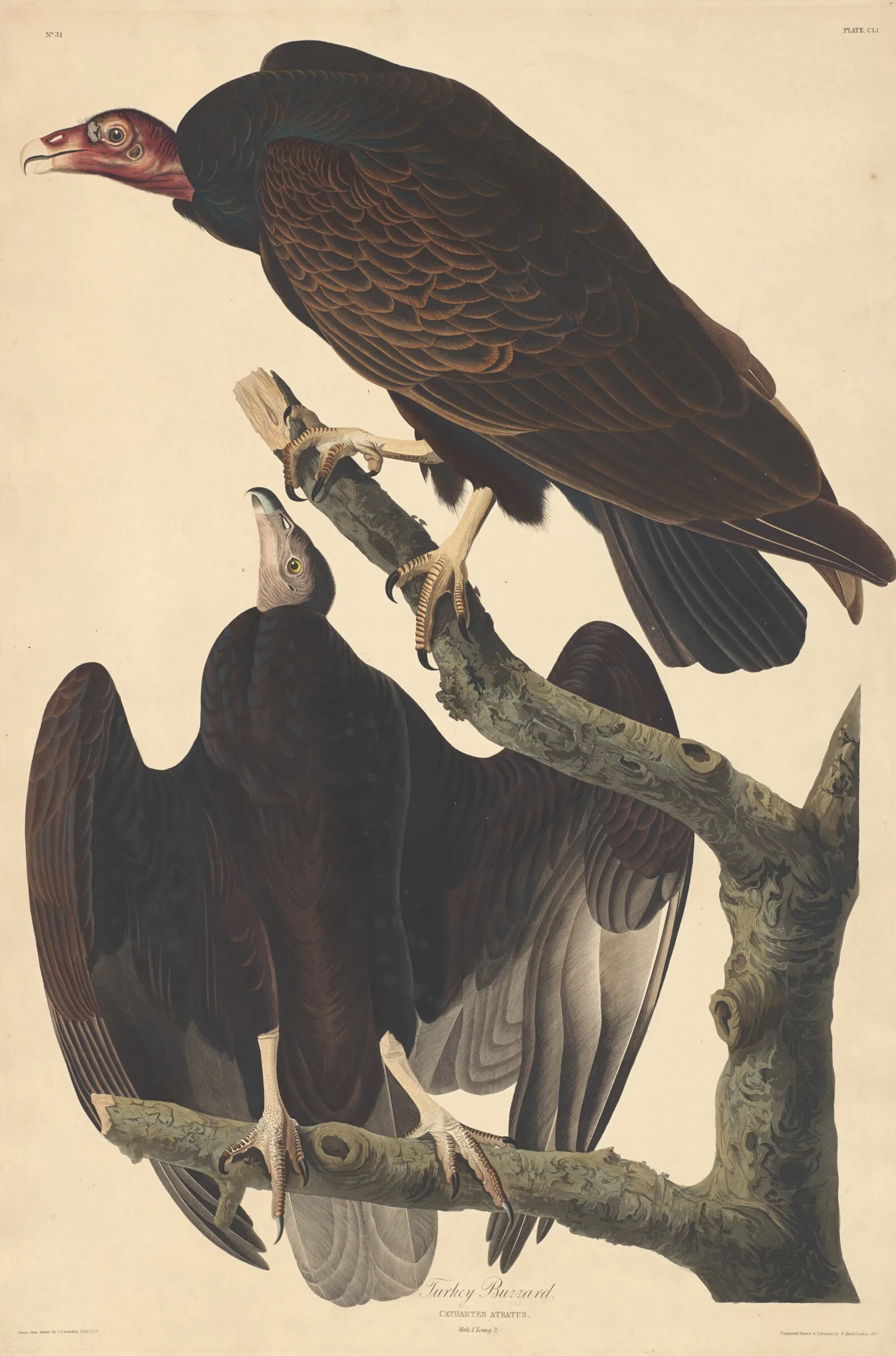
Audubon's “Turkey Buzzard”, The Birds of America, plate CLI
Click or press Enter to enlarge
Open the full-resolution image (5450 px, National Gallery of Art)
| Plate | 151 (CLI) |
|---|---|
| Audubon's name | Turkey Buzzard |
| Modern name | Turkey Vulture |
| Scientific name | Cathartes aura |
| Status | Least Concern |
| Engraved by | Robert Havell, after Audubon's watercolor |
| Date | 1832 |
| Medium | Hand-colored engraving and aquatint on Whatman wove paper |
| Collections | Hawks, Eagles and Falcons |
| This impression | National Gallery of Art, Washington, 1945.8.151; Gift of Mrs. Walter B. James |
About this plate
Plate 151 shows an adult male Turkey Vulture with its bare red head, and a fully fledged young bird. Audubon noted that the young has a flesh-coloured head and a smaller bill but plumage nearly the colour of the adult. In the text he says he chose to show the adult in full plumage alongside a bird in the autumn of its first year.
Audubon used Illiger's name Cathartes aura, which is still current. New World vultures are not related to Old World vultures, which are hawks, and their exact relationships were long debated. Audubon is known for experiments in the 1820s that he believed showed vultures find food by sight, not smell. Later work showed that the Turkey Vulture has one of the best senses of smell of any bird, though the Black Vulture does not.
The Turkey Vulture ranges from southern Canada to Tierra del Fuego and is the most widespread vulture in the Americas. It soars with its wings held in a shallow V. It is listed as Least Concern and has spread north into New England and Canada since Audubon's time.
Audubon wrote that the species had never been seen east of New Jersey and that people in Massachusetts and Maine did not know it. He described it following him in Florida to steal his game, feeding with Black Vultures in the streets of southern cities, and laying two eggs on the ground or in hollow trees.
In Audubon's words
They are gregarious, feed on all sorts of food, and suck the eggs and devour the young of many species of Heron and other birds. In the Floridas, I have, when shooting, been followed by some of them, to watch the spot where I might deposit my game, which, if not carefully covered, they would devour. They also eat birds of their own species, when they find them dead. They are more elegant in form than the Black Vultures, and walk well on the ground or the roofs of houses. They are daily seen in the streets of the southern cities, along with their relatives, and often roost with them on the same trees.
John James Audubon, Ornithological Biography, vol. 2 (1834), “The Turkey Buzzard”. Read the full chapter.