White-breasted Nuthatch (Plate 152)
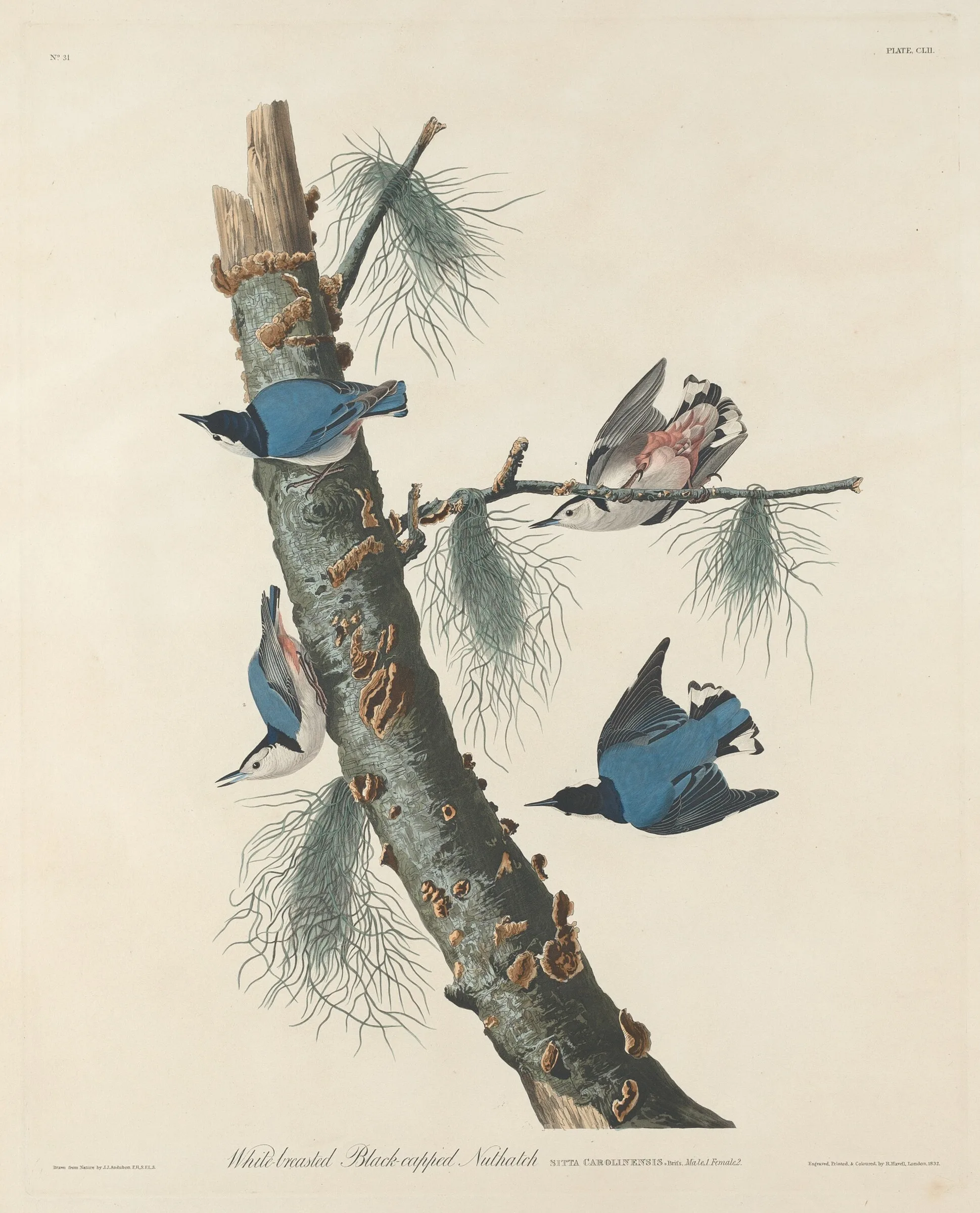
Audubon's “White-breasted Black-capped Nuthatch”, The Birds of America, plate CLII
Click or press Enter to enlarge
Open the full-resolution image (3230 px, National Gallery of Art)
| Plate | 152 (CLII) |
|---|---|
| Audubon's name | White-breasted Black-capped Nuthatch |
| Modern name | White-breasted Nuthatch |
| Scientific name | Sitta carolinensis |
| Status | Least Concern |
| Engraved by | Robert Havell, after Audubon's watercolor |
| Date | 1832 |
| Medium | Hand-colored engraving and aquatint on Whatman wove paper |
| Size | plate: 65.8 x 52.6 cm (25 7/8 x 20 11/16 in.) sheet: 100.5 x 67.5 cm (39 9/16 x 26 9/16 in.) |
| Collections | Songbirds |
| This impression | National Gallery of Art, Washington, 1945.8.152; Gift of Mrs. Walter B. James |
About this plate
Plate 152 shows a male and a female White-breasted Nuthatch. Audubon's description gives the male a glossy blue-black crown and nape and blue-grey back. Females of the eastern form have a duller, greyer cap.
Audubon used Brisson's name Sitta carolinensis, which is still current. It is the largest nuthatch in North America. The chapter opens with a prediction that at least two more nuthatches would be found in the West. The Pygmy Nuthatch of western pine forests was in fact described in 1839, though it is smaller than he expected.
The White-breasted Nuthatch lives in deciduous and mixed woods across much of southern Canada, the United States and Mexico. It does not migrate, and it stores seeds in bark crevices for winter. Eastern, interior and Pacific populations differ in their calls and may be separate species. It is listed as Least Concern.
Audubon wrote that it was found across the country but was the least numerous of the three nuthatches he knew. He described birds coming to farmhouses in winter, tapping at the eaves, entering barns and hopping on the ground among the poultry, and keeping to the deep forest in the breeding season.
In Audubon's words
It is an inhabitant of the forest and the orchard, frequently approaching to the very doors of the farm-houses during winter, when it is not unusually seen tapping at the eaves beneath the roof, thrusting itself into barns and houses, or searching for food among the poultry on the ground, where it moves prettily by short hops. During summer it gives a preference to the interior of the forest, and lives in a retired and secluded manner, especially during the breeding season. Although a lively bird, its actions are less animated, and it exhibits less petulance and restlessness than the other species. It moves alertly, however, when searching for food, climbing or retrograding downwards or sidewise, with cheerfulness and a degree of liveliness, which distinguish it at once from other birds.
John James Audubon, Ornithological Biography, vol. 2 (1834), “The White-breasted Nuthatch”. Read the full chapter.



