Yellow-rumped Warbler (Plate 153)
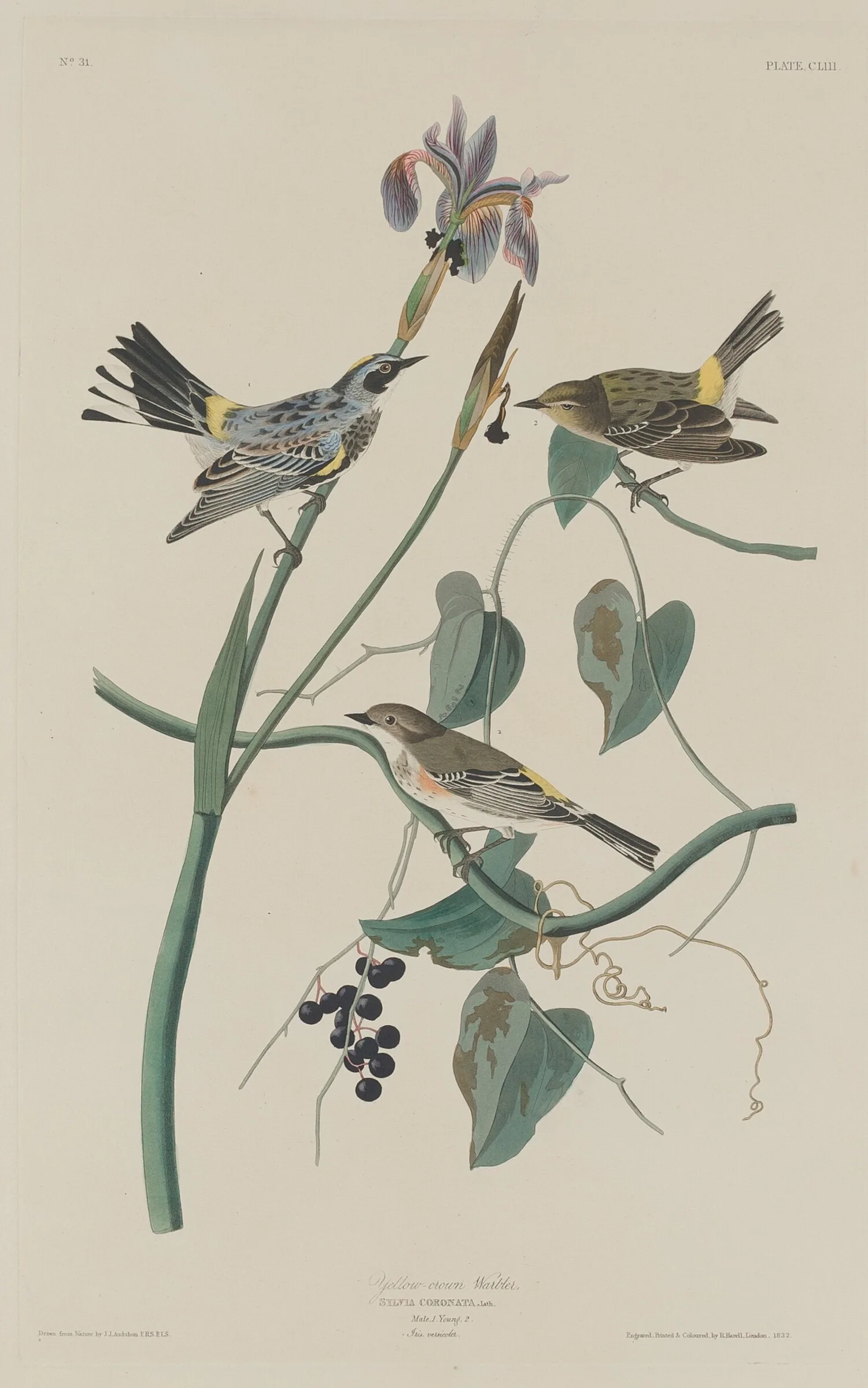
Audubon's “Yellow-crown Warbler”, The Birds of America, plate CLIII
Click or press Enter to enlarge
Open the full-resolution image (2444 px, National Gallery of Art)
| Plate | 153 (CLIII) |
|---|---|
| Audubon's name | Yellow-crown Warbler |
| Modern name | Yellow-rumped Warbler (Myrtle) |
| Scientific name | Setophaga coronata |
| Status | Least Concern |
| Engraved by | Robert Havell, after Audubon's watercolor |
| Date | 1832 |
| Medium | Hand-colored engraving and aquatint on Whatman wove paper |
| Size | plate: 49.9 x 31.1 cm (19 5/8 x 12 1/4 in.) sheet: 101 x 68.9 cm (39 3/4 x 27 1/8 in.) |
| Plants and setting | Blue flag iris (Iris versicolor) |
| Collections | Songbirds |
| This impression | National Gallery of Art, Washington, 1945.8.153; Gift of Mrs. Walter B. James |
About this plate
Plate 153 shows an adult male Yellow-rumped Warbler in breeding plumage, blue-grey with black streaks and yellow on the crown, sides and rump, and a brown streaked young bird. They are shown with blue flag, Iris versicolor, which Audubon described in his plant note.
Audubon's plate name is Yellow-crown Warbler, and his chapter calls it the Yellow-rump Warbler, or Myrtle Bird, Sylvia coronata. It is now Setophaga coronata. The eastern form Audubon drew is the Myrtle Warbler. The western form, with a yellow throat, was named Audubon's Warbler in his honour by John Kirk Townsend in 1837. The two were merged as the Yellow-rumped Warbler in 1973, though some authorities again treat them as separate species.
The species breeds in conifer forests across Canada, Alaska and the western mountains. It winters farther north than any other warbler, in part because it can digest the waxy berries of bayberry and wax myrtle. It is abundant and listed as Least Concern.
Audubon wrote that during a winter in Florida he saw these birds every day, skipping along piazzas, hovering at house walls for spiders and roosting in orange groves at night. In April he and John Bachman collected moulting birds near Charleston, and in May he found them so abundant in Maine that the edges of the woods seemed alive with them.
In Audubon's words
During a winter spent in the Floridas, I saw these birds daily, and so had abundant opportunity of studying their manners. They were very social among themselves, skipped by day along the piazzas, balanced themselves in the air, opposite the sides of the houses, in search of spiders and insects, rambled among the low bushes of the gardens, and often dived among the large cabbage-leaves, where they searched for worms and larvæ. At night they roosted on the branches of the orange trees, in the luxuriant groves so abundant in that country. Frequently, in the early part of warm mornings, I saw flocks of them fly off to sea until they were out of sight, and again observed their return to land about an hour after. This circumstance I considered as indicative of their desire to migrate, and as shewing that their journeys are performed by day.
John James Audubon, Ornithological Biography, vol. 2 (1834), “The Yellow-rump Warbler”. Read the full chapter.



