Tennessee Warbler (Plate 154)
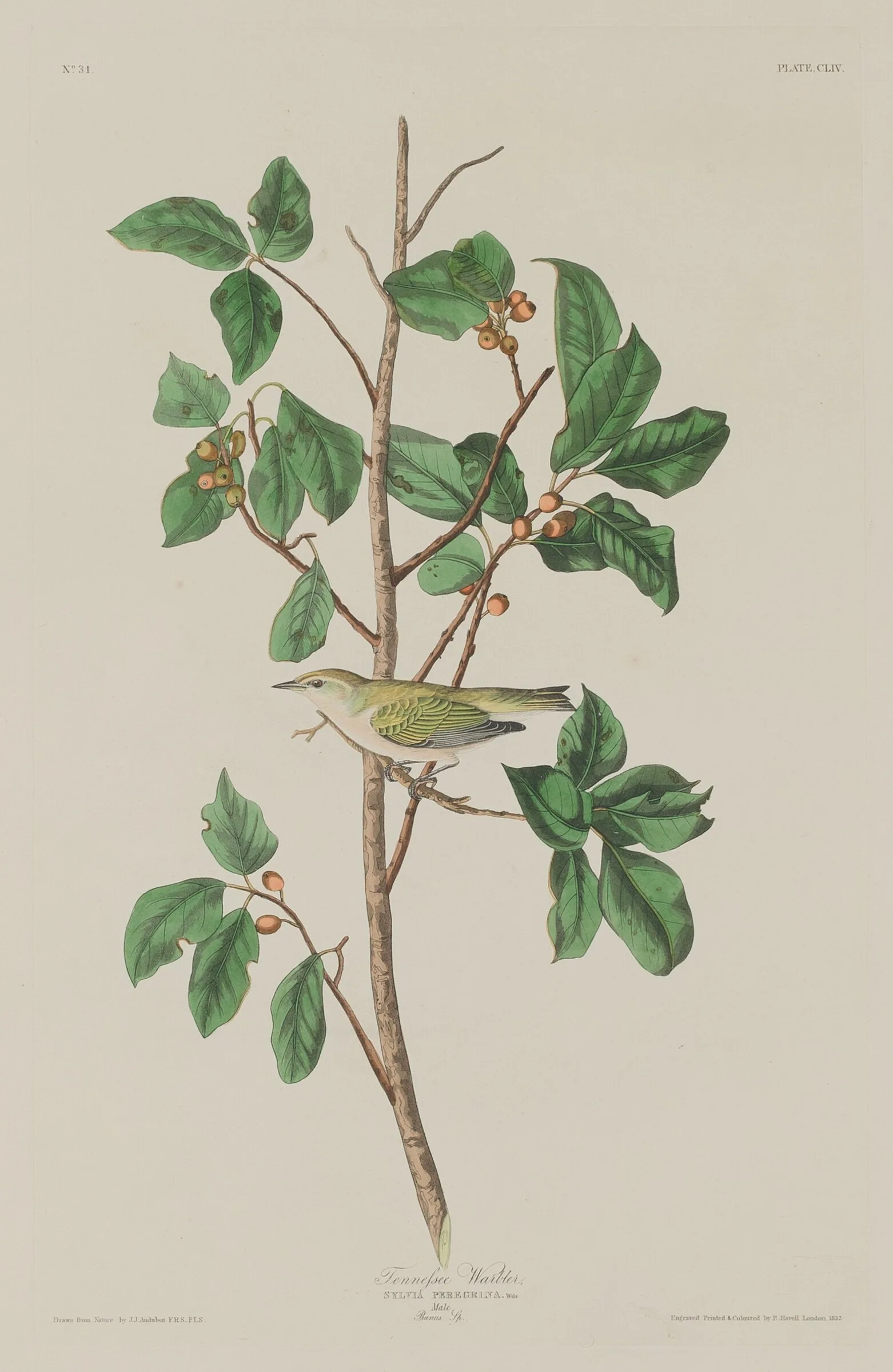
Audubon's “Tennessee Warbler”, The Birds of America, plate CLIV
Click or press Enter to enlarge
Open the full-resolution image (2453 px, National Gallery of Art)
| Plate | 154 (CLIV) |
|---|---|
| Audubon's name | Tennessee Warbler |
| Modern name | Tennessee Warbler |
| Scientific name | Leiothlypis peregrina |
| Status | Least Concern |
| Engraved by | Robert Havell, after Audubon's watercolor |
| Date | 1832 |
| Medium | Hand-colored engraving and aquatint on Whatman wove paper |
| Plants and setting | Holly twig with berries, named by Audubon as Ilex laxiflora |
| Collections | Songbirds |
| This impression | National Gallery of Art, Washington, 1945.8.154; Gift of Mrs. Walter B. James |
About this plate
Plate 154 shows a single male Tennessee Warbler, a plain bird with a grey head, olive back, white underparts and a pale eyebrow. It stands on a holly twig with yellowish-red berries, which Audubon called Ilex laxiflora. He wrote that the twig is the one the bird was standing on when he shot it.
Audubon used Wilson's name Sylvia peregrina. The species is now Leiothlypis peregrina. Wilson named it after the Cumberland River in Tennessee, where he found his specimen on migration, but the bird does not breed there.
The Tennessee Warbler breeds in boreal forest across Canada and winters from southern Mexico to northern South America. Its numbers rise and fall with outbreaks of spruce budworm, a caterpillar that it feeds its young. It is listed as Least Concern.
Audubon wrote that he saw only three in all his travels. He collected the first near Bayou Sara, Louisiana, in the spring of 1821 and drew it then with the holly twig. He took a second in Louisiana in autumn 1829 and the last at Key West in May 1832. He knew nothing of its breeding, and all three birds were males. The species is in fact common, but it passes through the Southeast mostly in the treetops.
In Audubon's words
The first was procured near Bayou Sara, in the State of Louisiana, in the spring of 1821, when I drew it with the holly twig on which it was standing when I shot it. The second I obtained in Louisiana also, not many miles from the same spot, in the autumn of 1829, and the last at Key West, in May 1832. Of its migrations or place of breeding I know nothing. It is an active and nimble species, an expert catcher of flies, fond of hanging to the extremities of branches, like several others of the tribe. It utters a single mellow tweet, as it passes from one branch to another in search of food, or while on the wing, when it moves in a desultory manner for some distance, diving suddenly towards the tree on which it intends to alight. All the individuals which I procured were males.
John James Audubon, Ornithological Biography, vol. 2 (1834), “The Tennessee Warbler”. Read the full chapter.



