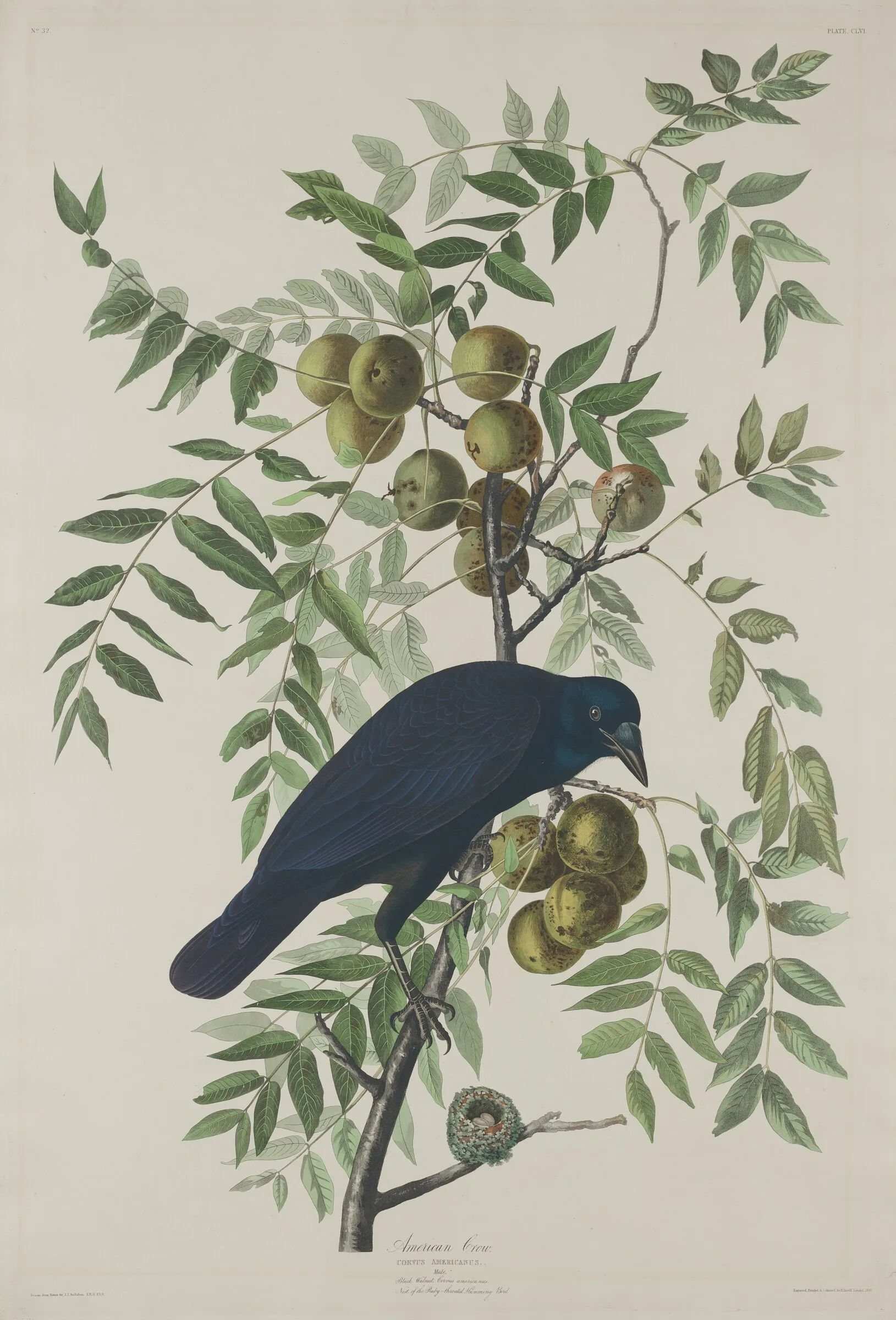
American Crow (Plate 156)
Audubon's “American Crow”, The Birds of America, plate CLVI
Click or press Enter to enlarge
Open the full-resolution image (4578 px, National Gallery of Art)
| Plate | 156 (CLVI) |
|---|---|
| Audubon's name | American Crow |
| Modern name | American Crow |
| Scientific name | Corvus brachyrhynchos |
| Status | Least Concern |
| Engraved by | Robert Havell, after Audubon's watercolor |
| Date | 1833 |
| Medium | Hand-colored engraving and aquatint on Whatman wove paper |
| Collections | Songbirds |
| This impression | National Gallery of Art, Washington, 1945.8.156; Gift of Mrs. Walter B. James |
About this plate
Plate 156 shows a single male American Crow, glossy black throughout. Audubon's chapter is less a natural history than a defence of the bird against the farmers and bounty hunters who killed it.
Audubon used the name Corvus americanus. The species is now Corvus brachyrhynchos, a name given by Brehm in 1822. Audubon's comparisons with the smaller Fish Crow (plate 146) and the Common Raven reflect the same identification problems birders face today.
The American Crow lives across most of North America, from southern Canada to northern Mexico, in farmland, towns and woodland edges. It is highly intelligent and lives in family groups. West Nile virus killed large numbers after 1999, but the species is abundant and listed as Least Concern.
Audubon describes a crow on a high branch judging each person who approaches by whether he carries a gun, and sounding the alarm for every crow within half a mile. He wrote that in one state 40,000 crows were shot in a season for the bounty on their heads, condemned the use of poisoned grain, and argued that the crow destroys countless grubs and pests that would ruin the farmer's crops.
In Audubon's words
I think I see him perched on the highest branch of a tree, watching every object around. He observes a man on horseback travelling towards him; he marks his movements in silence. No gun does the rider carry,—no, that is clear; but perhaps he has pistols in the holsters of his saddle!—of that the Crow is not quite sure, as he cannot either see them or "smell powder." He beats the points of his wings, jerks his tail once or twice, bows his head, and merrily sounds the joy which he feels at the moment. Another man he spies walking across the field towards his stand, but he has only a stick. Yonder comes a boy shouldering a musket loaded with large shot for the express purpose of killing crows! The bird immediately sounds an alarm; he repeats his cries, increasing their vehemence the nearer his enemy advances.
John James Audubon, Ornithological Biography, vol. 2 (1834), “The American Crow”. Read the full chapter.



