Rusty Blackbird (Plate 157)
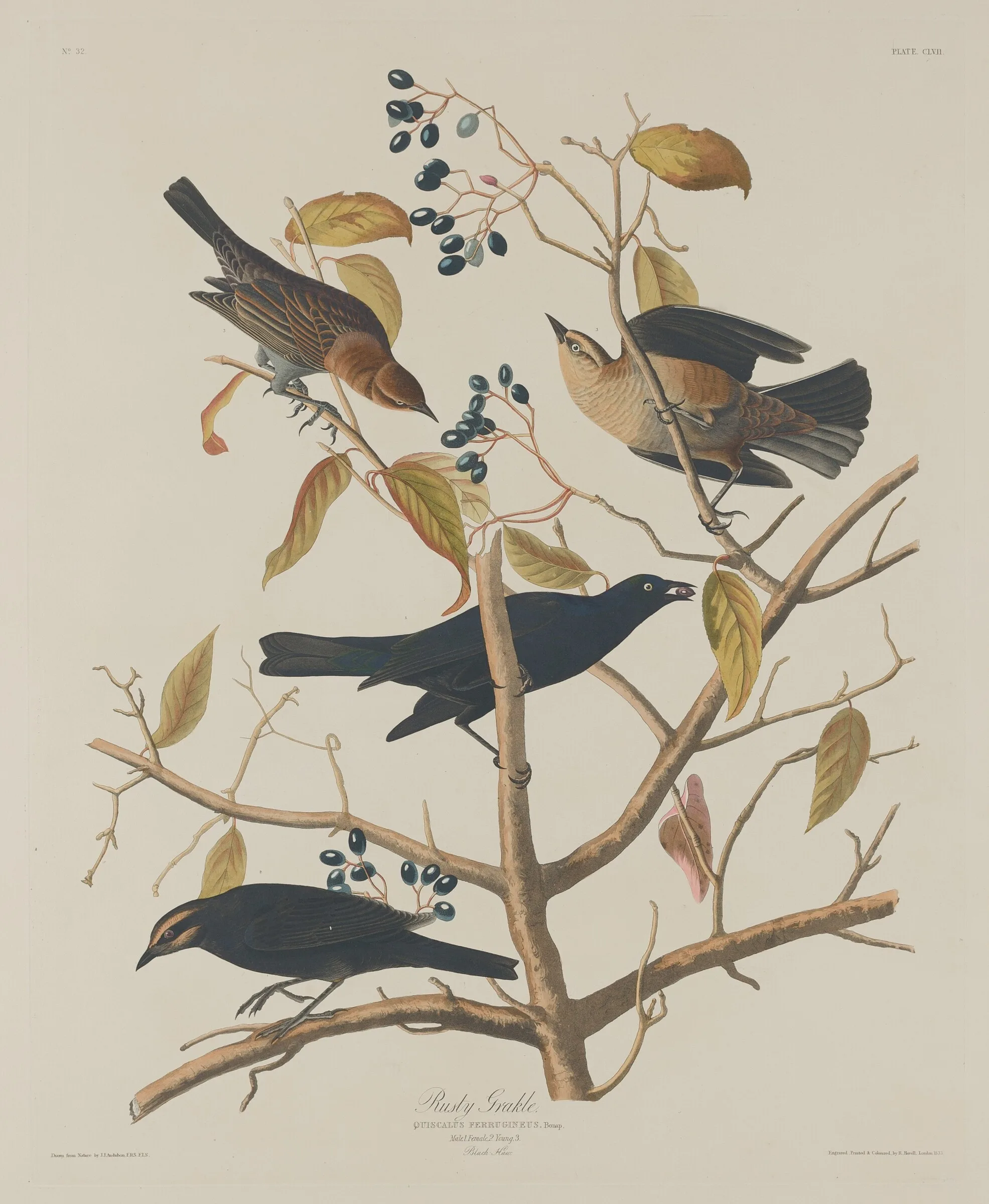
Audubon's “Rusty Grakle”, The Birds of America, plate CLVII
Click or press Enter to enlarge
Open the full-resolution image (3224 px, National Gallery of Art)
| Plate | 157 (CLVII) |
|---|---|
| Audubon's name | Rusty Grakle |
| Modern name | Rusty Blackbird |
| Scientific name | Euphagus carolinus |
| Status | Vulnerable |
| Engraved by | Robert Havell, after Audubon's watercolor |
| Date | 1833 |
| Medium | Hand-colored engraving and aquatint on Whatman wove paper |
| Plants and setting | A Prunus from Louisiana, called the Black Haw in Audubon's plant note |
| Collections | Songbirds |
| This impression | National Gallery of Art, Washington, 1945.8.157; Gift of Mrs. Walter B. James |
About this plate
Plate 157 shows four Rusty Blackbirds in different plumages: a glossy black breeding male, a grey-brown female and young birds edged with rusty brown. Audubon wrote that he drew four to show the changes of plumage, and placed them on a plant of the genus Prunus from Louisiana, whose berries they sometimes eat. His plant note calls it the Black Haw.
Audubon used Bonaparte's name Quiscalus ferrugineus, placing the bird with the grackles. It is now Euphagus carolinus, a close relative of Brewer's Blackbird. The rusty edges to the feathers in autumn and winter, which give the bird its name, wear off by spring.
The Rusty Blackbird breeds in wet boreal forest, bogs and beaver ponds across Canada and Alaska and winters in flooded woods of the southeastern United States. Its population has dropped by roughly 85 to 95 percent since the 1960s, one of the steepest declines of any North American bird, and the IUCN lists it as Vulnerable.
Audubon wrote that in winter the species reached Lower Louisiana and Florida in small flocks with cowbirds and Red-winged Blackbirds, followed cattle in pastures and searched wet places for aquatic insects and snails. He described a captive bird kept for months with smaller birds, fed only on rice, and said it was the only one he ever saw in a cage.
In Audubon's words
These Grakles are fond of the company of cattle, and are seen with them in the pastures or in the farm-yards, searching for food among their droppings, and picking up a few grains of the refuse corn. They are less shy than the other species, possibly because less acquainted with man, as they retire to the north for the purpose of breeding. In the winter they frequently resort to moist places, such as are met with round the ponds and low swampy meadows, where you sometimes find a single one remaining for weeks apart from its companions. They then feed on aquatic insects and small snails, for which they search diligently among the rank reeds or sedges, which they climb with great agility.
John James Audubon, Ornithological Biography, vol. 2 (1834), “The Rusty Grakle”. Read the full chapter.



