Chimney Swift (Plate 158)
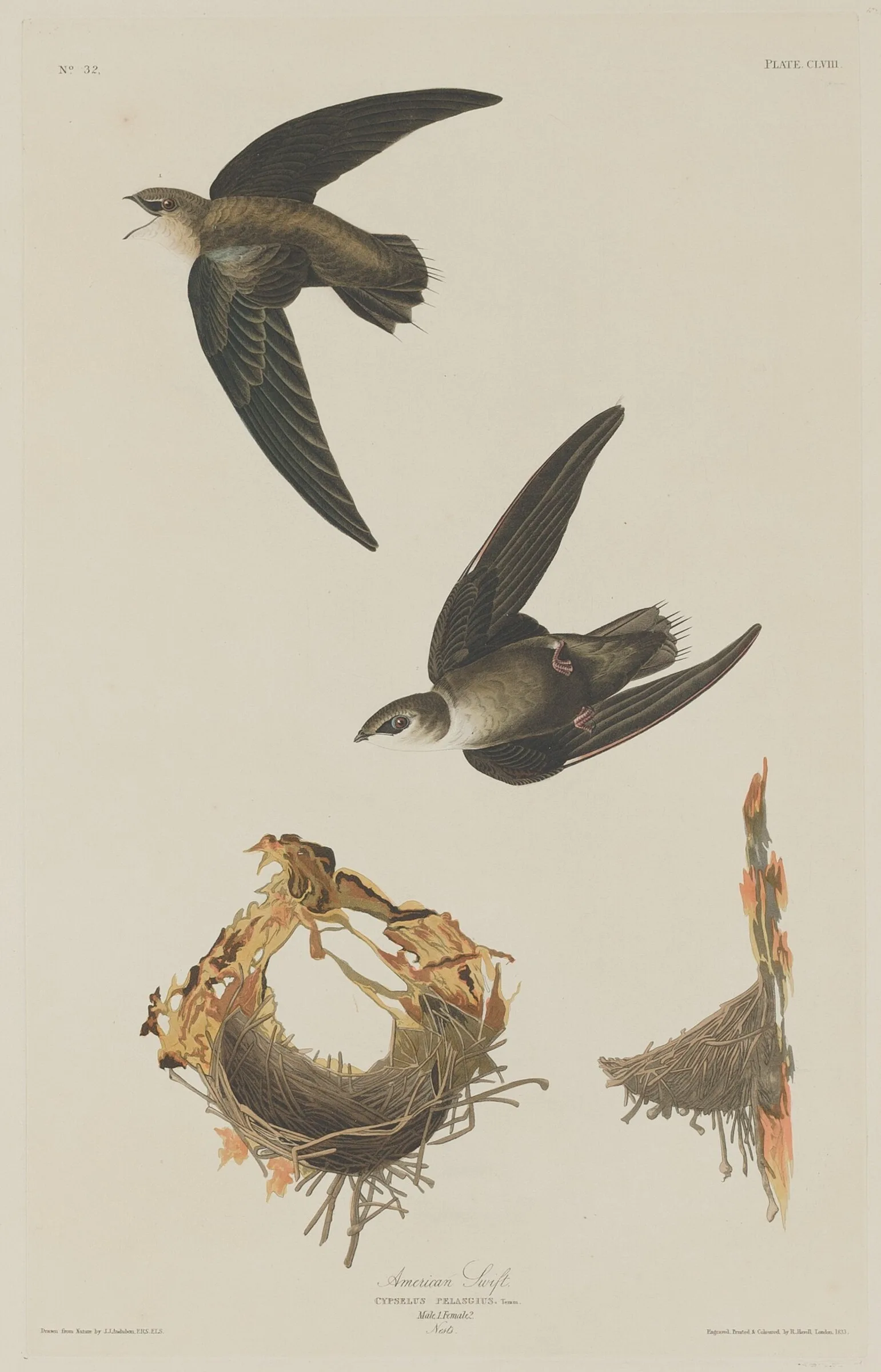
Audubon's “American Swift”, The Birds of America, plate CLVIII
Click or press Enter to enlarge
Open the full-resolution image (2422 px, National Gallery of Art)
| Plate | 158 (CLVIII) |
|---|---|
| Audubon's name | American Swift |
| Modern name | Chimney Swift |
| Scientific name | Chaetura pelagica |
| Status | Vulnerable |
| Engraved by | Robert Havell, after Audubon's watercolor |
| Date | 1833 |
| Medium | Hand-colored engraving and aquatint on Whatman wove paper |
| Collections | Songbirds |
| This impression | National Gallery of Art, Washington, 1945.8.158; Gift of Mrs. Walter B. James |
About this plate
Plate 158 shows a male and a female Chimney Swift clinging beside their nest, a small half-cup of twigs glued together with saliva. Audubon explained that the birds snap dead twigs off trees in flight with their feet and fix them to a wall, rock or tree with saliva.
Audubon headed the chapter 'The Chimney Swallow, or American Swift' and used Temminck's name Cypselus pelasgius. It is now Chaetura pelagica. Swifts are not related to swallows; their nearest relatives are the hummingbirds.
The Chimney Swift breeds across eastern North America and winters in the upper Amazon basin. Before European settlement it nested in hollow trees. It moved into chimneys as Audubon described, and now depends on them. As old chimneys are capped or torn down and flying insects decline, its numbers have fallen by about two thirds since the 1960s, and the IUCN lists it as Vulnerable.
Audubon wrote that in Kentucky, Indiana and Illinois he remembered swifts nesting in hollow sycamores, and that he had one tree cut down that held about thirty nests. At St Francisville, Louisiana, he counted more than a thousand entering one chimney at dusk. At Louisville, Major William Croghan directed him to a huge hollow sycamore used as a roost, and Audubon went back at dusk to watch the swifts pour into it.
In Audubon's words
Immediately after my arrival at Louisville, in the State of Kentucky, I became acquainted with the hospitable and amiable Major William Croghan and his family. While talking one day about birds, he asked me if I had seen the trees in which the Swallows were supposed to spend the winter, but which they only entered, he said, for the purpose of roosting. Answering in the affirmative, I was informed that on my way back to town, there was a tree remarkable on account of the immense numbers that resorted to it, and the place in which it stood was described to me. I found it to be a sycamore, nearly destitute of branches, sixty or seventy feet high, between seven and eight feet in diameter at the base, and about five for the distance of forty feet up, where the stump of a broken hollowed branch, about two feet in diameter, made out from the main stem. This was the place at which the Swallows entered.
John James Audubon, Ornithological Biography, vol. 2 (1834), “The Chimney Swallow, or American Swift”. Read the full chapter.



