Northern Cardinal (Plate 159)
Audubon's “Cardinal Grosbeak”, The Birds of America, plate CLIX
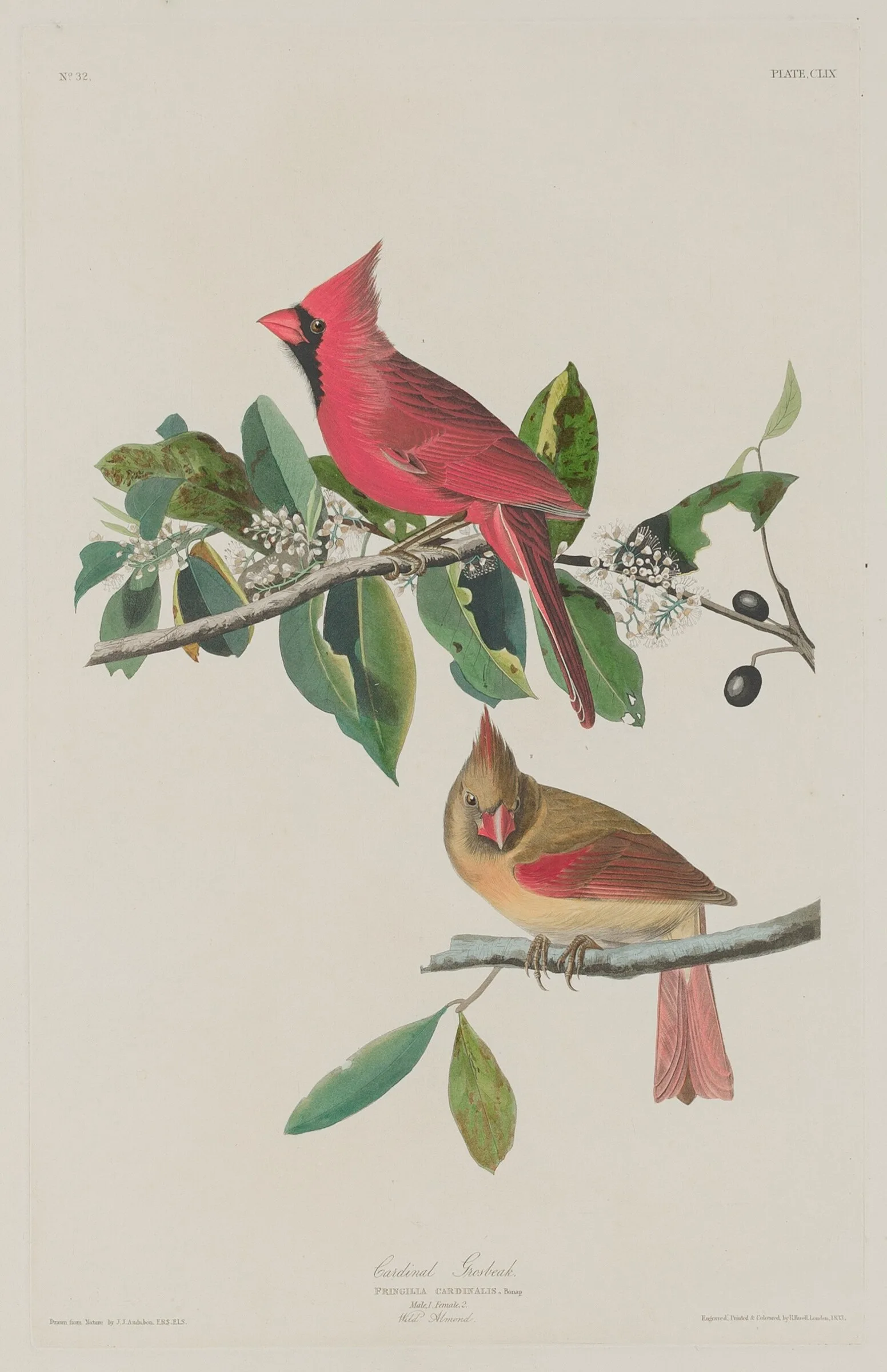
Click or press Enter to enlarge
Open the full-resolution image (2432 px, National Gallery of Art)
| Plate | 159 (CLIX) |
|---|---|
| Audubon's name | Cardinal Grosbeak |
| Modern name | Northern Cardinal |
| Scientific name | Cardinalis cardinalis |
| Status | Least Concern |
| Engraved by | Robert Havell, after Audubon's watercolor |
| Date | 1833 |
| Medium | Hand-colored engraving and aquatint on Whatman wove paper |
| Size | plate: 49.2 x 31.1 cm (19 3/8 x 12 1/4 in.) sheet: 99.7 x 67.3 cm (39 1/4 x 26 1/2 in.) |
| Collections | Songbirds |
| This impression | National Gallery of Art, Washington, 1945.8.159; Gift of Mrs. Walter B. James |
About this plate
Plate 159 shows a bright red male Northern Cardinal with its black face and crest, and a warm brown female with a red-tinged crest, wings and tail. Both have the heavy red bill that Audubon's name, Cardinal Grosbeak, refers to.
Audubon used Bonaparte's name Fringilla cardinalis and wrote that the bird was also called the Red Bird, the Virginia Nightingale and the Cardinal Bird. It is now Cardinalis cardinalis, in the cardinal family. It is the state bird of seven states, more than any other species.
In Audubon's day the cardinal was a southern bird. He wrote that it reached the maritime parts of Pennsylvania and New Jersey, that stragglers got to Massachusetts, and that none had been seen farther east. Since then it has spread north into New England and southeastern Canada, helped by milder winters and bird feeders. It lives from southern Canada to Mexico and Belize and is listed as Least Concern.
Audubon wrote that cardinals lived everywhere from deep cane-brakes to the streets of southern towns and planters' yards, and that he found them already paired in Florida at the beginning of March. He praised it as surpassing all its kindred in the United States in richness of plumage, elegance of motion and strength of song.
In Audubon's words
This fine songster relishes the interior of the forest, and the heart of the deepest cane-brakes or retired swamps, as well as the neighbourhood of cities. It is constantly found in our fields, orchards and gardens; nay, it often enters the very streets of our southern towns and villages to breed; and it is rare that one goes into a planter's yard without observing the Red Bird skipping about the trees or on the turf beneath them. Go where it may, it is always welcome, and every where a favourite, so rich is its song, and so brilliant its plumage.
John James Audubon, Ornithological Biography, vol. 2 (1834), “The Cardinal Grosbeak”. Read the full chapter.
Northern Cardinal (Plate 159): the story behind one of the most famous plates in the collection →



