Carolina Chickadee (Plate 160)
Audubon's “Black-capped Titmouse”, The Birds of America, plate CLX
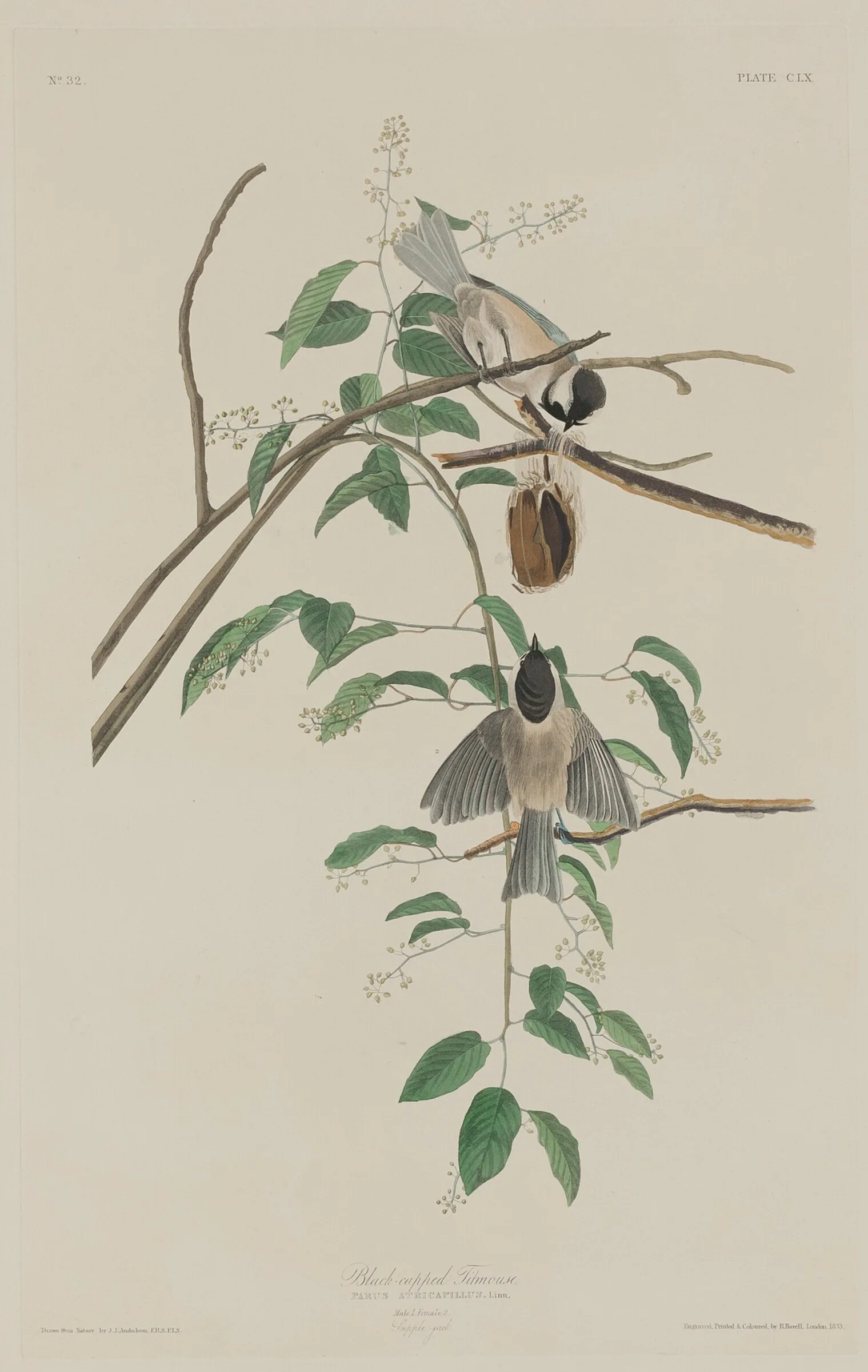
Click or press Enter to enlarge
Open the full-resolution image (2439 px, National Gallery of Art)
| Plate | 160 (CLX) |
|---|---|
| Audubon's name | Black-capped Titmouse |
| Modern name | Carolina Chickadee |
| Scientific name | Poecile carolinensis |
| Status | Least Concern |
| Engraved by | Robert Havell, after Audubon's watercolor |
| Date | 1833 |
| Medium | Hand-colored engraving and aquatint on Whatman wove paper |
| Plants and setting | Supple-jack, described by Audubon as a species of Smilax |
| Collections | Songbirds |
| This impression | National Gallery of Art, Washington, 1945.8.160; Gift of Mrs. Walter B. James |
About this plate
Plate 160 shows a male and a female chickadee on a stem of supple-jack, which Audubon described as a Smilax very common in southern swamps. The plate was engraved under the name Black-capped Titmouse, but the birds are Carolina Chickadees.
Audubon explains in this chapter that only after the plate had been engraved and sent to subscribers did he realise that the small southern bird differed from the northern Black-capped Chickadee. He named the southern species Parus carolinensis, the Carolina Titmouse. It is now Poecile carolinensis, and Audubon is credited as the author of the name. The two species are very alike and hybridise where their ranges meet.
The Carolina Chickadee lives year-round in woods and suburbs across the southeastern United States, from New Jersey and Kansas to Florida and Texas. It is smaller than the Black-capped, with less white in the wing, and its song has four notes rather than two. It is listed as Least Concern.
Audubon wrote that the difference struck him at Eastport, Maine, in May 1833, when Lieutenant Green of the US Army showed him a large northern bird. On returning from Labrador he went to Charleston, where John Bachman told him he had reached the same view. Friends in Boston, Maine and Baltimore sent northern specimens in spirits, and the two men compared them side by side.
In Audubon's words
Indeed, I never was struck with the difference of size until I reached Eastport in the State of Maine, early in May 1833, when one morning my friend Lieutenant Green of the United States army entered my room and shewed me a Titmouse which he had just procured. The large size of his bird, compared with those met with in the south, instantly struck me. On my return from Labrador, I immediately proceeded to Charleston in South Carolina, with a view of once more visiting the western portions of the Floridas and the whole coast of the Gulf of Mexico. In the course of conversation with my friend, the Reverend John Bachman, I mentioned my ideas on the subject of Titmice, when he immediately told me that he had for some time been of the same mind. We both went to the woods, and procured some specimens.
John James Audubon, Ornithological Biography, vol. 2 (1834), “The Carolina Titmouse”. Read the full chapter.



