Veery (Plate 164)
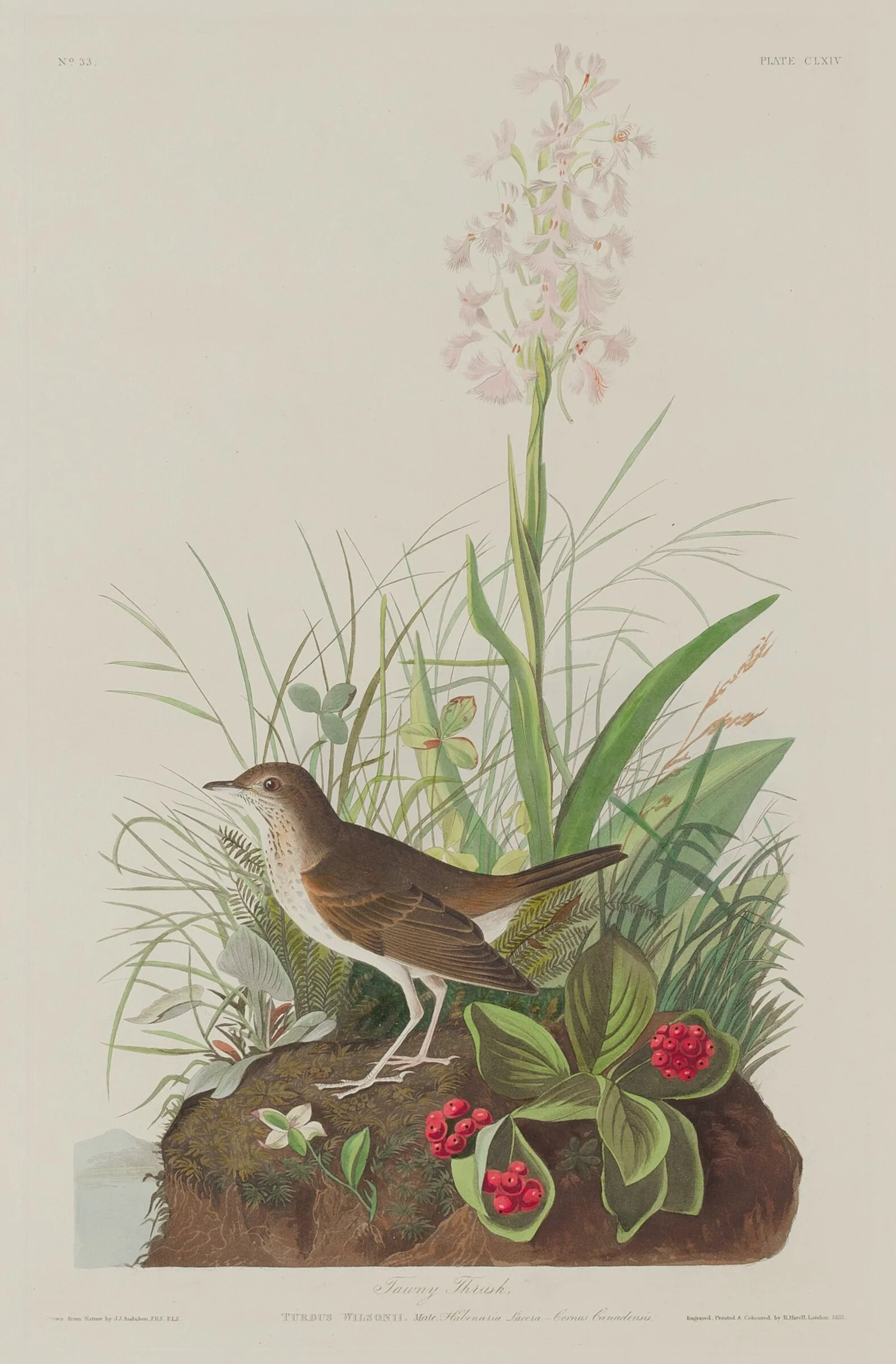
Audubon's “Tawny Thrush”, The Birds of America, plate CLXIV
Click or press Enter to enlarge
Open the full-resolution image (2402 px, National Gallery of Art)
| Plate | 164 (CLXIV) |
|---|---|
| Audubon's name | Tawny Thrush |
| Modern name | Veery |
| Scientific name | Catharus fuscescens |
| Status | Least Concern |
| Engraved by | Robert Havell, after Audubon's watercolor |
| Date | 1833 |
| Medium | Hand-colored engraving and aquatint on Whatman wove paper |
| Plants and setting | Ragged fringed orchid (Habenaria lacera, now Platanthera lacera) |
| Collections | Songbirds |
| This impression | National Gallery of Art, Washington, 1945.8.164; Gift of Mrs. Walter B. James |
About this plate
Plate 164 shows a single male Veery, a tawny-brown thrush with faint spotting on a buff breast, beside a ragged fringed orchid, Habenaria lacera, a pale green orchid of wet meadows. Audubon wrote that the bird in the plate was collected and drawn in Maine, in full plumage.
Audubon called it the Tawny Thrush and used Bonaparte's name Turdus wilsonii, after Alexander Wilson, who had described it. It was also called Wilson's Thrush. The species is now Catharus fuscescens. The name Veery imitates its song, a downward spiral of breezy, reedy notes.
The Veery breeds in damp deciduous woods with thick undergrowth across southern Canada, the northern United States and the Appalachians, and winters in central Brazil. It is listed as Least Concern.
Audubon wrote that in March 1834 at Charleston he heard a thrush singing in the garden of Joel Poinsett. The next day he and John Bachman heard it again, could not agree whether it was a Wood Thrush, and shot it to find it was this species, the first Bachman had ever heard. Audubon found the Veery more common the farther north he went and saw young following their mother in Labrador on 20 July.
In Audubon's words
While at Charleston, in March 1834, I heard a bird singing in the garden-ground of my learned and highly respected fellow-citizen Mr Poinsett, in the immediate neighbourhood of the city. I mentioned the circumstance to my friend John Bachman, who expressed his surprise on account of the early period of the season. The next day, as we were both going out to the woods, we heard the same music again, when a short discussion ensued, and as neither of us could be positive whether it came from a Wood-Thrush or not, we shot the bird, which we instantly discovered to be of the species which has been honoured with the name of its illustrious discoverer. This was the more extraordinary, as that Thrush is very rarely seen in Carolina either in winter or in summer. It was indeed the first time my friend Bachman had ever heard its voice.
John James Audubon, Ornithological Biography, vol. 2 (1834), “The Tawny Thrush”. Read the full chapter.



