Bachman's Sparrow (Plate 165)
Audubon's “Bachmans Finch”, The Birds of America, plate CLXV
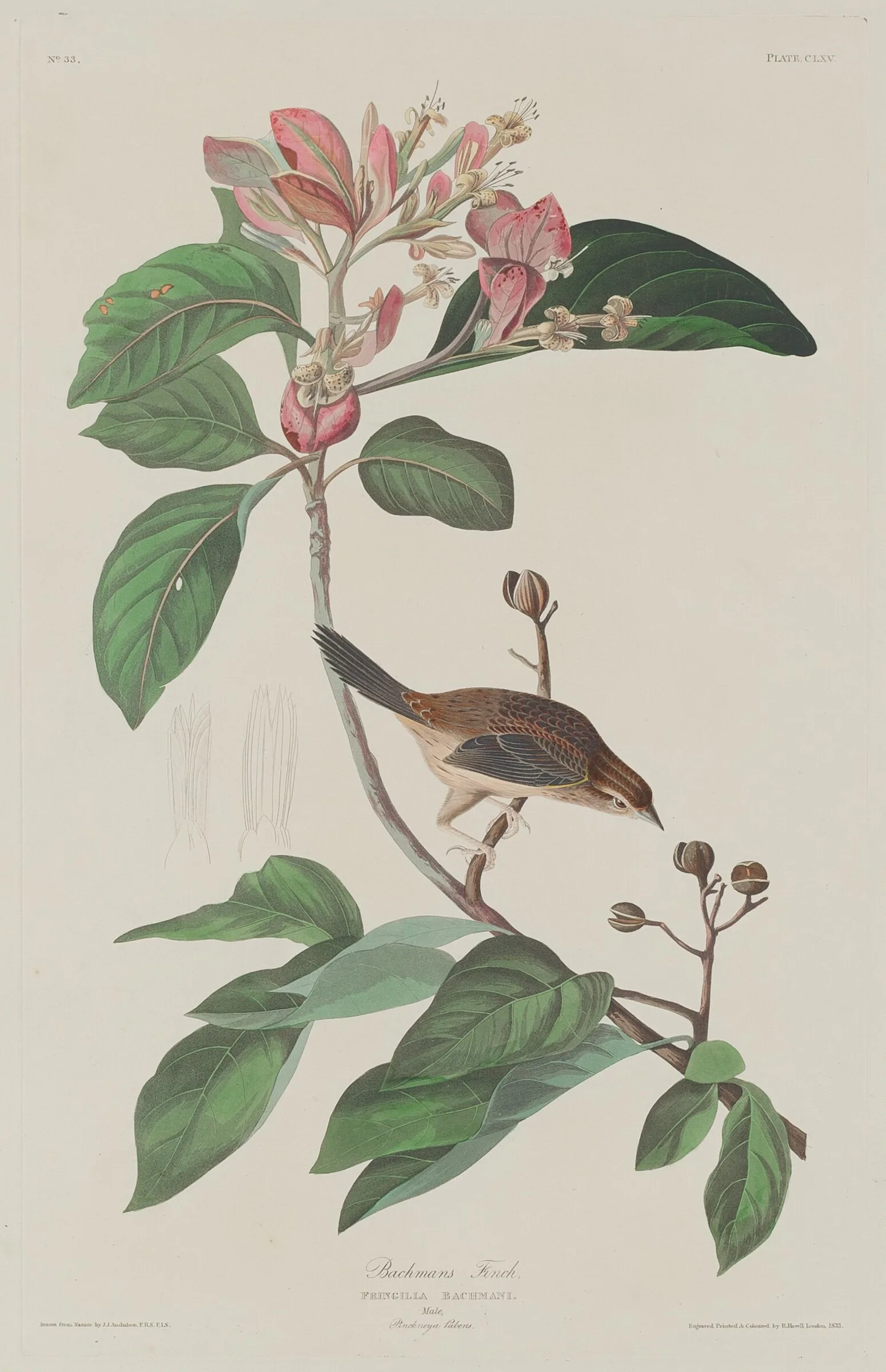
Click or press Enter to enlarge
Open the full-resolution image (2394 px, National Gallery of Art)
| Plate | 165 (CLXV) |
|---|---|
| Audubon's name | Bachmans Finch |
| Modern name | Bachman's Sparrow |
| Scientific name | Peucaea aestivalis |
| Status | Near Threatened |
| Engraved by | Robert Havell, after Audubon's watercolor |
| Date | 1833 |
| Medium | Hand-colored engraving and aquatint on Whatman wove paper |
| Size | plate: 49.2 x 31 cm (19 3/8 x 12 3/16 in.) sheet: 99.2 x 67.6 cm (39 1/16 x 26 5/8 in.) |
| Plants and setting | Fevertree (Pinckneya bracteata), named by Audubon as Pinckneya pubescens |
| Collections | Songbirds |
| This impression | National Gallery of Art, Washington, 1945.8.165; Gift of Mrs. Walter B. James |
About this plate
Plate 165 shows a single male Bachman's Sparrow in summer plumage on a twig of Pinckneya, the fevertree, with its yellow-and-red flowers and large pink-white leaf-like sepals. Audubon wrote that the twig came from a tree in the botanic garden of Philippe Noisette, a few miles from Charleston.
Audubon named the bird Fringilla bachmanii to honour John Bachman, the Charleston minister and naturalist who found it and gave him the specimen. The same bird had been described earlier from Georgia as Fringilla aestivalis, so the scientific name is now Peucaea aestivalis. Bachman's name lives on in the English name.
Bachman's Sparrow lives in open, frequently burned pine woods with a grassy ground layer in the southeastern United States, especially longleaf pine savanna. It has declined along with that habitat and depends on prescribed fire. The IUCN lists it as Near Threatened.
Much of the chapter quotes Bachman. He wrote that he discovered the bird in April 1832 near Parker's Ferry on the Edisto River in South Carolina, then found it breeding on the pine barrens six miles north of Charleston. He described a sweet song from the pines that he first took for a towhee, and a bird that ran off through the grass like a mouse.
In Audubon's words
This bird appears to be rarer in Carolina than it really is. It is in fact oftener heard than seen. When I first heard its notes, they so nearly resembled those of the Towhe Bunting, that I took it to be that bird: a somewhat greater softness, and a slight variation in the notes, alone induced me to suspect that it was another, and caused me to go in pursuit of it. Since then I have heard as many as five or six in the course of a morning's ride, but found it almost impossible to get even a sight of the bird. This was owing, not to its being particularly wild, but to the habits it possesses of darting from the tall pine-trees, where it usually sits to warble out its melodious notes, and concealing itself in the tall brome-grass which is almost invariably found in those places which it frequents. As soon as alighted, it keeps running off in the grass, like a mouse, and it is extremely difficult to put them up, or see them afterwards.
John James Audubon, Ornithological Biography, vol. 2 (1834), “Bachman's Finch”. Read the full chapter.



