Mangrove Cuckoo (Plate 169)
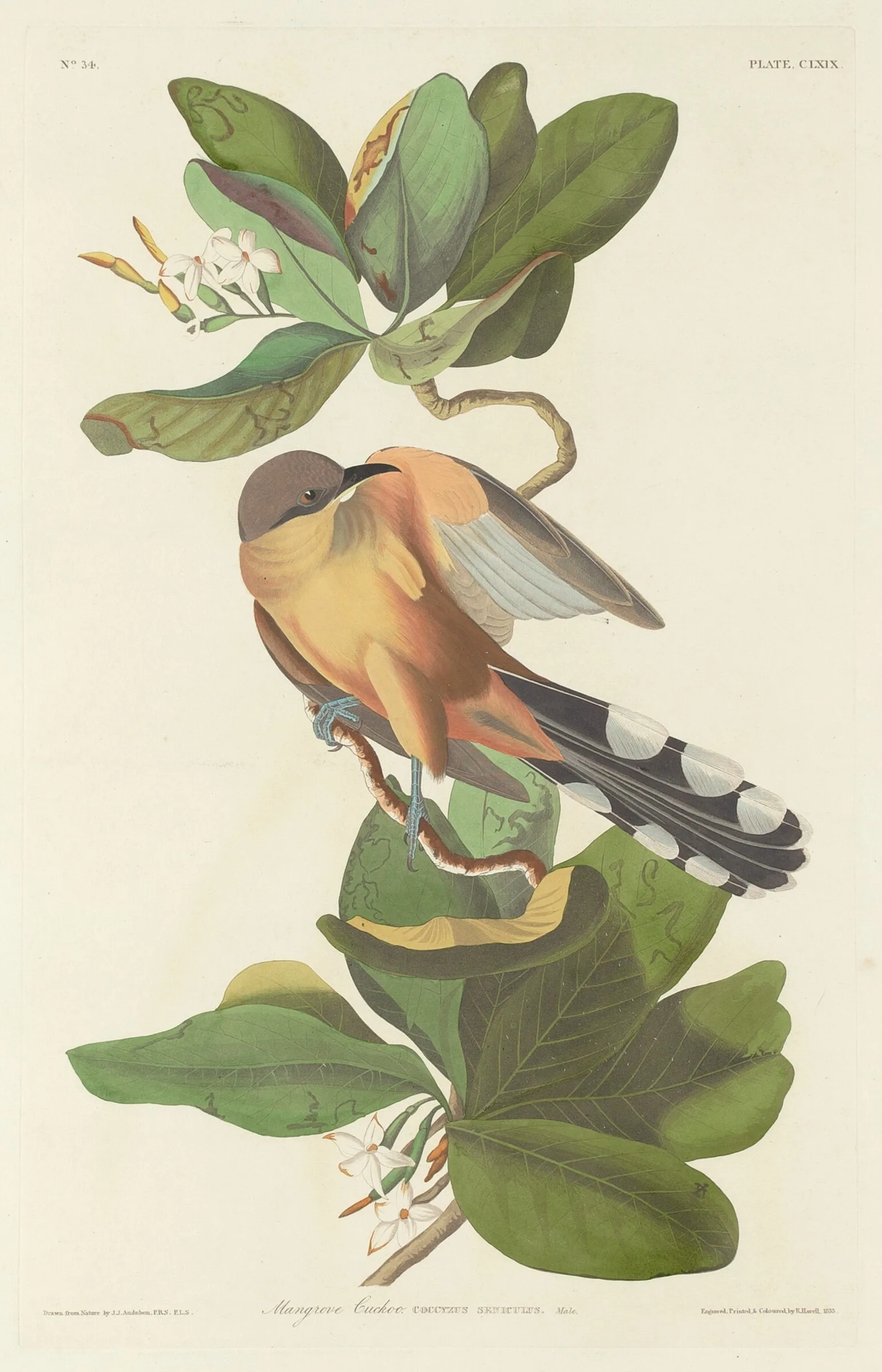
Audubon's “Mangrove Cuckoo”, The Birds of America, plate CLXIX
Click or press Enter to enlarge
Open the full-resolution image (2457 px, National Gallery of Art)
| Plate | 169 (CLXIX) |
|---|---|
| Audubon's name | Mangrove Cuckoo |
| Modern name | Mangrove Cuckoo |
| Scientific name | Coccyzus minor |
| Status | Least Concern |
| Engraved by | Robert Havell, after Audubon's watercolor |
| Date | 1833 |
| Medium | Hand-colored engraving and aquatint on Whatman wove paper |
| Plants and setting | Seven Years' Apple (Casasia clusiifolia) |
| Collections | Songbirds, Florida and Wading Birds |
| This impression | National Gallery of Art, Washington, 1945.8.169; Gift of Mrs. Walter B. James |
About this plate
Plate 169 shows a male Mangrove Cuckoo on a twig of the Seven Years' Apple, a shrub of the Florida Keys with thick glossy leaves that are brown and furred beneath. The bird has the long graduated tail with white tips typical of American cuckoos, and buff to orange underparts that set it apart from the Yellow-billed Cuckoo.
Audubon called it Coccyzus seniculus after Nuttall. The species is now Coccyzus minor. It lives in mangroves and tropical hardwood hammocks in southern Florida, the Caribbean, and from Mexico to northern South America. It is secretive and more often heard than seen. It is listed as Least Concern.
Audubon first got the bird at Key West in early May 1832, when Major Glassel of the United States Army gave him a specimen shot by a soldier of the garrison. He had passed similar cuckoos on his walks, taking them for Yellow-billed Cuckoos, and recognised at once that this one was new to him. He drew it immediately and later shot several more.
He wrote that it nests in mangroves, eats eggs, fruit and insects, and robs the nests of the White-crowned Pigeon. Fishermen and wreckers told him it killed young squabs, but he saw no case of it. The plant is Casasia clusiifolia, which Mark Catesby had figured a century earlier.
In Audubon's words
It is, however, more vigilant and shy, and does not extend its migrations northward beyond the eastern capes of the Floridas, appearing, indeed, to confine itself mostly to the islets covered with mangroves, among the sombre foliage of which trees it usually builds its nest and rears its young. It retires southward in the beginning of September, according to the accounts of it which I received in the country. The nest is slightly constructed of dry twigs, and is almost flat, nearly resembling that of the Yellow-billed Cuckoo, which I have already described. The eggs are of the same number and form as those of that species, but somewhat larger. It raises two broods in the season, and feeds its young on insects until they are able to go abroad. The White-headed Pigeon is frequently robbed of its eggs by this plunderer, and it is alleged by the fishermen and wreckers that it destroys the squabs when yet very young, but I saw no instance of this barbarous propensity.
John James Audubon, Ornithological Biography, vol. 2 (1834), “The Mangrove Cuckoo”. Read the full chapter.