Gray Kingbird (Plate 170)
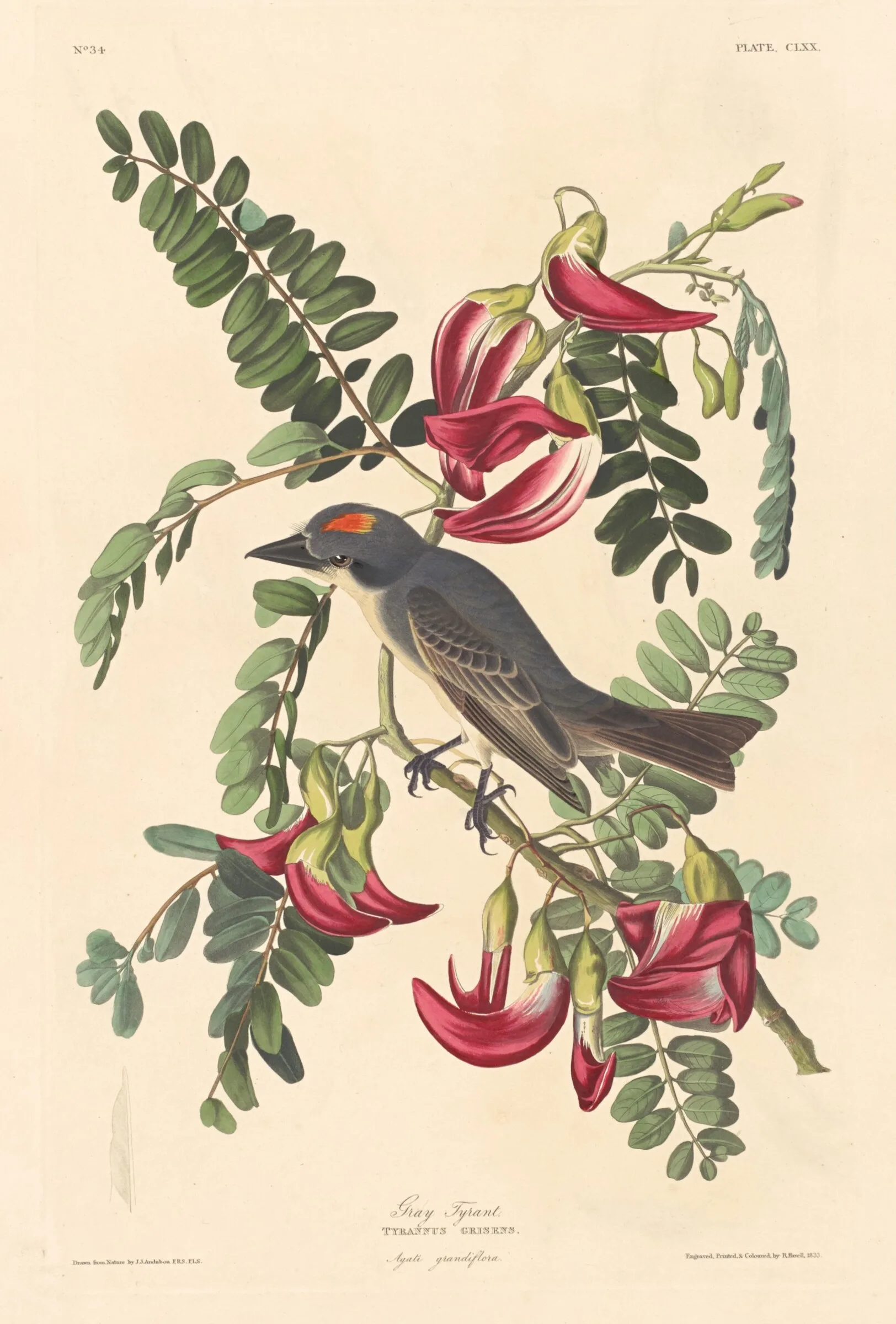
Audubon's “Gray Tyrant”, The Birds of America, plate CLXX
Click or press Enter to enlarge
Open the full-resolution image (2836 px, National Gallery of Art)
| Plate | 170 (CLXX) |
|---|---|
| Audubon's name | Gray Tyrant |
| Modern name | Gray Kingbird |
| Scientific name | Tyrannus dominicensis |
| Status | Least Concern |
| Engraved by | Robert Havell, after Audubon's watercolor |
| Date | 1833 |
| Medium | Hand-colored engraving and aquatint on Whatman wove paper |
| Collections | Songbirds, Florida and Wading Birds |
| This impression | National Gallery of Art, Washington, 1945.8.170; Gift of Mrs. Walter B. James |
About this plate
Plate 170 shows a male Gray Kingbird, engraved as the Gray Tyrant and described in the Ornithological Biography as the Pipiry Flycatcher. It is a large, pale grey flycatcher with a heavy bill and a dark mask through the eye, and is a close relative of the Eastern Kingbird.
The species is now Tyrannus dominicensis. Its Caribbean name, pitirre, imitates its call, and Audubon's "Pipiry" comes from the same source. It breeds in the Florida Keys and along the coasts of Florida and nearby states, and through the West Indies, wintering in the Caribbean and northern South America. It is listed as Least Concern.
Audubon met the bird on his first landing on the Florida Keys in spring 1832. His chapter opens with his delight at the tropical scene, watching a pair rise straight up into the air, twittering. He wrote that it arrives on the Keys about the first of April from Cuba and that he found it on almost every key, however small. He studied it for weeks, watching it chase herons, crows and hawks away from its nest tree.
The chapter ends with a lesson from Charleston. A young man named Lee told Audubon that these flycatchers nested near the city. Audubon doubted it, and when they found the nest destroyed and a common kingbird flew over, the party teased him. The birds then nested again, and John Bachman confirmed the identification.
In Audubon's words
Having landed on one of the Florida Keys, I scarcely had time to cast a glance over the diversified vegetation which presented itself, when I observed a pair of birds mounting perpendicularly in the air twittering with a shrill continued note new to me. The country itself was new: it was what my mind had a thousand times before conceived a tropical scene to be. As I walked over many plants, curious and highly interesting to me, my sensations were joyous in the highest degree, for I saw that in a few moments I should possess a new subject, on which I could look with delight, as one of the great Creator's marvellous works. I was on one of those yet unknown islets, which the foot of man has seldom pressed. A Flycatcher unknown to me had already presented itself, and the cooing of a Dove never before heard come on my ear. I felt some of that pride, which doubtless pervades the breast of the discoverer of some hitherto unknown land.
John James Audubon, Ornithological Biography, vol. 2 (1834), “The Pipiry Flycatcher”. Read the full chapter.