Olive-sided Flycatcher (Plate 174)
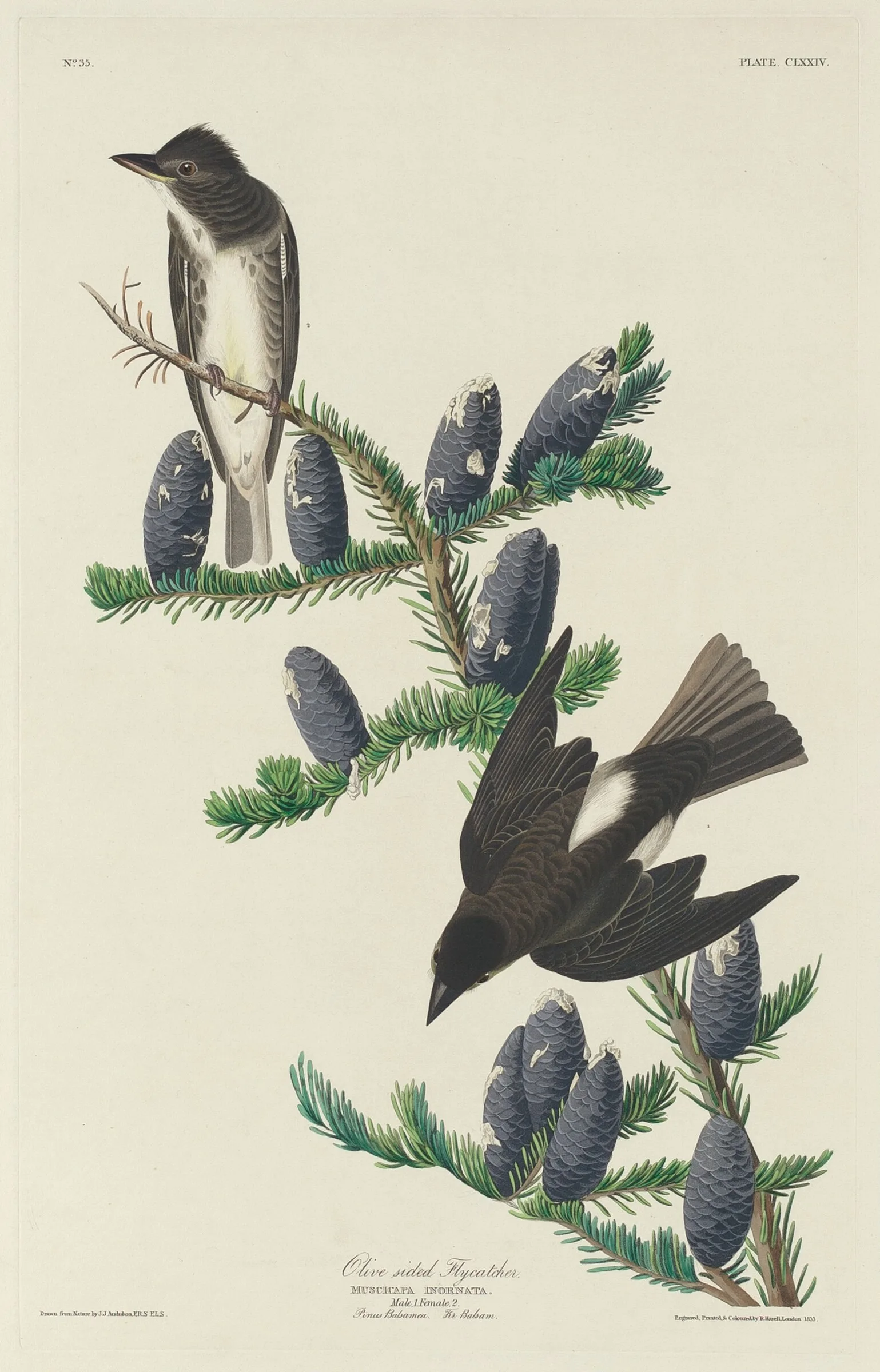
Audubon's “Olive-sided Flycatcher”, The Birds of America, plate CLXXIV
Click or press Enter to enlarge
Open the full-resolution image (2452 px, National Gallery of Art)
| Plate | 174 (CLXXIV) |
|---|---|
| Audubon's name | Olive-sided Flycatcher |
| Modern name | Olive-sided Flycatcher |
| Scientific name | Contopus cooperi |
| Status | Near Threatened |
| Engraved by | Robert Havell, after Audubon's watercolor |
| Date | 1833 |
| Medium | Hand-colored engraving and aquatint on Whatman wove paper |
| Collections | Songbirds |
| This impression | National Gallery of Art, Washington, 1945.8.174; Gift of Mrs. Walter B. James |
About this plate
Plate 174 shows a male and female Olive-sided Flycatcher. It is a stocky, big-headed flycatcher with dark olive sides that frame a pale center to the breast, like an unbuttoned vest. It typically sings from the very top of a dead snag.
Audubon used Thomas Nuttall's name Muscicapa cooperi, honouring William Cooper. The species is now Contopus cooperi, a pewee. It breeds in coniferous forest across Canada, the northern United States and the western mountains, and winters mainly in the Andes of South America. It is listed as Near Threatened because its numbers have fallen steeply, a decline often linked to the loss of wintering habitat and of flying insects.
Audubon credited the discovery to Nuttall and quoted his notes on a pair that nested in a tall red cedar at Mount Auburn, near Cambridge, Massachusetts. Nuttall described a nest of interlaced cedar twigs so thin that light showed through it. Audubon also opened the chapter by wondering why birds unknown twenty years before now seemed to be spreading across the country.
His own first meeting came on 8 August 1832, walking from Boston with Nuttall toward the country seat of Thomas H. Perkins. They heard a male singing. Nuttall went for a gun and came back with a large flintless musket, so they walked nearly a mile to Perkins's house for a working gun, returned and shot the bird. Audubon drew it as the type of the species.
In Audubon's words
On the 8th of August 1832, while walking out from Boston towards the country seat of the Honourable THOMAS H. PERKINS, along with my friend NUTTALL, we were suddenly saluted with the note of this bird. As I had never seen it, I leaped over the fence beside us, and cautiously approached the tree on which a male was perched and singing. Desiring my friend to go in search of a gun, I watched the motions of the devoted bird. He returned with a large musket, a cow's horn filled with powder, and a handful of shot nearly as large as peas; but just as I commenced charging this curious piece, I discovered that it was flintless! We were nearly a mile distant from Mr PERKINS' house, but as we were resolved to have the bird, we proceeded to it with all dispatch, procured a gun, and returning to the tree, found the Flycatcher, examined its flight and manners for a while, and at length shot it.
John James Audubon, Ornithological Biography, vol. 2 (1834), “The Olive-sided Flycatcher”. Read the full chapter.



