House Wren (Wood Wren) (Plate 179)
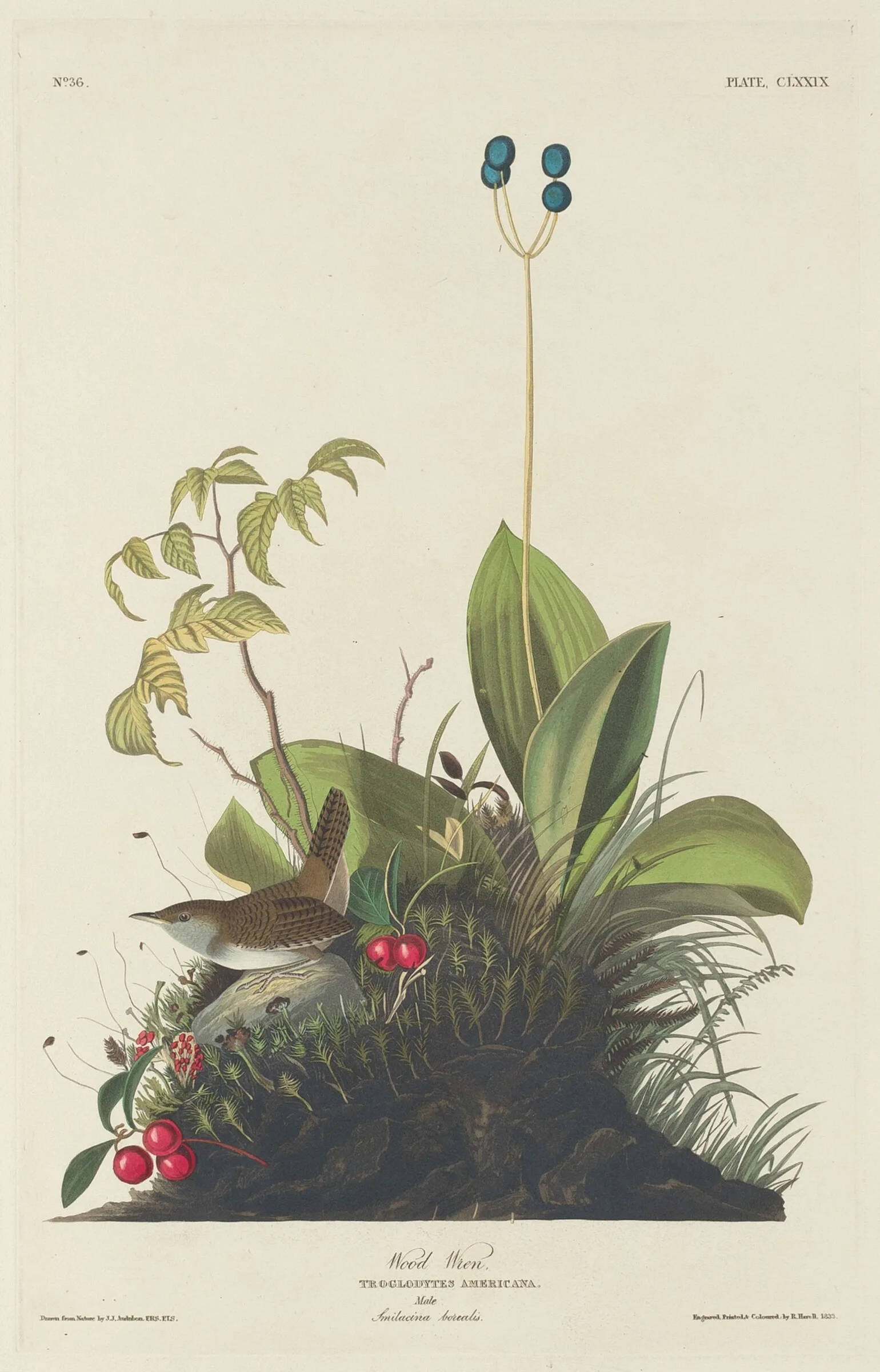
Audubon's “Wood Wren”, The Birds of America, plate CLXXIX
Click or press Enter to enlarge
Open the full-resolution image (2431 px, National Gallery of Art)
| Plate | 179 (CLXXIX) |
|---|---|
| Audubon's name | Wood Wren |
| Modern name | House Wren (Audubon's "Wood Wren") |
| Scientific name | Troglodytes aedon |
| Status | Least Concern |
| Engraved by | Robert Havell, after Audubon's watercolor |
| Date | 1833 |
| Medium | Hand-colored engraving and aquatint on Whatman wove paper |
| Plants and setting | Bluebead lily (Smilacina borealis, now Clintonia borealis) and bearberry (Arctostaphylos uva-ursi) |
| Collections | Songbirds |
| This impression | National Gallery of Art, Washington, 1945.8.179; Gift of Mrs. Walter B. James |
About this plate
Plate 179 shows a single male of what Audubon called the Wood Wren, a small brown wren with a barred tail. It is set among northern woodland plants: a bluebead lily with blue berries and creeping bearberry with scarlet fruit, both from the woods of Maine.
Audubon presented the Wood Wren as a new species, Troglodytes americana. It is not now recognised. The bird is a House Wren, Troglodytes aedon, and his "species" was based on darker, more richly coloured birds of the northern forests. Audubon himself noted that it was nearly allied to the House Wren, though he heard differences in its notes. The House Wren breeds across most of North America and is listed as Least Concern.
His sons shot a family of these wrens in deep woods eight or ten miles from Eastport, Maine, in the summer of 1832. Weeks later three adults were taken near Dennisville, where Thomas Lincoln told him the birds bred in hollow logs and seldom came near farms. Audubon made his drawing at Dennisville. The following winter in Charleston he saw many more and obtained skins through John Bachman.
The chapter ends with a table ranking the wrens then known in the United States, from the Carolina Wren to the House and Winter Wrens, by region and abundance.
In Audubon's words
A family of Wrens of this species were shot by my sons in a deep wood, eight or ten miles from Eastport in Maine, in the summer of 1832. The young were following their parents through the dark and tangled recesses of their favourite places of abode, busily engaged in search of their insect prey; but their nest was not seen. Some weeks afterwards three adult birds of the same kind were shot near Dennisville in the same district; and, on shewing them to my young and intelligent friend THOMAS LINCOLN, Esq. he told me that they bred in hollow logs in the woods, and seldom if ever approached the farms. He had seen the eggs, but, considering it a common species there, had made no notes of their number or colour; nor had he attended to the form or materials of their nest. My drawing was made at that place.
John James Audubon, Ornithological Biography, vol. 2 (1834), “The Wood Wren”. Read the full chapter.



