Pine Siskin (Plate 180)
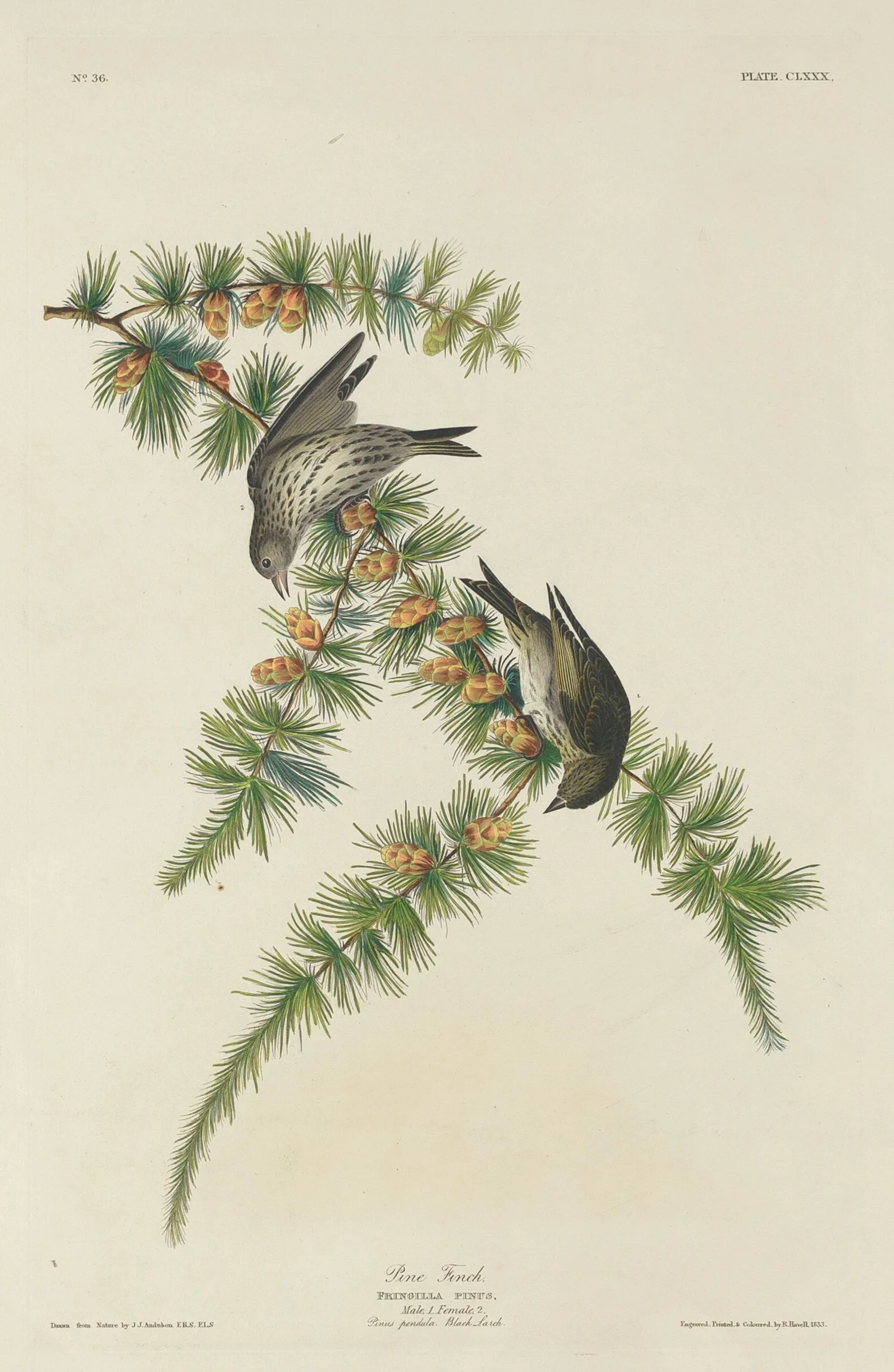
Audubon's “Pine Finch”, The Birds of America, plate CLXXX
Click or press Enter to enlarge
Open the full-resolution image (2485 px, National Gallery of Art)
| Plate | 180 (CLXXX) |
|---|---|
| Audubon's name | Pine Finch |
| Modern name | Pine Siskin |
| Scientific name | Spinus pinus |
| Status | Least Concern |
| Engraved by | Robert Havell, after Audubon's watercolor |
| Date | 1833 |
| Medium | Hand-colored engraving and aquatint on Whatman wove paper |
| Plants and setting | Black larch or tamarack (Pinus pendula, now Larix laricina) |
| Collections | Songbirds |
| This impression | National Gallery of Art, Washington, 1945.8.180; Gift of Mrs. Walter B. James |
About this plate
Plate 180 shows a male and female Pine Siskin on a branch of the black larch, or tamarack, with its small cones. The birds are streaky brown finches with thin pointed bills and flashes of yellow in the wings and tail. Audubon noted that the sexes look almost the same.
Audubon followed Wilson in calling it the Pine Finch, Fringilla pinus. It is now the Pine Siskin, Spinus pinus, a close relative of the American Goldfinch and the European Siskin, both of which Audubon compared it with. It breeds in conifer forests across Canada, Alaska and the western mountains. In some winters, when seed crops fail in the north, it irrupts far to the south. It is listed as Least Concern.
Audubon described exactly that irregular wandering. He shot several near Charleston in December 1833 and had earlier taken five near Henderson, Kentucky. In August and September 1832 he met flocks in the British provinces feeding with crossbills high in fir trees and on thistles, hanging upside down like titmice. The plate's specimens came from near the residence of Sir Archibald Campbell, governor of New Brunswick.
On the 1833 Labrador voyage, small groups of siskins landed on the spars and rigging of his schooner, the Ripley, near the Magdalen Islands, rested and called, then flew on toward shore. The larch in the plate he gave as Pinus pendula, now Larix laricina.
In Audubon's words
In August and September 1832, while travelling in the British provinces, I and my companions frequently met with flocks of these birds, in company with the American Crossbill, feeding amid the branches of the tallest fir trees, as well as on the seeds of the thistles of that country, much in the manner of the American Goldfinch, and the European Siskin. When disturbed, they would rise high in the air in an irregular flight, emitting their peculiar call-note as they flew; but would always realight as soon as another group of thistles was seen by them. When feeding, they often hung head downwards, like so many Titmice, and as often would balance themselves on the wing, as if afraid to alight on the sharp points of the plants, which after all they appeared greatly to prefer to all others.
John James Audubon, Ornithological Biography, vol. 2 (1834), “The Pine Finch”. Read the full chapter.



