Louisiana Waterthrush (Plate 19)
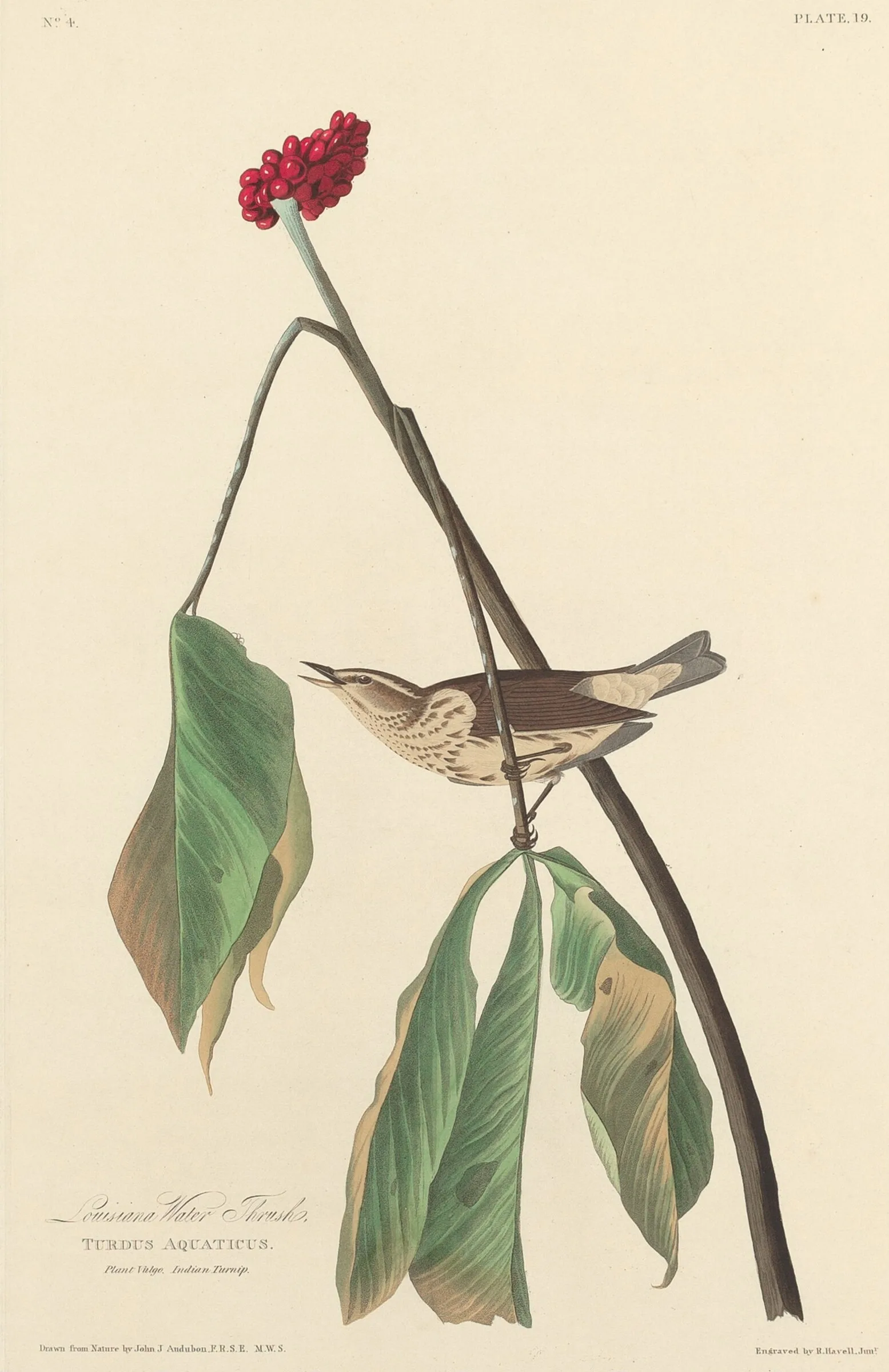
Audubon's “Louisiana Water Thrush”, The Birds of America, plate XIX
Click or press Enter to enlarge
Open the full-resolution image (2287 px, National Gallery of Art)
| Plate | 19 (XIX) |
|---|---|
| Audubon's name | Louisiana Water Thrush |
| Modern name | Louisiana Waterthrush |
| Scientific name | Parkesia motacilla |
| Status | Least Concern |
| Engraved by | Robert Havell, after Audubon's watercolor |
| Date | 1827 |
| Medium | Hand-colored engraving and aquatint on Whatman wove paper |
| Plants and setting | Indian Turnip (Jack-in-the-pulpit, Arisaema triphyllum) |
| Collections | Songbirds |
| This impression | National Gallery of Art, Washington, 1945.8.19; Gift of Mrs. Walter B. James |
About this plate
Plate 19 shows a single Louisiana Waterthrush perched on Indian Turnip, the plant now called Jack-in-the-pulpit, Arisaema triphyllum. Audubon wrote that the plant grew abundantly where the bird lived and that its potato-like root was extremely pungent. He drew only a male because the sexes look alike. The plate was engraved by Robert Havell in 1827.
Audubon opened the chapter by saying the song of the Nightingale was no better than this bird's. He described it singing from a low bough just above the canes, swelling its throat and running down a scale like the keys of a piano. He wrote that the young leave the nest in about ten days and follow the parent on the ground. He never saw it farther east than Georgia or higher on the Ohio than the canebrakes near Henderson, Kentucky.
Audubon called it Turdus ludovicianus, a thrush, but it is a wood warbler. The current name is Louisiana Waterthrush, Parkesia motacilla. It was moved from Seiurus to the new genus Parkesia in 2010 with the Northern Waterthrush. Audubon believed it lived in Louisiana all year. In fact it winters in Mexico, Central America and the Caribbean.
The species breeds along clear, fast-moving streams in hilly forest across the eastern United States. It walks along the water bobbing its tail and is one of the earliest warblers to arrive in spring. It is listed as Least Concern.
In Audubon's words
This bird is a resident of the low lands of the States of Louisiana and Mississippi, and is to be found at all seasons in the deepest and most swampy of our cane brakes, from which its melodies are heard to a considerable distance, its voice being nearly as loud as that of the Wood Thrush. The bird may be observed perched on a low bough scarcely higher than the tops of the canes, in an erect attitude, swelling its throat, and repeating several times in succession sounds so approaching the whole two octaves of a good piano-forte, as almost to induce the hearer to imagine that the keys of that instrument are used on the occasion. The bird begins on the upper key, and progressively passes from one to another, until it reaches the base note, this last frequently being lost when there is the least agitation in the air. Its song is heard even in the winter, when the weather is calm and warm.
John James Audubon, Ornithological Biography, vol. 1 (1831), “The Louisiana Water Thrush”. Read the full chapter.



