Passenger Pigeon (Plate 62)
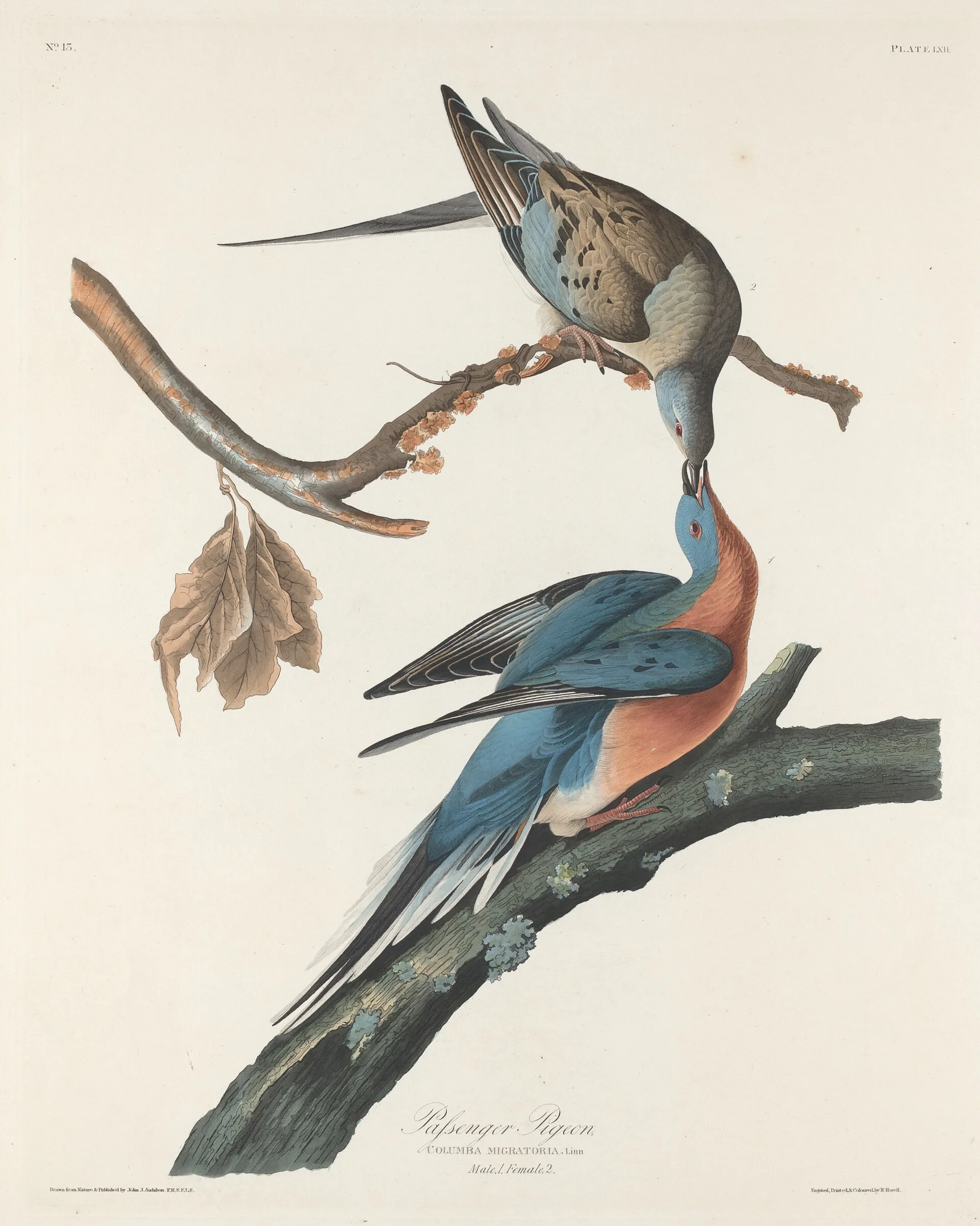
Audubon's “Passenger Pigeon”, The Birds of America, plate LXII
Click or press Enter to enlarge
Open the full-resolution image (3262 px, National Gallery of Art)
| Plate | 62 (LXII) |
|---|---|
| Audubon's name | Passenger Pigeon |
| Modern name | Passenger Pigeon |
| Scientific name | Ectopistes migratorius |
| Status | Extinct |
| Engraved by | Robert Havell, after Audubon's watercolor |
| Date | 1829 |
| Medium | Hand-colored engraving and aquatint on Whatman wove paper |
| Size | plate: 65.7 x 52.7 cm (25 7/8 x 20 3/4 in.) sheet: 101 x 68 cm (39 3/4 x 26 3/4 in.) |
| Collections | Turkeys, Grouse and Game Birds, Extinct Birds |
| This impression | National Gallery of Art, Washington, 1945.8.62; Gift of Mrs. Walter B. James |
About this plate
Plate 62 shows a male and female Passenger Pigeon on a branch, the bird above leaning down to touch bills with the bird below. The male has a slate-blue head and rosy breast; the female is browner and duller. Audubon began the chapter with the flight: rapid flaps, wings clapped together in courtship, and a fluttering brake before landing.
The chapter contains his most famous description of abundance. In autumn 1813, riding from Henderson to Louisville, Kentucky, he tried to count passing flocks near Hardinsburg and marked 163 in twenty-one minutes before giving up. The birds darkened the noon sky, and they kept passing for three days. Along the Ohio, people shot them from the banks, and for a week the town ate little else.
Audubon explained that the migrations followed food, mainly beech mast and acorns, not the seasons. The species nested in vast colonies in eastern forests. Market hunting by rail and telegraph-guided crews, together with forest clearing, destroyed it within a few decades. The last wild birds were reported around 1900, and the last known Passenger Pigeon, a female named Martha, died at the Cincinnati Zoo on 1 September 1914.
In Audubon's words
In passing over the Barrens a few miles beyond Hardensburgh, I observed the pigeons flying from north-east to south-west, in greater numbers than I thought I had ever seen them before, and feeling an inclination to count the flocks that might pass within the reach of my eye in one hour, I dismounted, seated myself on an eminence, and began to mark with my pencil, making a dot for every flock that passed. In a short time finding the task which I had undertaken impracticable, as the birds poured in in countless multitudes, I rose, and counting the dots then put down, found that 163 had been made in twenty-one minutes. I travelled on, and still met more the farther I proceeded. The air was literally filled with Pigeons; the light of noon-day was obscured as by an eclipse; the dung fell in spots, not unlike melting flakes of snow; and the continued buzz of wings had a tendency to lull my senses to repose.
John James Audubon, Ornithological Biography, vol. 1 (1831), “The Passenger Pigeon”. Read the full chapter.
Passenger Pigeon (Plate 62): the story behind one of the most famous plates in the collection →