Eskimo Curlew (Plate 208)
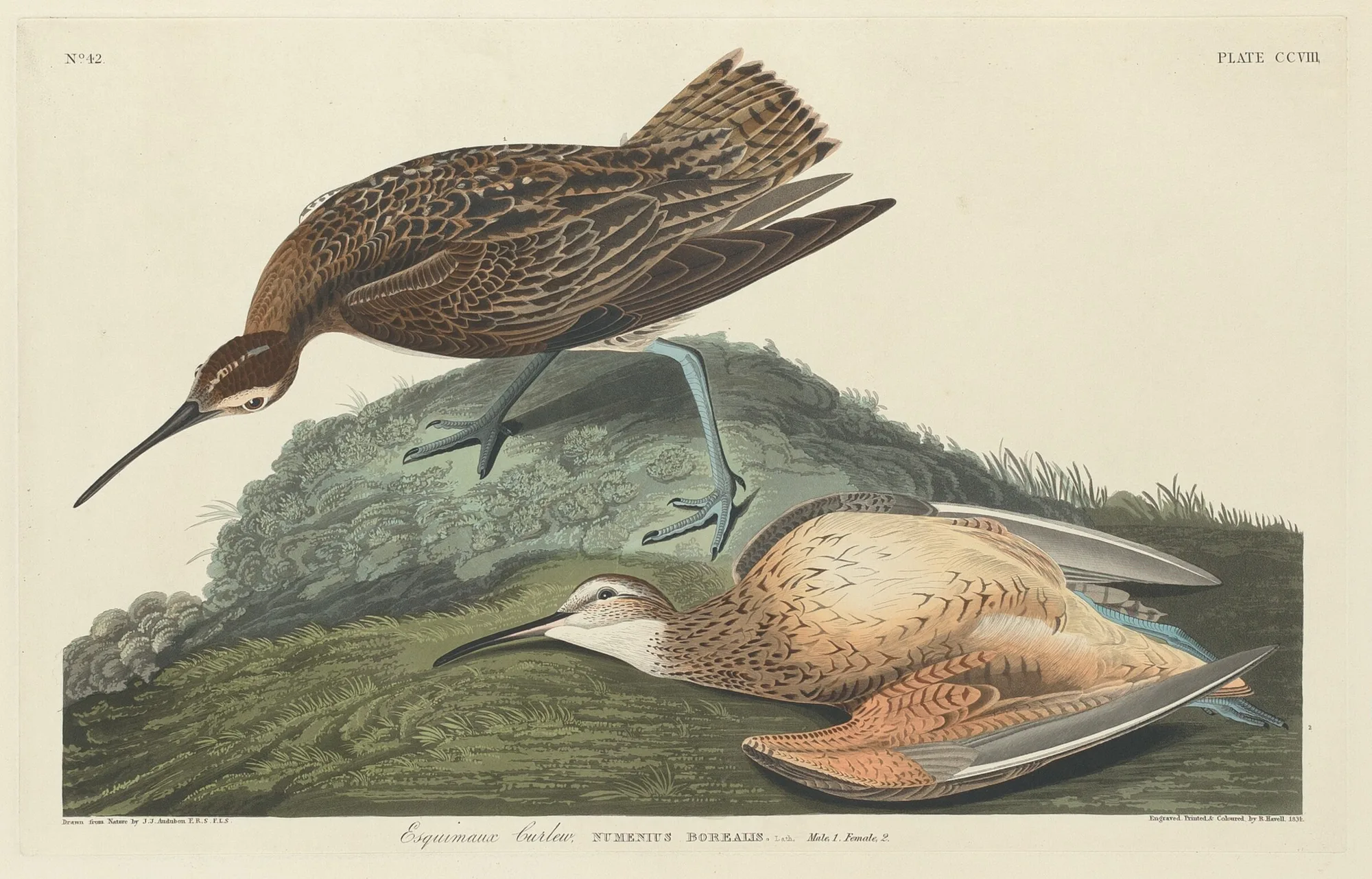
Audubon's “Esquimaux Curlew”, The Birds of America, plate CCVIII
Click or press Enter to enlarge
Open the full-resolution image (2459 px, National Gallery of Art)
| Plate | 208 (CCVIII) |
|---|---|
| Audubon's name | Esquimaux Curlew |
| Modern name | Eskimo Curlew |
| Scientific name | Numenius borealis |
| Status | Possibly extinct |
| Engraved by | Robert Havell, after Audubon's watercolor |
| Date | 1834 |
| Medium | Hand-colored engraving and aquatint on Whatman wove paper |
| Collections | Shorebirds, Rails and Cranes, Extinct Birds |
| This impression | National Gallery of Art, Washington, 1945.8.208; Gift of Mrs. Walter B. James |
About this plate
Plate 208 shows a male and female Eskimo Curlew, engraved as the Esquimaux Curlew. They are small curlews with a short, slightly curved bill, a striped crown and warm cinnamon underwings. Audubon drew them from birds taken on the 1833 Labrador expedition.
Audubon called it Numenius borealis, the name it still carries. It bred on the tundra of northwestern Canada and Alaska, fattened on berries in Labrador and New England in late summer, flew over the Atlantic to South America, and returned north through the Great Plains in spring. It was one of the most numerous shorebirds in North America, and Audubon compared the flocks to Passenger Pigeons.
Market hunting in the 1870s and 1880s, together with the plowing of the prairies where it fed in spring, destroyed the population. The last specimen was shot in Barbados in 1963, and the last widely accepted sightings date from the 1960s to the 1980s. IUCN lists it as Critically Endangered, possibly extinct.
Before Labrador, Audubon had seen only one bird, given to him by William Oakes of Ipswich, Massachusetts, where the species was called the Dough Bird. He once saw a dense flock pass at dawn while watching Long-billed Curlews with John Bachman on a South Carolina island. On 29 July 1833 the curlews arrived at Bras d'Or in fog, in great flocks that every fisherman had been waiting for as a delicacy.
In Audubon's words
On one occasion only have I ever had a glimpse of it. I was in company with my learned and generous friend John Bachman of Charleston, on one of the islands on the coast of South Carolina, whither we had gone with the view of watching the Long-billed Curlews (Numenius longirostris). It was at the dawn of a fine day, when a dense flock of the northern Curlews passed to the southward, near enough to enable us to ascertain the species, but so swiftly, that in a few minutes they were quite out of sight. On the 29th of July 1833, during a thick fog, the Esquimaux Curlews made their first appearance in Labrador, near the harbour of Bras d'Or. They evidently came from the north, and arrived in such dense flocks as to remind me of the Passenger Pigeons. The weather was extremely cold as well as foggy. For more than a week we had been looking for them, as was every fisherman in the harbour, these birds being considered there, as indeed they are, great delicacies.
John James Audubon, Ornithological Biography, vol. 3 (1835), “Esquimaux Curlew”. Read the full chapter.