American Tree Sparrow (Plate 188)
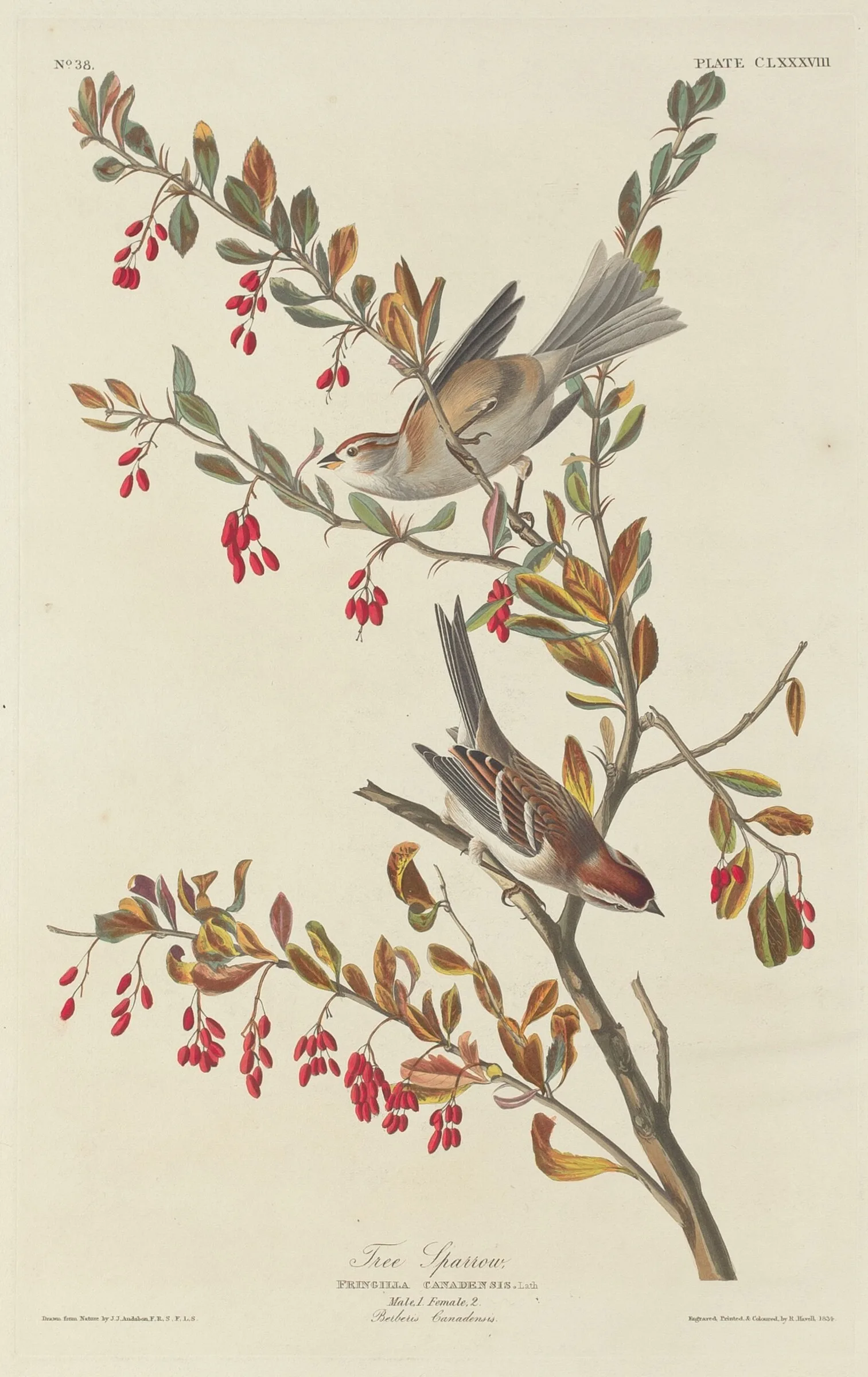
Audubon's “Tree Sparrow”, The Birds of America, plate CLXXXVIII
Click or press Enter to enlarge
Open the full-resolution image (2408 px, National Gallery of Art)
| Plate | 188 (CLXXXVIII) |
|---|---|
| Audubon's name | Tree Sparrow |
| Modern name | American Tree Sparrow |
| Scientific name | Spizelloides arborea |
| Status | Least Concern |
| Engraved by | Robert Havell, after Audubon's watercolor |
| Date | 1834 |
| Medium | Hand-colored engraving and aquatint on Whatman wove paper |
| Plants and setting | Barberry bush |
| Collections | Songbirds |
| This impression | National Gallery of Art, Washington, 1945.8.188; Gift of Mrs. Walter B. James |
About this plate
Plate 188 shows a male and female American Tree Sparrow on a twig of barberry. The birds have a rusty cap, a grey face with a rusty eye line, two white wing bars and a dark spot in the center of a plain grey breast. Audubon wrote that the pair were collected at Boston and that the drawing was made by his youngest son, John Woodhouse Audubon.
Audubon called it Fringilla canadensis. Despite the name, it is not closely related to the Eurasian Tree Sparrow. It is now Spizelloides arborea, placed in its own genus. It breeds on the tundra edge and in shrubby taiga across Alaska and northern Canada, and winters across southern Canada and the northern and central United States in weedy fields and hedgerows. It is listed as Least Concern, though winter counts show long-term declines.
Audubon treated it as a strictly northern bird that rarely went beyond Louisville or Maryland and never, in his experience, reached the Carolinas. He saw it arrive in Boston each October among the city's elms and admired its hardiness in the cold.
He wrote warmly of its song. Near Eastport, Maine, he listened to choruses of twenty or more singing in a single tree with a few White-throated Sparrows, before the flocks moved north in spring. He noted that the birds would turn back to their winter quarters at the first return of cold weather.
In Audubon's words
The Tree Sparrow sings sweetly during the love season. I have frequently listened to their musical festivals near Eastport, in the State of Maine, while gazing upon them with an ardent desire to follow them in their progress northward. Twenty or more, perched on the same tree, often delighted me with their choruses, now and then varied with the still clearer notes of one or two White-throated Finches, that, like leaders of an orchestra, seemed to mark time for the woodland choristers. Toward the close of the day their single notes were often repeated, and sounded like those of a retreat.
John James Audubon, Ornithological Biography, vol. 2 (1834), “The Tree Sparrow”. Read the full chapter.



