Snow Bunting (Plate 189)
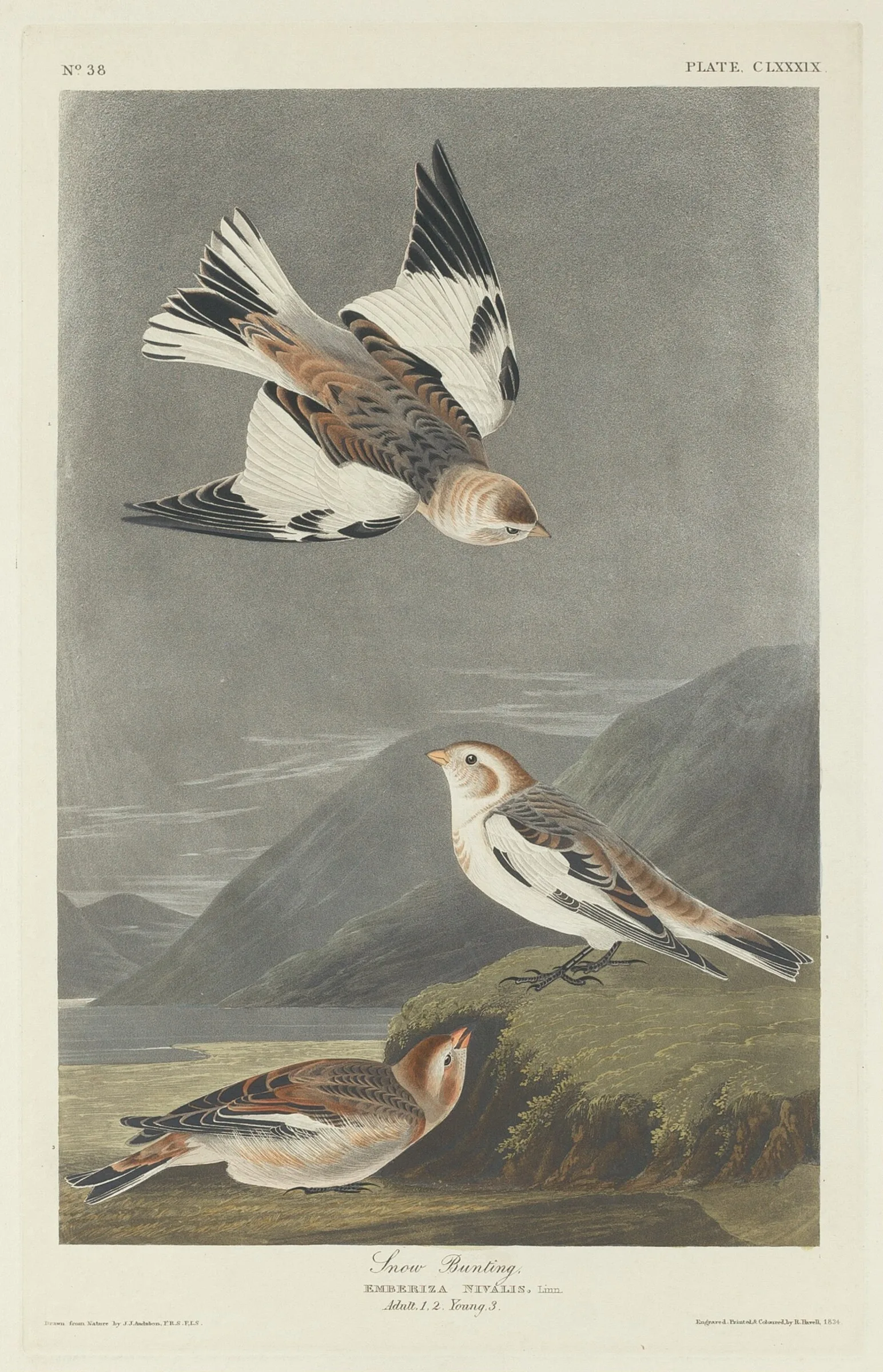
Audubon's “Snow Bunting”, The Birds of America, plate CLXXXIX
Click or press Enter to enlarge
Open the full-resolution image (2411 px, National Gallery of Art)
| Plate | 189 (CLXXXIX) |
|---|---|
| Audubon's name | Snow Bunting |
| Modern name | Snow Bunting |
| Scientific name | Plectrophenax nivalis |
| Status | Least Concern |
| Engraved by | Robert Havell, after Audubon's watercolor |
| Date | 1834 |
| Medium | Hand-colored engraving and aquatint on Whatman wove paper |
| Collections | Songbirds |
| This impression | National Gallery of Art, Washington, 1945.8.189; Gift of Mrs. Walter B. James |
About this plate
Plate 189 shows Snow Buntings, an adult and young birds, in the plumage they wear in the United States in winter. In this season they are white below with warm buff and chestnut on the head, breast and back. The black and white breeding plumage is seen mainly in the Arctic.
Audubon called it Emberiza nivalis. It is now Plectrophenax nivalis. It breeds farther north than almost any other songbird, on rocky Arctic tundra around the world, and nests in crevices among rocks. In winter it comes south in flocks to open fields, beaches, prairies and lakeshores across southern Canada and the northern United States. It is listed as Least Concern.
Audubon's chapter opens with one of his set pieces: flocks driven south by winter storms, swirling low over the land, rising again, and at last dropping onto ground free of snow to run among the corn stalks for seeds and insects. He noted that the birds sometimes perched in dense lines on fences or low roofs, where hunters could kill many at one shot.
He wrote that Snow Buntings reached the eastern states as early as November and stayed until March, and that in the United States they never entered woods. They kept instead to bare uplands and the shores of the sea, lakes and rivers.
In Audubon's words
As soon as the cold blasts of winter have stiffened the earth's surface, and brought with them the first snow-clouds, millions of these birds, driven before the pitiless storm, make their way towards milder climes. Their wings seem scarcely able to support their exhausted, nay almost congealed bodies, which seem little larger than the great feathery flakes of the substance from which these delicate creatures have borrowed their name. In compressed squadrons they are seen anxiously engaged in attempting to overcome the difficulties which beset them amid their perilous adventures. They now glide low over the earth, relax the closeness of their phalanx, and with amazing swiftness sweep over the country in search of that food, without which they must all shortly perish. Disappointed in their endeavours, the travellers again ascend, close their files, and continue their journey.
John James Audubon, Ornithological Biography, vol. 2 (1834), “The Snow Bunting”. Read the full chapter.



