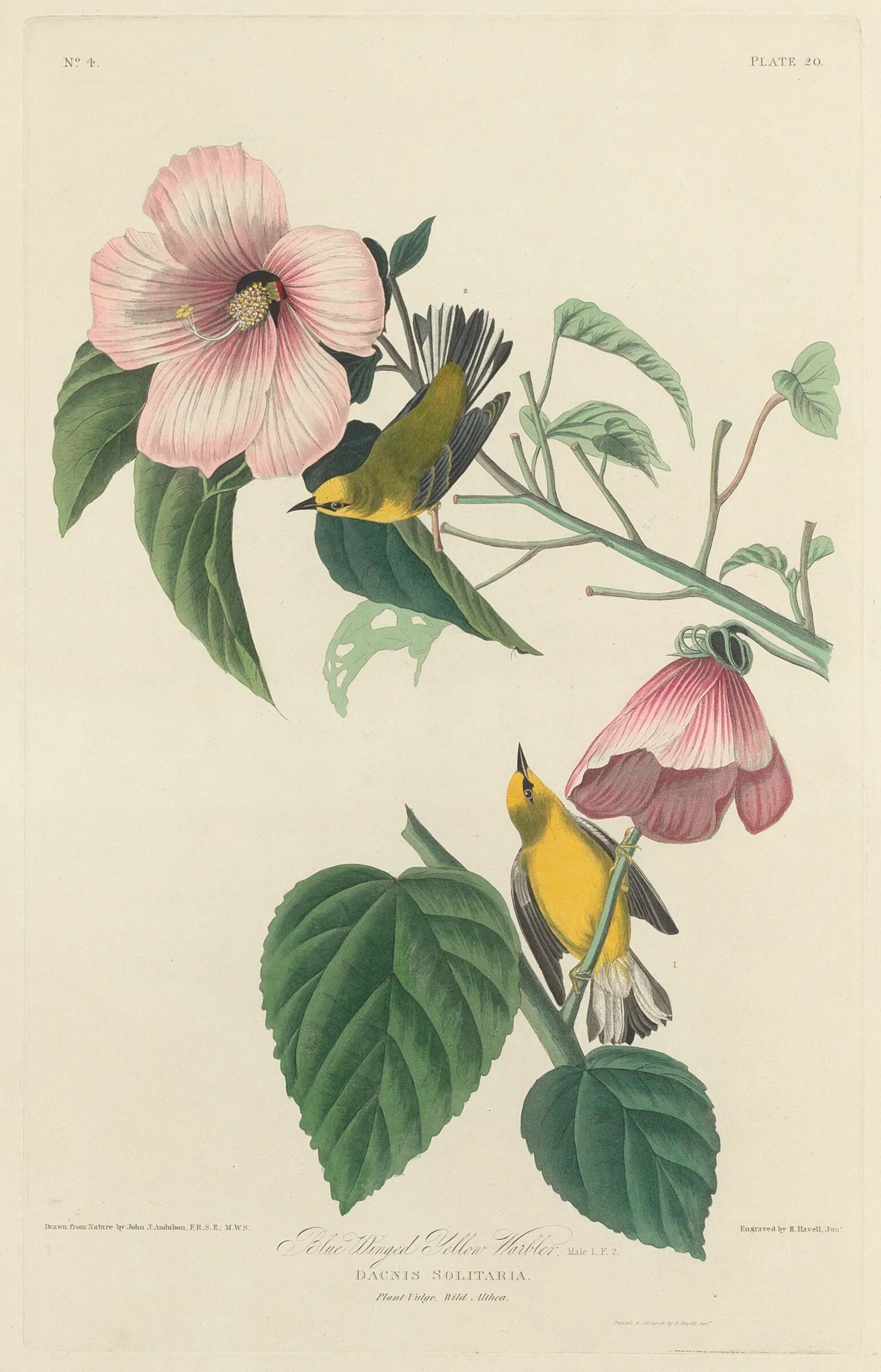
Blue-winged Warbler (Plate 20)
Audubon's “Blue-winged Yellow Warbler”, The Birds of America, plate XX
Click or press Enter to enlarge
Open the full-resolution image (2474 px, National Gallery of Art)
| Plate | 20 (XX) |
|---|---|
| Audubon's name | Blue-winged Yellow Warbler |
| Modern name | Blue-winged Warbler |
| Scientific name | Vermivora cyanoptera |
| Status | Least Concern |
| Engraved by | Robert Havell, after Audubon's watercolor |
| Date | 1827 |
| Medium | Hand-colored engraving and aquatint on Whatman wove paper |
| Size | plate: 49.5 x 31.1 cm (19 1/2 x 12 1/4 in.) sheet: 99.4 x 68.3 cm (39 1/8 x 26 7/8 in.) |
| Plants and setting | Hibiscus from pond edges |
| Collections | Songbirds |
| This impression | National Gallery of Art, Washington, 1945.8.20; Gift of Mrs. Walter B. James |
About this plate
Plate 20 shows a male and female Blue-winged Warbler with a flowering Hibiscus. Audubon wrote that this Hibiscus grew on the edges of ponds where the warbler lived, and that its handsome flowers had no pleasant scent. The plate was engraved by Robert Havell in 1827.
Audubon described the bird as a spring migrant to Louisiana, found in open woods and near ponds grown up with bushes and weeds. He wrote that its few weak notes were of no interest and that it fed mainly on small spiders. He shot several in New Jersey near Philadelphia in 1829 and two at Ste. Genevieve on the Mississippi many years earlier. He described its zig-zag flight, rising twenty or thirty yards and then dropping back.
The modern name is Blue-winged Warbler, Vermivora cyanoptera. Audubon used Wilson's name Sylvia solitaria, and for many years it was known as Vermivora pinus, a name later found to belong to the Pine Warbler. It hybridizes freely with the Golden-winged Warbler, producing the forms called Brewster's and Lawrence's Warblers.
The Blue-winged Warbler breeds in shrubby old fields and forest edges across the eastern and central United States and winters in Mexico and Central America. It has spread north since Audubon's time and is replacing the Golden-winged Warbler in many areas. It is listed as Least Concern.
In Audubon's words
Its nest, which is singularly constructed, and of an elongated inversely conical form, is attached to several stalks or blades of tall grass by its upper edge. The materials of which it is formed are placed obliquely from its mouth to the bottom. The latter part is composed of dried leaves, and is finished within with fine grass and lichens. The female lays from four to six eggs, of a pure white colour, with a few pale red spots at the larger end. The first brood is out about the middle of May, the second in the middle of July. The young disperse as soon as they are able to provide for themselves, this bird being of solitary habits.
John James Audubon, Ornithological Biography, vol. 1 (1831), “The Blue-winged Yellow Warbler”. Read the full chapter.



