Lincoln's Sparrow (Plate 193)
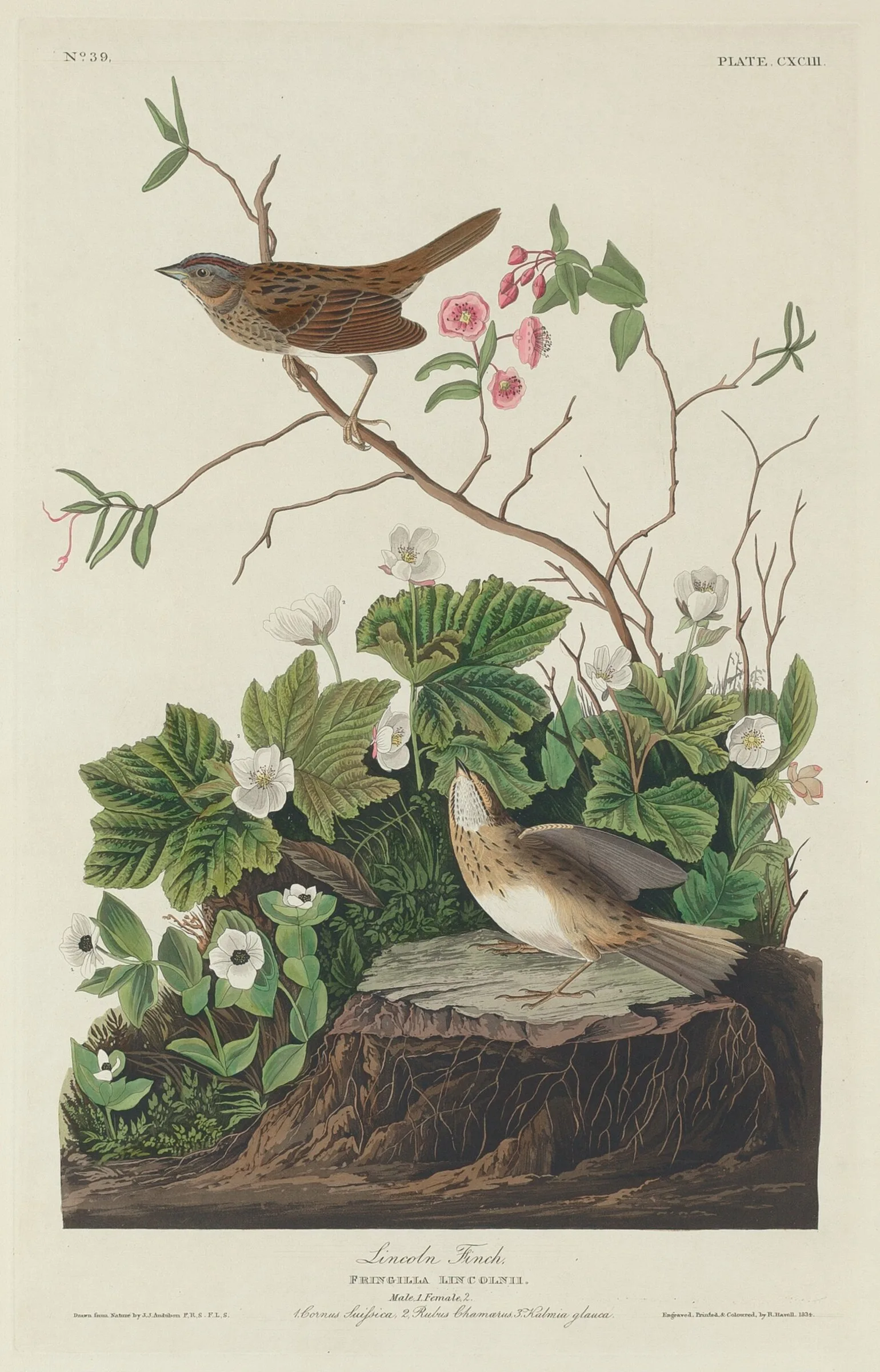
Audubon's “Lincoln Finch”, The Birds of America, plate CXCIII
Click or press Enter to enlarge
Open the full-resolution image (2431 px, National Gallery of Art)
| Plate | 193 (CXCIII) |
|---|---|
| Audubon's name | Lincoln Finch |
| Modern name | Lincoln's Sparrow |
| Scientific name | Melospiza lincolnii |
| Status | Least Concern |
| Engraved by | Robert Havell, after Audubon's watercolor |
| Date | 1834 |
| Medium | Hand-colored engraving and aquatint on Whatman wove paper |
| Plants and setting | Bunchberry (Cornus canadensis) and cloudberry (Rubus chamaemorus) |
| Collections | Songbirds |
| This impression | National Gallery of Art, Washington, 1945.8.193; Gift of Mrs. Walter B. James |
About this plate
Plate 193 shows a male and female Lincoln's Sparrow among Labrador ground plants: bunchberry, with its four white bracts and red berries, and cloudberry, a low bramble with a single white flower and yellow-red fruit. The birds are neat, finely streaked sparrows with a buffy breast band and a grey face.
This is one of the species Audubon discovered and named. On the 1833 Labrador voyage, after almost three weeks on the coast, he entered a small green valley and heard a song he thought more vigorous than that of any American finch. The bird was wary. Thomas Lincoln of Dennisville, Maine, one of the young men on the expedition, finally shot it. Audubon called it Tom's Finch and later published it as Fringilla lincolnii in Lincoln's honour. The party gave three cheers, and Audubon went back to the schooner to draw it.
It is now Melospiza lincolnii, a close relative of the Song Sparrow and Swamp Sparrow. It breeds in wet willow and alder thickets and bogs across Canada, Alaska and the western mountains, and winters from the southern United States to Central America. It is secretive and easily overlooked on migration. It is listed as Least Concern.
Audubon wrote that the birds grew more common and less shy the farther north he went, but stopped singing as the season advanced, and that his party never found a nest.
In Audubon's words
But if the view of this favoured spot was pleasing to my eye, how much more to my ear were the sweet notes of this bird as they came thrilling on the sense, surpassing in vigour those of any American Finch with which I am acquainted, and forming a song which seemed a compound of those of the Canary and Wood-lark of Europe. I immediately shouted to my companions, who were not far distant. They came, and we all followed the songster as it flitted from one bush to another to evade our pursuit. No sooner would it alight than it renewed its song; but we found more wildness in this species than in any other inhabiting the same country, and it was with difficulty that we at last procured it.
John James Audubon, Ornithological Biography, vol. 2 (1834), “Lincoln's Finch”. Read the full chapter.



