Boreal Chickadee (Plate 194)
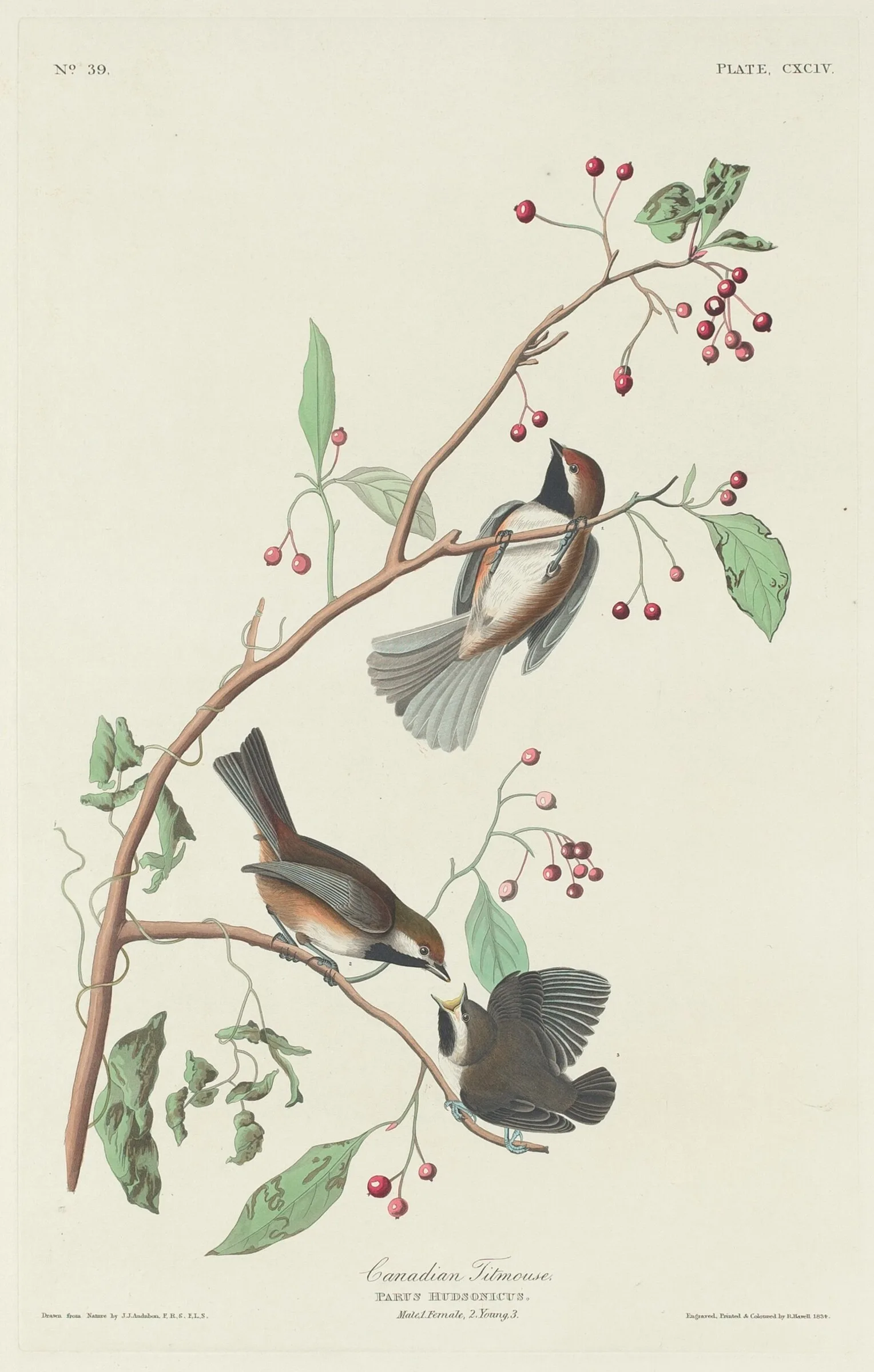
Audubon's “Canadian Titmouse”, The Birds of America, plate CXCIV
Click or press Enter to enlarge
Open the full-resolution image (2412 px, National Gallery of Art)
| Plate | 194 (CXCIV) |
|---|---|
| Audubon's name | Canadian Titmouse |
| Modern name | Boreal Chickadee |
| Scientific name | Poecile hudsonicus |
| Status | Least Concern |
| Engraved by | Robert Havell, after Audubon's watercolor |
| Date | 1834 |
| Medium | Hand-colored engraving and aquatint on Whatman wove paper |
| Plants and setting | Wild cherry (Prunus species) |
| Collections | Songbirds |
| This impression | National Gallery of Art, Washington, 1945.8.194; Gift of Mrs. Walter B. James |
About this plate
Plate 194 shows a male, female and fully fledged young Boreal Chickadee on a branch of a wild cherry Audubon described only as a Prunus growing eight or ten feet high in Labrador, Newfoundland and the northern states. The birds have a brown cap, a black bib, grey-brown back and rusty flanks.
Audubon engraved it as the Canadian Titmouse and wrote of it as the Hudson's Bay Titmouse, Parus hudsonicus. It is now the Boreal Chickadee, Poecile hudsonicus. It lives year-round in spruce and fir forest across Alaska and Canada and just into the northern United States, including northern Maine, New Hampshire, Vermont and New York. It stores seeds and insects in bark crevices to survive winter. Its call is a slower, wheezy version of the familiar chick-a-dee. It is listed as Least Concern.
Audubon had searched for it in Maine without success and first found it in Labrador on 18 July 1833. His party left the schooner Ripley before dawn and rowed five miles through fog to the mainland. After a fruitless marsh, he and the captain pushed into a stunted wood, where the captain shot a bird and found its nest.
The nest was in a rotten stump about three feet up. Audubon removed it intact: a purse eight inches deep, felted from the fur of the northern hare and other mammals. They collected both parents and the young, which had jumped out at the sound of the guns.
In Audubon's words
The nest was placed at the height of not more than three feet from the ground, in the hollow of a decayed low stump, scarcely thicker than a man's leg, the whole so rotten that it crumbled to pieces on being touched. I cautiously removed the woody enclosure, and took possession of the nest, which I obtained in perfect order. It was shaped like a purse, eight inches in depth, two in diameter inside, its sides about half an inch thick. It was entirely composed of the finest fur of different quadrupeds, but principally of the great northern hare, so thickly and ingeniously matted throughout, that it looked as if it had been felted by the hand of man.
John James Audubon, Ornithological Biography, vol. 2 (1834), “The Hudson's Bay Titmouse”. Read the full chapter.



