Ruby-crowned Kinglet (Plate 195)
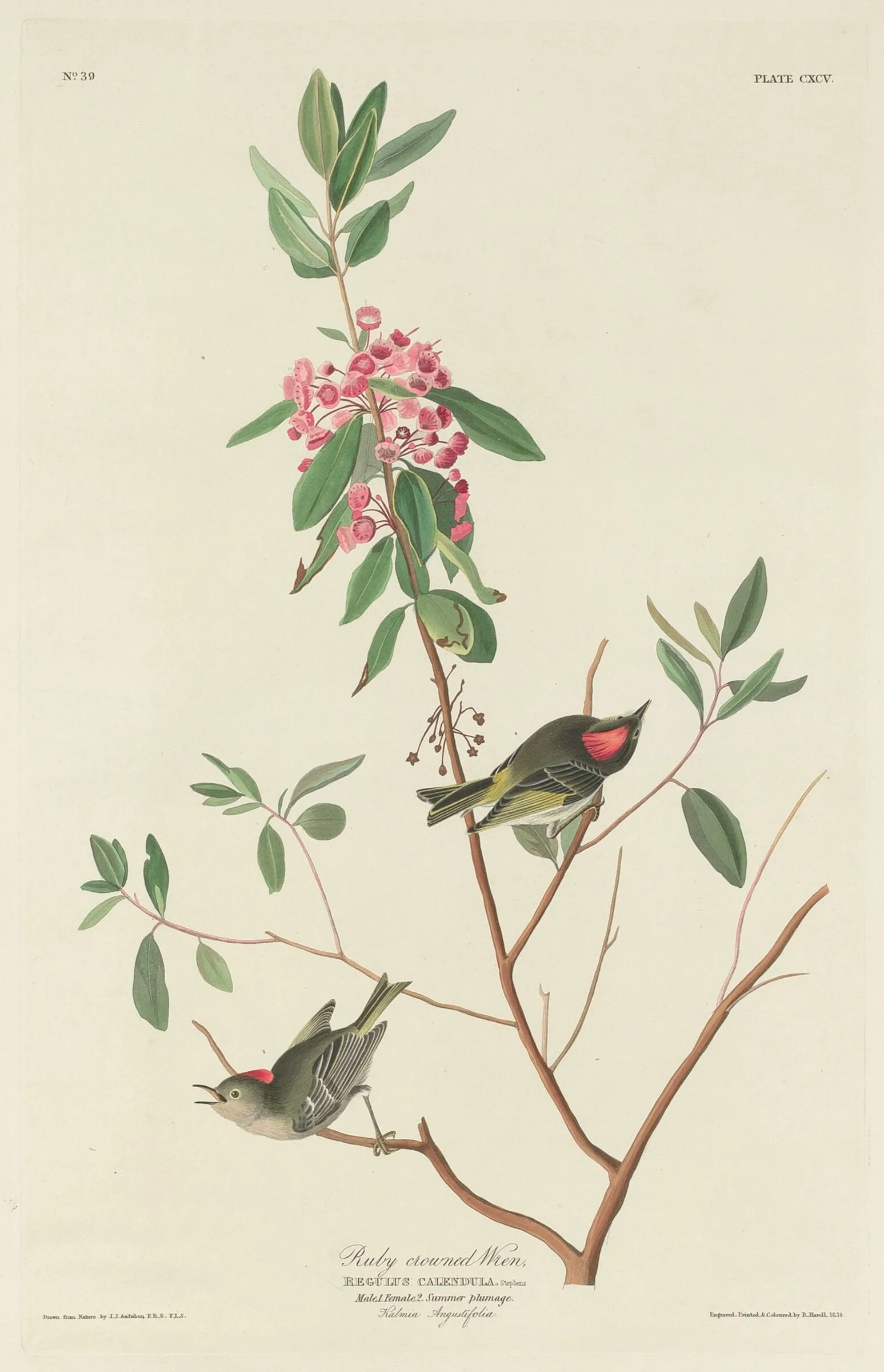
Audubon's “Ruby-crowned Wren”, The Birds of America, plate CXCV
Click or press Enter to enlarge
Open the full-resolution image (2416 px, National Gallery of Art)
| Plate | 195 (CXCV) |
|---|---|
| Audubon's name | Ruby-crowned Wren |
| Modern name | Ruby-crowned Kinglet |
| Scientific name | Corthylio calendula |
| Status | Least Concern |
| Engraved by | Robert Havell, after Audubon's watercolor |
| Date | 1834 |
| Medium | Hand-colored engraving and aquatint on Whatman wove paper |
| Plants and setting | Sheep laurel (Kalmia angustifolia) |
| Collections | Songbirds |
| This impression | National Gallery of Art, Washington, 1945.8.195; Gift of Mrs. Walter B. James |
About this plate
Plate 195 shows a male and female Ruby-crowned Kinglet on a flowering sprig of sheep laurel, Kalmia angustifolia, with clusters of deep rose flowers. The kinglets are tiny olive birds with a broken white eye ring and white wing bars. The male's scarlet crown patch is shown raised, though in life it is often hidden.
Audubon engraved it as the Ruby-crowned Wren and wrote of it as the Ruby-crowned Regulus, Regulus calendula. In 2021 it was moved to its own genus and is now Corthylio calendula. It breeds in spruce and fir forest across Canada, Alaska and the western mountains, and winters across the southern United States and Mexico. It is listed as Least Concern.
The chapter centres on its song, which is astonishingly loud for so small a bird. On 27 June 1833 in Labrador, Audubon heard a warbler-like song he took for a new species and followed the singer from tree to tree. His son John shot it, but it fell into the brushwood and was lost. The next day the party crossed a creek and searched again, and John found it in the moss under the tree.
Audubon wrote that he had never before heard its full song, and compared it to the Canary's, only richer and more varied. He admitted that he had not succeeded in finding its nest, although he had seen the bird in places where it certainly bred.
In Audubon's words
My son was so fortunate as to find the little Regulus among the moss near the tree from which it had fallen, and brought it to me greatly disappointed. Not so was I; for I had never heard the full song of the Ruby-crowned Wren, and as I looked at it in my hand, I could not refrain from exclaiming—"And so this is the tiny body of the songster from which came the loud notes I heard yesterday!" When I tell you that its song is fully as sonorous as that of the Canary Bird, and much richer, I do not come up to the truth, for it is not only as powerful and clear, but much more varied and pleasing to the ear.
John James Audubon, Ornithological Biography, vol. 2 (1834), “The Ruby-crowned Regulus”. Read the full chapter.



