Gyrfalcon (Plate 196)
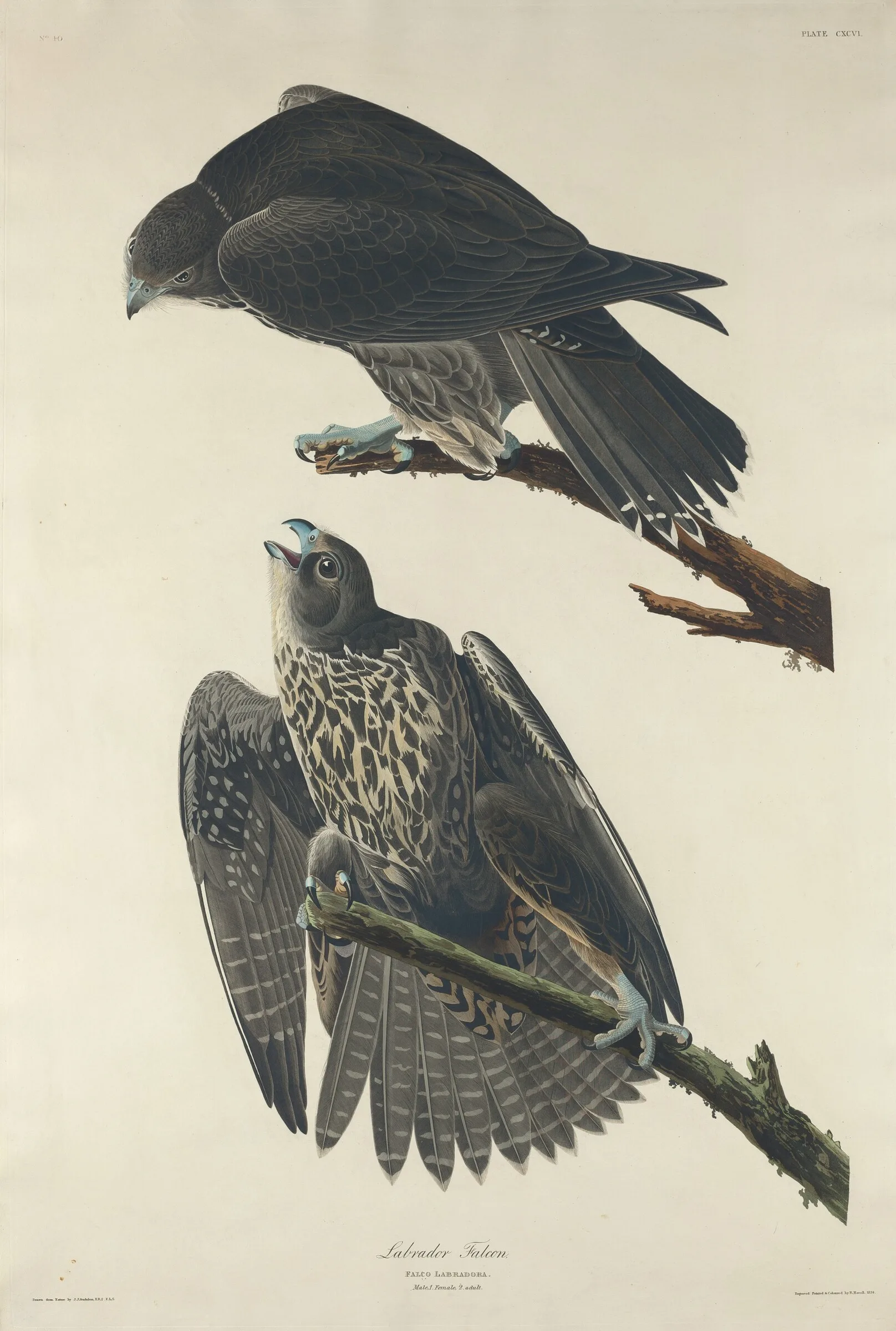
Audubon's “Labrador Falcon”, The Birds of America, plate CXCVI
Click or press Enter to enlarge
Open the full-resolution image (4639 px, National Gallery of Art)
| Plate | 196 (CXCVI) |
|---|---|
| Audubon's name | Labrador Falcon |
| Modern name | Gyrfalcon |
| Scientific name | Falco rusticolus |
| Status | Least Concern |
| Engraved by | Robert Havell, after Audubon's watercolor |
| Date | 1834 |
| Medium | Hand-colored engraving and aquatint on Whatman wove paper |
| Collections | Hawks, Eagles and Falcons |
| This impression | National Gallery of Art, Washington, 1945.8.196; Gift of Mrs. Walter B. James |
About this plate
Plate 196 shows a pair of dark Gyrfalcons, engraved as the Labrador Falcon. Both birds are deep brown, heavily marked, with pale streaks below. Audubon drew them from birds shot in Labrador during the 1833 expedition.
In his text Audubon called the bird the Iceland or Jer Falcon, Falco islandicus, and argued that his dark birds were young Iceland Falcons, which he believed could breed before reaching adult plumage. The Gyrfalcon, Falco rusticolus, is now known to come in white, grey and dark morphs, and the dark birds of Labrador are a regular colour form rather than a separate species or age class. It is the largest falcon in the world and breeds on Arctic cliffs around the pole, hunting ptarmigan and seabirds. It is listed as Least Concern.
On 6 August 1833, Thomas Lincoln, Joseph Coolidge and John Woodhouse Audubon were exploring a rocky brook eight or ten miles from Bras d'Or on the Labrador coast. A falcon dived at them screaming, and John shot it, then shot its mate as it came to the rescue. The young men climbed to the nest, a flat platform of sticks, seaweed and moss on the cliff, and found it empty.
Below it lay the wings of murres, puffins and Willow Ptarmigan, the falcons' prey. Audubon examined the birds closely back on the schooner Ripley and saw at once that they were new to him in America.
In Audubon's words
It was instantly brought to the ground. A second hawk dashed towards the dead one, as if determined to rescue it; but it quickly met the same fate, the contents of my son's second barrel bringing it to his feet. The nest of these hawks was placed on the rocks, about fifty feet from their summit, and more than a hundred from their base. Two other birds of the same species, and apparently in the same plumage, now left their eyry in the cliff, and flew off. The party having ascended by a circuitous and dangerous route, contrived to obtain a view of the nest, which, however, was empty. It was composed of sticks, sea-weeds, and mosses, about two feet in diameter, and almost flat. About its edges were strewed the remains of their food, and beneath, on the margin of the stream, lay a quantity of wings of the Uria Troile, Mormon arcticus, and Tetrao Saliceti, together with large pellets composed of fur, bones, and various substances.
John James Audubon, Ornithological Biography, vol. 2 (1834), “The Iceland or Jer Falcon”. Read the full chapter.