Red Crossbill (Plate 197)
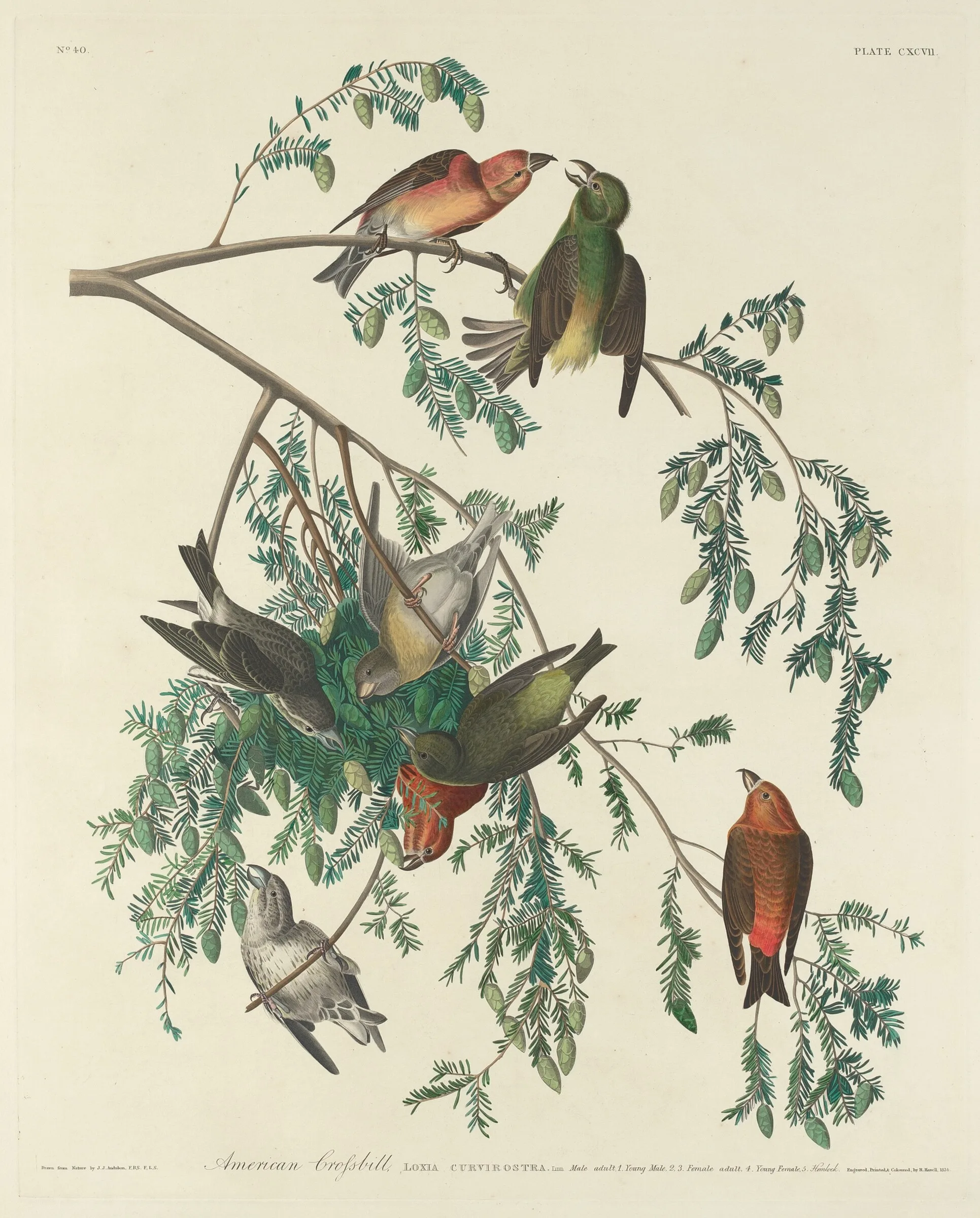
Audubon's “American Crossbill”, The Birds of America, plate CXCVII
Click or press Enter to enlarge
Open the full-resolution image (3202 px, National Gallery of Art)
| Plate | 197 (CXCVII) |
|---|---|
| Audubon's name | American Crossbill |
| Modern name | Red Crossbill |
| Scientific name | Loxia curvirostra |
| Status | Least Concern |
| Engraved by | Robert Havell, after Audubon's watercolor |
| Date | 1834 |
| Medium | Hand-colored engraving and aquatint on Whatman wove paper |
| Collections | Songbirds |
| This impression | National Gallery of Art, Washington, 1945.8.197; Gift of Mrs. Walter B. James |
About this plate
Plate 197 shows Red Crossbills in several plumages: an adult male in dull vermilion, a young male after its first moult with yellow mixed into the red, and a greenish young bird. The crossed tips of the bill, which the birds use to pry open conifer cones, are clearly drawn.
Audubon called it the Common Crossbill, Loxia curvirostra, and engraved it as the American Crossbill. The scientific name is unchanged, and the species is found across the conifer forests of North America, Europe and Asia. In North America it is now known to include about a dozen call types that differ in bill size and cone preference, and one of them was split as the Cassia Crossbill in 2017. Red Crossbills wander widely following cone crops and can nest in any month, including midwinter. The species is listed as Least Concern.
Audubon found them most common in Maine, New Brunswick and Nova Scotia, and also saw them in August in the Great Pine Forest of Pennsylvania. He never found a nest, but lumbermen in Maine told him they had caught young crossbills thrown from nests in pines felled in midwinter, which fits the bird's habit of winter breeding.
He described tame, social flocks that came to woodmen's cabins to pick at the mud chinking between the logs, and that fed on pine, hemlock and spruce seeds and on apples. He was surprised to find none in Labrador or Newfoundland, where White-winged Crossbills were common.
In Audubon's words
The Crossbill lives in flocks, composed apparently of several families, and is an extremely gentle and social bird. They are easily approached, caught in traps, or even killed with a stick. So unsuspicious are they with respect to man, that they not unfrequently come up to the very door of the woodman's cabin, and pick the mud with which he has plastered the spaces between the logs of which it is composed. When the huts are raised on blocks, to prevent dampness, they are often seen under them, picking up the earth for want of better food, while the weather is at its coldest.
John James Audubon, Ornithological Biography, vol. 2 (1834), “The Common Crossbill”. Read the full chapter.



