Swainson's Warbler (Plate 198)
Audubon's “Brown-headed Worm-eating Warbler”, The Birds of America, plate CXCVIII
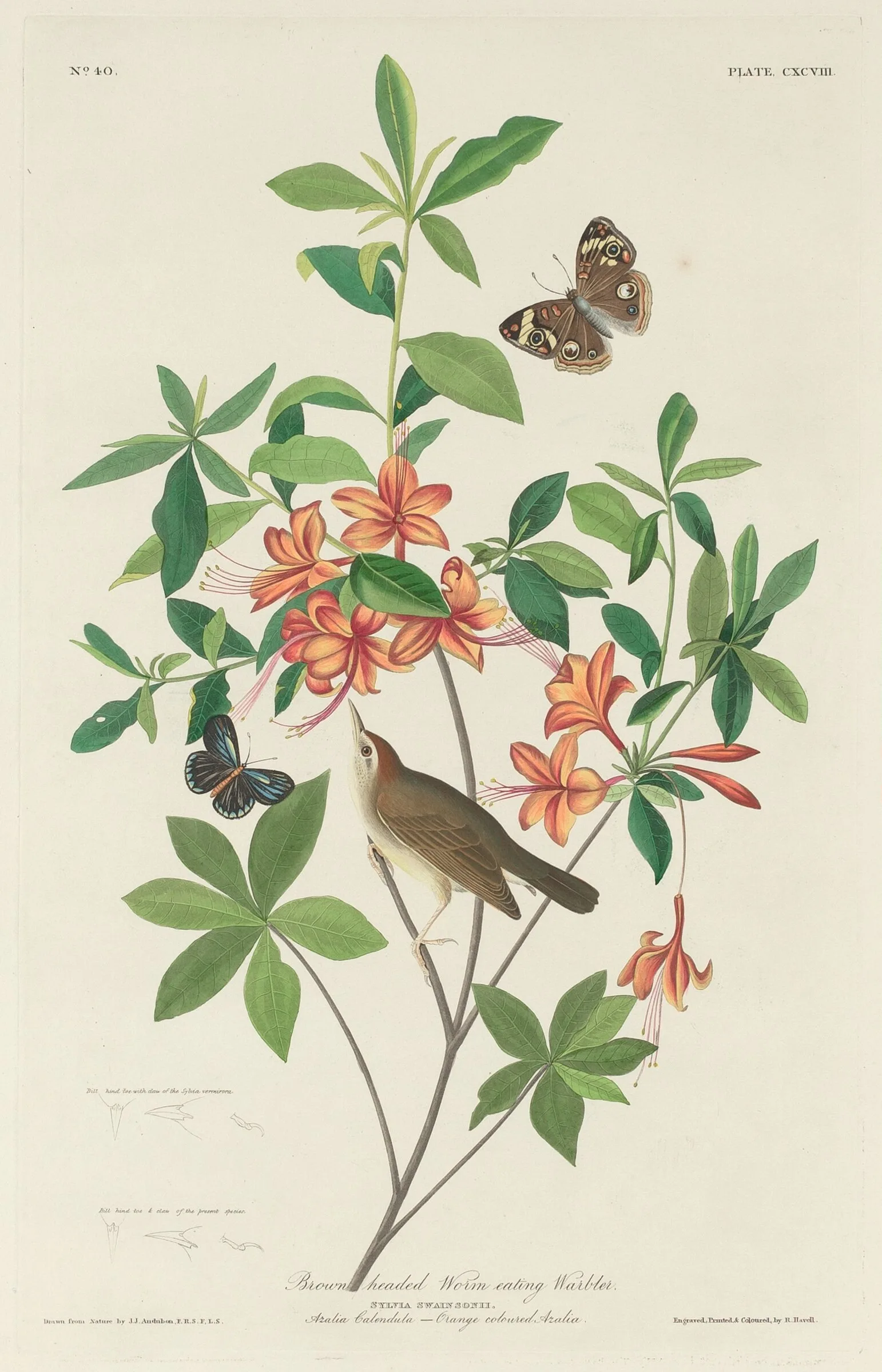
Click or press Enter to enlarge
Open the full-resolution image (2432 px, National Gallery of Art)
| Plate | 198 (CXCVIII) |
|---|---|
| Audubon's name | Brown-headed Worm-eating Warbler |
| Modern name | Swainson's Warbler |
| Scientific name | Limnothlypis swainsonii |
| Status | Least Concern |
| Engraved by | Robert Havell, after Audubon's watercolor |
| Date | 1834 |
| Medium | Hand-colored engraving and aquatint on Whatman wove paper |
| Plants and setting | Flame azalea (Azalea calendulacea, now Rhododendron calendulaceum) |
| Collections | Songbirds |
| This impression | National Gallery of Art, Washington, 1945.8.198; Gift of Mrs. Walter B. James |
About this plate
Plate 198 shows a single male Swainson's Warbler on a branch of flame azalea with bright orange flowers. The bird is plain olive-brown above and whitish below, with a warm brown cap and a pale line over the eye. Audubon engraved it as the Brown-headed Worm-eating Warbler and named it in the text after the English naturalist William Swainson.
John Bachman discovered it near the Edisto River in South Carolina in 1832 and supplied Audubon with specimens and notes. Bachman wrote that he first noticed its loud, whistled notes, which seemed to come from farther away than the bird really was, like a ventriloquist. He found it in swampy, muddy places covered with water, feeding on beetles and small worms.
It is now Limnothlypis swainsonii, the only species in its genus. It breeds in canebrakes, dense floodplain forest and rhododendron thickets of the southeastern United States, including the southern Appalachians, and winters in the Caribbean, Yucatán and Central America. It is one of the most secretive North American warblers. It is listed as Least Concern.
Audubon opened the chapter by mocking a man who had declared, after Alexander Wilson's death, that no new birds remained to be found in America. He listed the naturalists who had since added species, and offered this warbler as proof. The plant, which he called the orange-coloured azalea, is Rhododendron calendulaceum.
In Audubon's words
Shortly after the death of WILSON, one of the wise men of a certain city in the United States, assured the members of a Natural History Society there, that no more birds would be found in the country than had been described by that justly celebrated writer. Had the assertions however been made in the hearing of that ornithologist, he would doubtless at once have refuted the speech of this extraordinary orator, who continued as follows:—"No more Finches, no more Hawks, no more Owls, no more Herons, and certainly no more Pigeons; and as to Water birds, let the list given by WILSON of such as he has not described be filled, and again I say, there will end the American Ornithology."
John James Audubon, Ornithological Biography, vol. 2 (1834), “Swainson's Warbler”. Read the full chapter.



