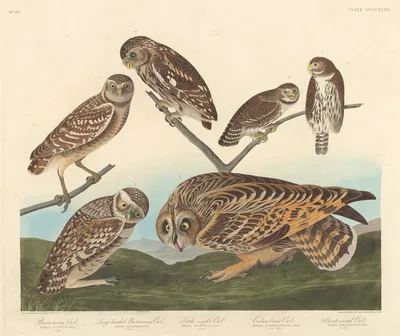
Northern Saw-whet Owl (Plate 199)
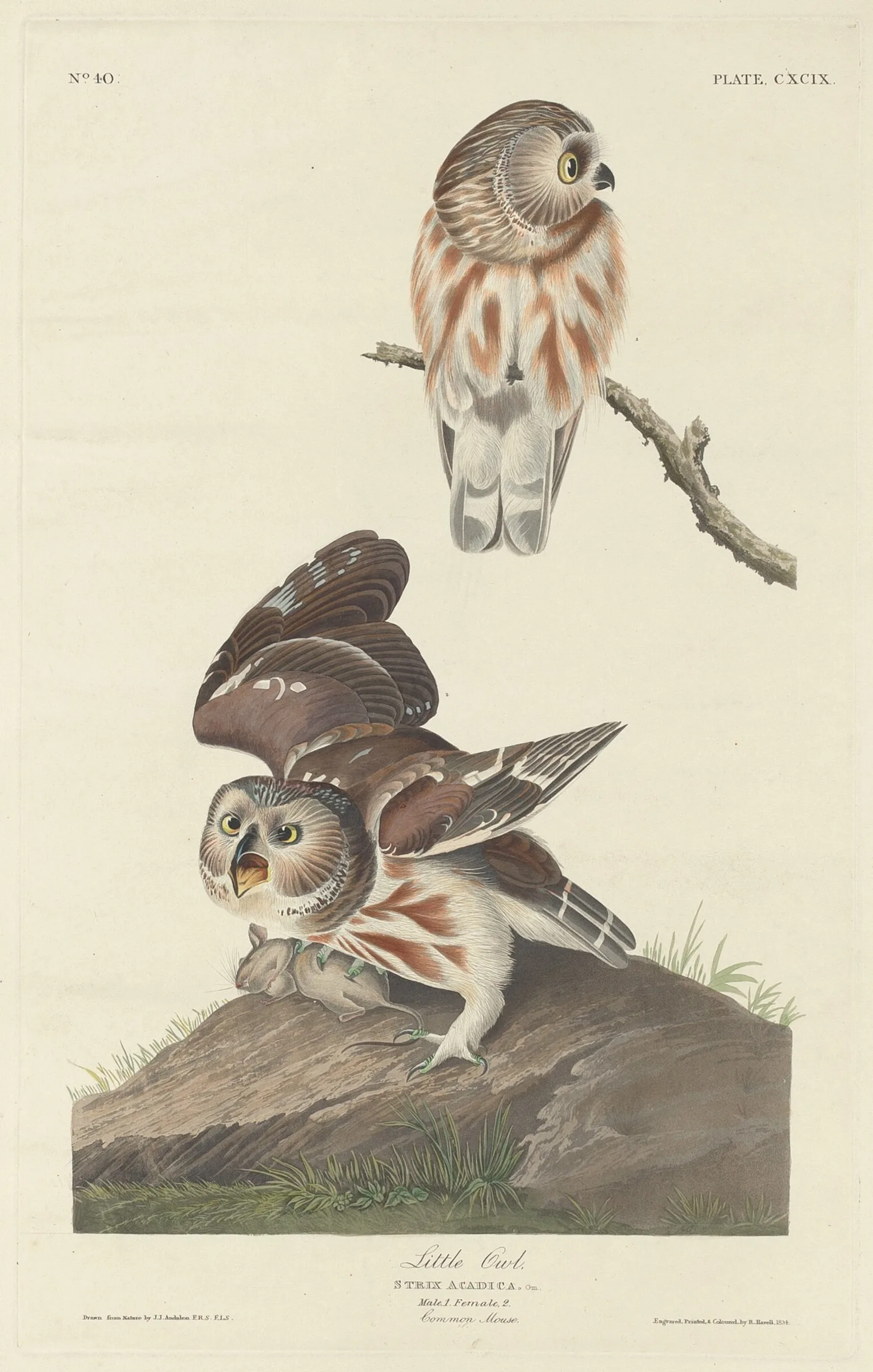
Audubon's “Little Owl”, The Birds of America, plate CXCIX
Click or press Enter to enlarge
Open the full-resolution image (2428 px, National Gallery of Art)
| Plate | 199 (CXCIX) |
|---|---|
| Audubon's name | Little Owl |
| Modern name | Northern Saw-whet Owl |
| Scientific name | Aegolius acadicus |
| Status | Least Concern |
| Engraved by | Robert Havell, after Audubon's watercolor |
| Date | 1834 |
| Medium | Hand-colored engraving and aquatint on Whatman wove paper |
| Collections | Owls |
| This impression | National Gallery of Art, Washington, 1945.8.199; Gift of Mrs. Walter B. James |
About this plate
Plate 199 shows a male and female Northern Saw-whet Owl. Audubon engraved it as the Little Owl and wrote of it as the Little or Acadian Owl. The birds are small, round-headed owls without ear tufts, brown above with white spots, with a pale facial disk and broad reddish-brown streaks below.
Audubon called it Strix acadica. It is now Aegolius acadicus, a relative of the Boreal Owl, which Audubon knew as Tengmalm's Owl. Saw-whets breed in coniferous and mixed forest across southern Canada, the northern United States and the western mountains, and in the Appalachians. Many migrate south in autumn. They nest in old woodpecker holes and other tree cavities. The species is listed as Least Concern.
The chapter explains the name. In Massachusetts it was called the saw-whet because its call sounds like a large saw being sharpened with a file. Audubon wrote that travellers hearing it in the forest expected to find a saw-mill nearby. He was fooled himself. Near his own saw-mill in Pennsylvania he once heard the sound coming from the locked grist-mill. His miller told him it was an owl nesting in a hollow tree that Wood Ducks had used for years.
Audubon reported that it nested in Louisiana, Kentucky and the eastern states to Maine, laying three to six glossy white eggs. Modern breeding records from Louisiana are lacking, and that claim is doubtful.
In Audubon's words
These notes, when coming, as they frequently do, from the interior of a deep forest, produce a very peculiar effect on the traveller, who, not being aware of their real nature, expects, as he advances on his route, to meet with shelter under a saw-mill at no great distance. Until I shot the bird in the act, I had myself been more than once deceived in this manner. On one particular occasion, while walking near my saw-mill in Pennsylvania, to see that all was right there, I was much astonished to hear these sounds issuing from the interior of the grist-mill. The door having been locked, I had to go to my miller's house close by, to inquire if any one was at work in it. He, however, informed me that the sounds I had heard were merely the notes of what he called the Screech Owl, whose nest was close by, in a hollow tree, deserted by the Wood Ducks, a pair of which had been breeding there for several years in succession.
John James Audubon, Ornithological Biography, vol. 2 (1834), “The Little or Acadian Owl”. Read the full chapter.