Prothonotary Warbler (Plate 3)
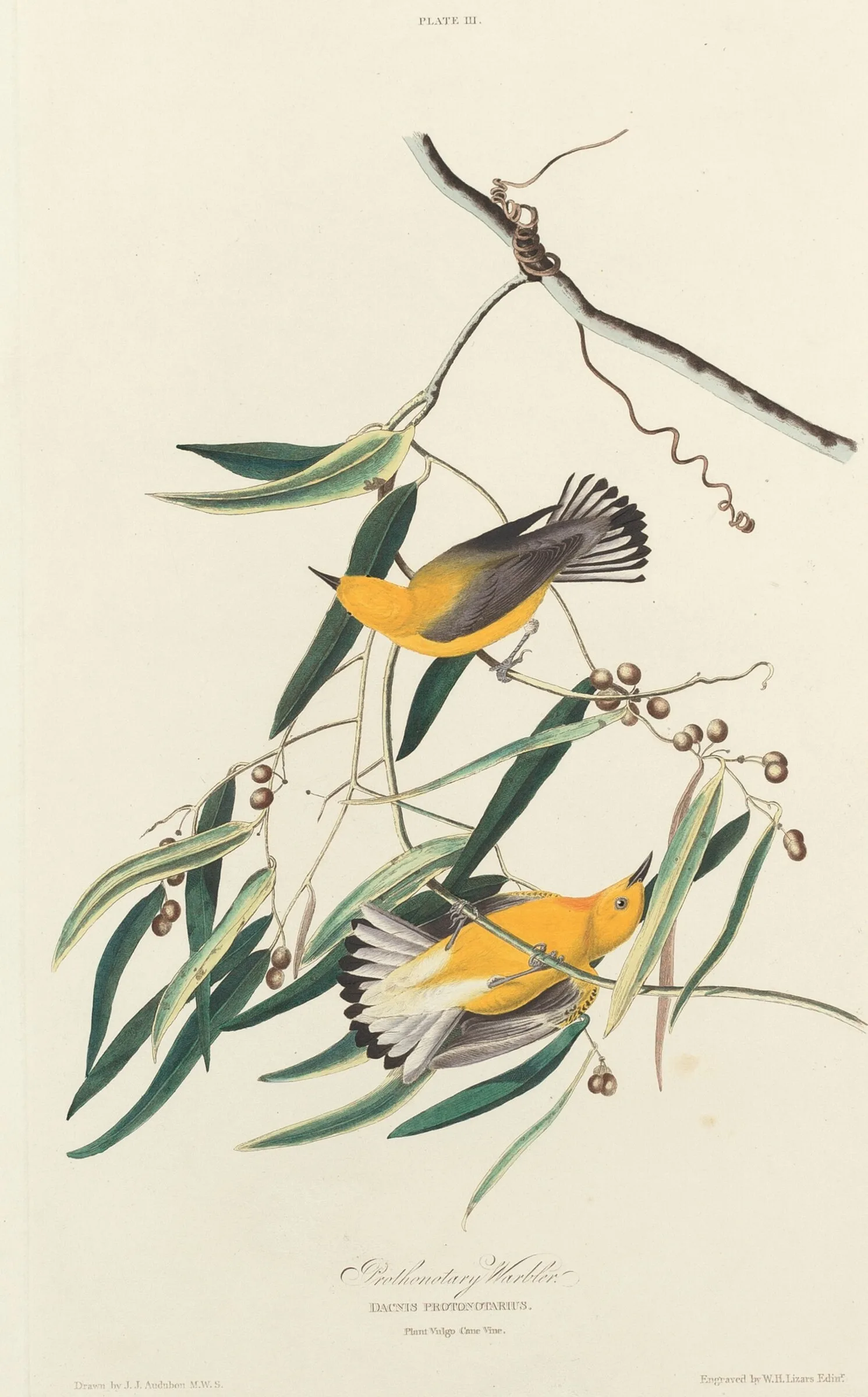
Audubon's “Prothonotary Warbler”, The Birds of America, plate III
Click or press Enter to enlarge
Open the full-resolution image (2486 px, National Gallery of Art)
| Plate | 3 (III) |
|---|---|
| Audubon's name | Prothonotary Warbler |
| Modern name | Prothonotary Warbler |
| Scientific name | Protonotaria citrea |
| Status | Least Concern |
| Engraved by | William Home Lizars, after Audubon's watercolor |
| Date | 1827 |
| Medium | Etching and engraving with hand coloring on Whatman paper |
| Plants and setting | Cane Vine, a climbing swamp plant Audubon could not identify |
| Collections | Songbirds |
| This impression | National Gallery of Art, Washington, 1945.8.3; Gift of Mrs. Walter B. James |
About this plate
Plate 3 shows a male and female Prothonotary Warbler on a climbing plant with thick leaves and clusters of berries. Audubon could find no scientific name for the plant. He wrote that in Louisiana it was called the Cane Vine, that it grew in swampy places, and that its stem was as tough as a cord. The plate was engraved by William Home Lizars in 1827.
Audubon said he never saw the bird in the eastern states and rarely above Louisville on the Ohio. He thought Louisiana suited it best because of its lakes, creeks and lagoons under large trees. He recorded arrival in Louisiana between mid March and early April, and about a month later at Henderson, Kentucky.
The modern name is Prothonotary Warbler, Protonotaria citrea, the only member of its genus. The name refers to the yellow robes worn by papal clerks called prothonotaries. Audubon described the nest as placed in the fork of a twig over water. In fact the species is one of only two North American warblers that nest in cavities, usually in dead stumps over water.
It breeds in flooded bottomland forest and cypress swamps of the southeastern United States and winters in mangroves from southern Mexico to northern South America. It is listed as Least Concern, though breeding numbers have declined with the loss of swamp forest.
In Audubon's words
It is fond of flying over the water of these creeks and lagoons, and is seldom seen in the woods. Its flight is rapid, and more steady than is usual in birds of its genus; and as it moves along, the brightness of its colours attracts the eye. On alighting, it moves rapidly along the twigs, partly sidewise, frequently turning about and extending its neck to look under the leaves, from which it picks various kinds of insects. It often perches upon the rank grasses and water plants, in quest of minute molluscous animals which creep upon them, and which, together with small land snails, I have found in its stomach. It does not perform sorties, or sally forth after flying insects, as many other Warblers are in the habit of doing. It has a few notes for its song, which possess no interest. The males, when chasing each other, keep up a creaking noise, until the little battle is over, when they perch and balance their body with much grace and liveliness.
John James Audubon, Ornithological Biography, vol. 1 (1831), “The Prothonotary Warbler”. Read the full chapter.



