Northern Mockingbird (Plate 21)
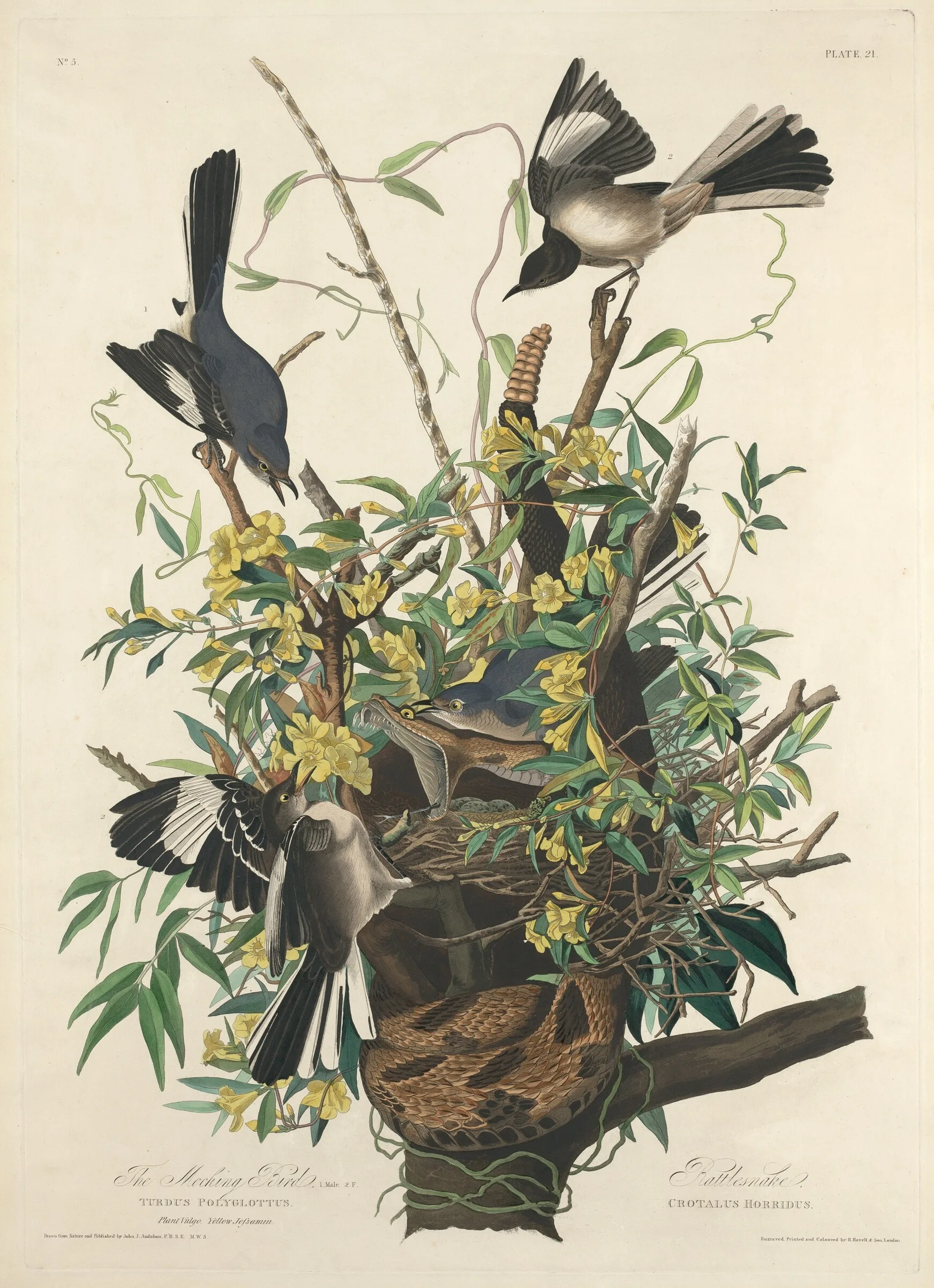
Audubon's “The Mocking Bird”, The Birds of America, plate XXI
Click or press Enter to enlarge
Open the full-resolution image (4189 px, National Gallery of Art)
| Plate | 21 (XXI) |
|---|---|
| Audubon's name | The Mocking Bird |
| Modern name | Northern Mockingbird |
| Scientific name | Mimus polyglottos |
| Status | Least Concern |
| Engraved by | Robert Havell, after Audubon's watercolor |
| Date | 1827 |
| Medium | Hand-colored engraving and aquatint on Whatman wove paper |
| Size | plate: 84.4 x 60 cm (33 1/4 x 23 5/8 in.) sheet: 99.5 x 66.5 cm (39 3/16 x 26 3/16 in.) |
| Plants and setting | Yellow Jessamine (Carolina Jessamine, Gelsemium sempervirens) |
| Collections | Songbirds |
| This impression | National Gallery of Art, Washington, 1945.8.21; Gift of Mrs. Walter B. James |
About this plate
Plate 21 shows a group of Northern Mockingbirds attacking a rattlesnake that has climbed into their nest in a vine of Yellow Jessamine, Gelsemium sempervirens. The snake coils around the branch with open mouth while the birds dive at it. It is one of the most dramatic scenes in the work. The plate was engraved by Robert Havell in 1827.
The plate drew sharp criticism in Audubon's lifetime. Opponents in Britain and America claimed that rattlesnakes could not climb trees and that the fangs were drawn wrongly. Later observers confirmed that rattlesnakes do sometimes climb into shrubs and trees, and the plate stood. The chapter itself is mostly about song and nesting. Audubon describes the male singing through spring nights and the pair building close to houses, often in orange, fig or pear trees.
The bird is the Northern Mockingbird, Mimus polyglottos. The scientific name means many-tongued mimic. Audubon wrote that it reached its full song only in the warm South, among magnolias and orange groves, and described the nest of briar sticks, leaves and wool, with up to three broods a season.
The species is resident across the southern and eastern United States and Mexico, and has spread north and into Canada since the nineteenth century. It is the state bird of five states, including Texas and Florida. Caged mockingbirds were once sold widely as songbirds. It is listed as Least Concern.
In Audubon's words
Dried twigs, leaves, grasses, cotton, flax, and other substances, are picked up, carried to a forked branch, and there arranged. The female has laid an egg, and the male redoubles his caresses. Five eggs are deposited in due time, when the male having little more to do than to sing his mate to repose, attunes his pipe anew. Every now and then he spies an insect on the ground, the taste of which he is sure will please his beloved one. He drops upon it, takes it in his bill, beats it against the earth, and flies to the nest to feed and receive the warm thanks of his devoted female.
John James Audubon, Ornithological Biography, vol. 1 (1831), “The Mocking Bird”. Read the full chapter.



