Clapper Rail (Plate 204)
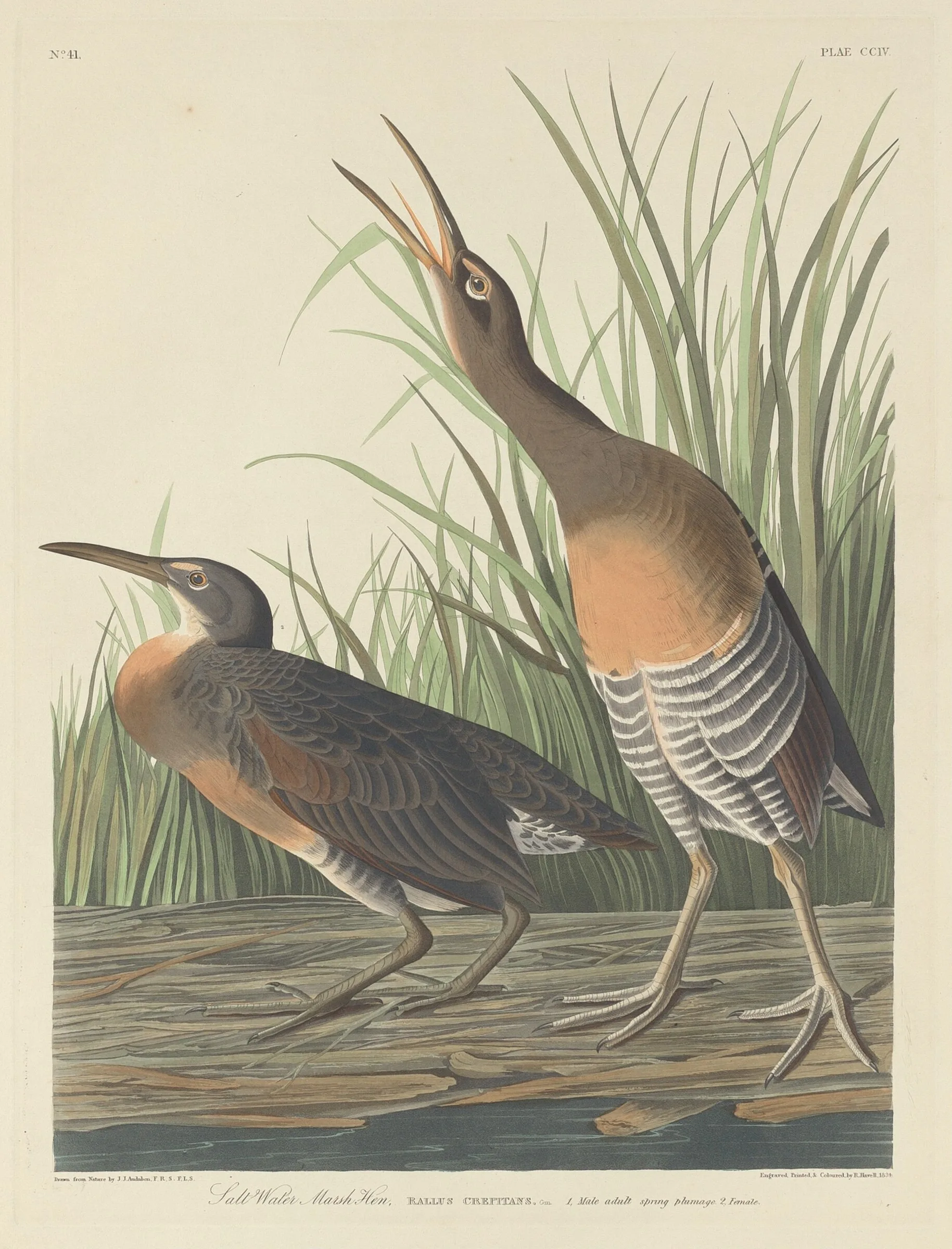
Audubon's “Salt Water Marsh Hen”, The Birds of America, plate CCIV
Click or press Enter to enlarge
Open the full-resolution image (2452 px, National Gallery of Art)
| Plate | 204 (CCIV) |
|---|---|
| Audubon's name | Salt Water Marsh Hen |
| Modern name | Clapper Rail |
| Scientific name | Rallus crepitans |
| Status | Least Concern |
| Engraved by | Robert Havell, after Audubon's watercolor |
| Date | 1834 |
| Medium | Hand-colored engraving and aquatint on Whatman wove paper |
| Collections | Shorebirds, Rails and Cranes |
| This impression | National Gallery of Art, Washington, 1945.8.204; Gift of Mrs. Walter B. James |
About this plate
Plate 204 shows a male and female Clapper Rail, engraved as the Salt Water Marsh Hen. The birds are greyer and plainer than the King Rail of the previous plate, with a long bill, a buff breast and grey and white barred flanks.
Audubon called it Rallus crepitans, the name used today. In 2014 the American Ornithological Society split the old Clapper Rail into three species. Rallus crepitans is the Clapper Rail of the Atlantic and Gulf coasts and the Caribbean. The western birds became Ridgway's Rail and the South American ones the Mangrove Rail. The Clapper Rail lives in salt marshes with cordgrass and in mangroves. It is listed as Least Concern, though it depends on coastal marshes that are threatened by development and sea level rise.
Audubon studied it in New Jersey, South Carolina and Florida. He wrote that it was resident and very common in the salt marshes from South Carolina to Louisiana, and that part of the population moved north in spring as far as New Jersey and Long Island. Migration took place silently at night, but on arrival the marshes rang with loud cackling. In March and April the cries could be heard by day and night, and a gunshot would set thousands calling at once.
He also described high storm tides driving the rails off the marsh, when many were killed, and rails rising from the grass to strike at Marsh Hawks passing low overhead.
In Audubon's words
Having studied the habits of these interesting birds in the Jerseys, in South Carolina, and in the Floridas, on the maritime borders of all of which they breed, I shall here attempt to describe them. In these countries, from about the beginning of March to that of April, the salt-marshes resound with the cries of the Clapper Rail, which resemble the syllables cac, cac, cac, cac, ca, caha, caha. The commencement of the cry, which is heard quite as frequently during day as by night, is extremely loud and rapid, its termination lower and protracted. At the report of a gun, when thousands of these birds instantaneously burst forth with their cries, you may imagine what an uproar they make. This bird seems to possess the power of ventriloquism, for, when several hundred yards off, its voice often seems to be issuing from the grass around you.
John James Audubon, Ornithological Biography, vol. 3 (1835), “The Clapper Rail, or Salt-water Marsh-hen”. Read the full chapter.