Wilson's Plover (Plate 209)
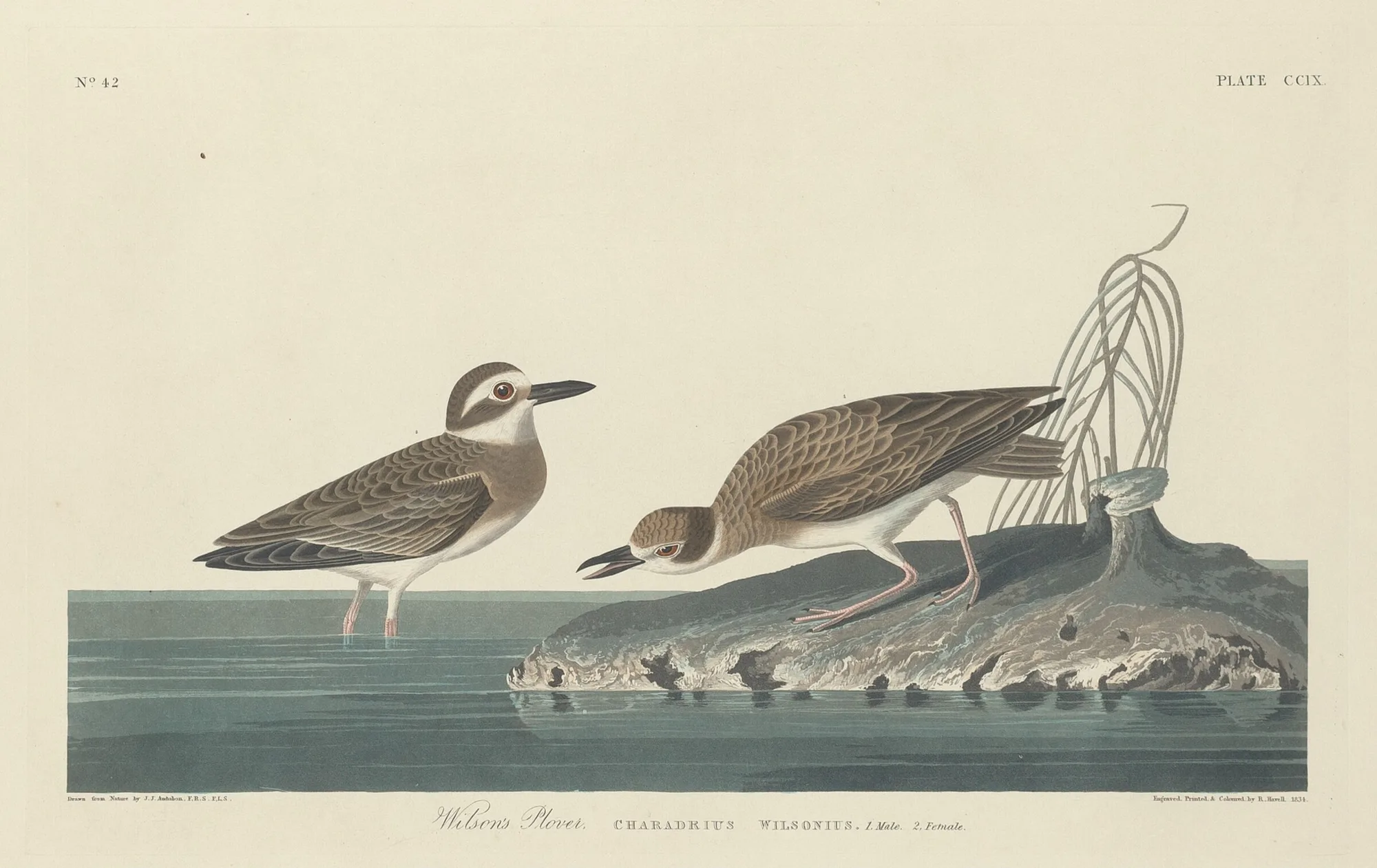
Audubon's “Wilson's Plover”, The Birds of America, plate CCIX
Click or press Enter to enlarge
Open the full-resolution image (2448 px, National Gallery of Art)
| Plate | 209 (CCIX) |
|---|---|
| Audubon's name | Wilson's Plover |
| Modern name | Wilson's Plover |
| Scientific name | Anarhynchus wilsonia |
| Status | Least Concern |
| Engraved by | Robert Havell, after Audubon's watercolor |
| Date | 1834 |
| Medium | Hand-colored engraving and aquatint on Whatman wove paper |
| Collections | Shorebirds, Rails and Cranes |
| This impression | National Gallery of Art, Washington, 1945.8.209; Gift of Mrs. Walter B. James |
About this plate
Plate 209 shows a male and female Wilson's Plover on a beach. They are sand-coloured plovers with a single breast band, black in the male and brown in the female, pink legs and a heavy black bill that is much thicker than that of the similar Semipalmated Plover.
The bird was named by George Ord for Alexander Wilson, who collected the first specimen at Cape May, New Jersey, in 1813. Audubon called it Charadrius wilsonius. Genetic studies have since moved it, with several other small plovers, to the genus Anarhynchus, so it is now Anarhynchus wilsonia. It breeds on open sandy beaches, sandbars and salt flats from Virginia to Texas, through the Caribbean, and on both coasts of Mexico and northern South America. It feeds mostly on fiddler crabs. It is listed as Least Concern, but beach development and disturbance have reduced it in the United States.
The chapter opens at dawn on a beach between South Carolina and the tip of Florida, where Audubon says he returned for several seasons to watch the bird, find its nests and see it raise young. He then turns to Wilson himself, saying he loved the name because of his respect for the man and wishing he could have spent such a morning with him.
He wrote that Wilson was with him only a few times and that nothing worth Wilson's attention was collected on those occasions. The two had met at Louisville in 1810.
In Audubon's words
See the bright blaze that issues from the verge of the waters! and now the sun himself appears, and all is life, or seems to be; for as the influence of the Divinity is to the universe, so is that of the sun to the things of this world. Far away beyond that treacherous reef, floats a gallant bark, that seems slumbering on the bosom of the waters like a silvery sea-bird. Gentle breezes now creep over the ocean, and ruffle its surface into tiny wavelets. The ship glides along, the fishes leap with joy, and on my ear comes the well known note of the bird which bears the name of one whom every ornithologist must honour. Long have I known the bird myself, and yet desirous of knowing it better, I have returned to this beach many successive seasons for the purpose of observing its ways, examining its nest, marking the care with which it rears its young, and the attachment which it manifests to its mate.
John James Audubon, Ornithological Biography, vol. 3 (1835), “Wilson's Plover”. Read the full chapter.