Least Bittern (Plate 210)
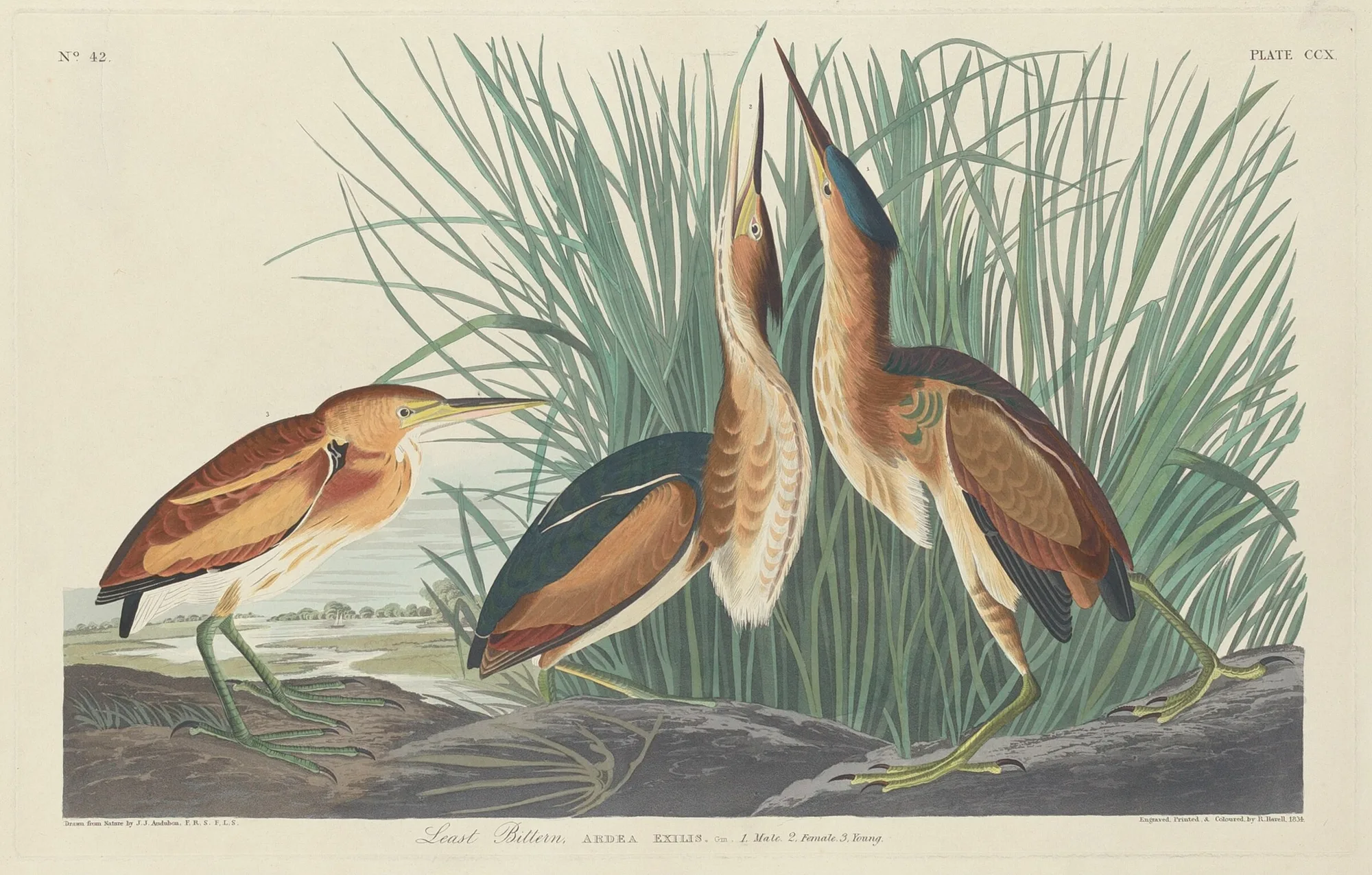
Audubon's “Least Bittern”, The Birds of America, plate CCX
Click or press Enter to enlarge
Open the full-resolution image (2418 px, National Gallery of Art)
| Plate | 210 (CCX) |
|---|---|
| Audubon's name | Least Bittern |
| Modern name | Least Bittern |
| Scientific name | Botaurus exilis |
| Status | Least Concern |
| Engraved by | Robert Havell, after Audubon's watercolor |
| Date | 1834 |
| Medium | Hand-colored engraving and aquatint on Whatman wove paper |
| Collections | Herons and Egrets |
| This impression | National Gallery of Art, Washington, 1945.8.210; Gift of Mrs. Walter B. James |
About this plate
Plate 210 shows three Least Bitterns: an adult male with a glossy black crown and back, a female with a browner back, and a young bird on the left. Audubon drew the adults in poses he watched in live birds kept in his rooms.
The young bird has a story. At the Cincinnati Museum, where Audubon worked around 1820, a woman brought in a live young bittern that had fallen down her chimney in the night and was perched on her bedpost at dawn. Audubon drew it standing still on his table for two hours. He then set two books an inch and a half apart and watched it walk between them, and then through a gap of one inch, showing how narrow it could make its body.
In Philadelphia in September 1832 he was given a live adult pair caught in a meadow below the city. He kept them for days on small fish and strips of pork, watched them climb the curtains to the top, repeated the book test, and drew both birds in the attitudes in the plate. His wife admired their gentle manners.
Audubon called it Ardea exilis. It was long Ixobrychus exilis and is now placed in Botaurus with the larger bitterns. It is the smallest heron in the Americas, breeding in dense cattail and reed marshes from southern Canada to South America. It is listed as Least Concern.
In Audubon's words
One morning while I was at the Cincinnati Museum in the State of Ohio, a woman came in holding in her apron one of this delicate species alive, which she said had fallen down the chimney of her house under night, and which, when she awoke at daybreak, was the first object she saw, it having perched on one of the bed posts. It was a young bird. I placed it on the table before me, and drew from it the figure on the left of my plate. It stood perfectly still for two hours, but on my touching it with a pencil, after my drawing was done, it flew off and alighted on the cornice of a window.
John James Audubon, Ornithological Biography, vol. 3 (1835), “The Least Bittern”. Read the full chapter.