Purple Martin (Plate 22)
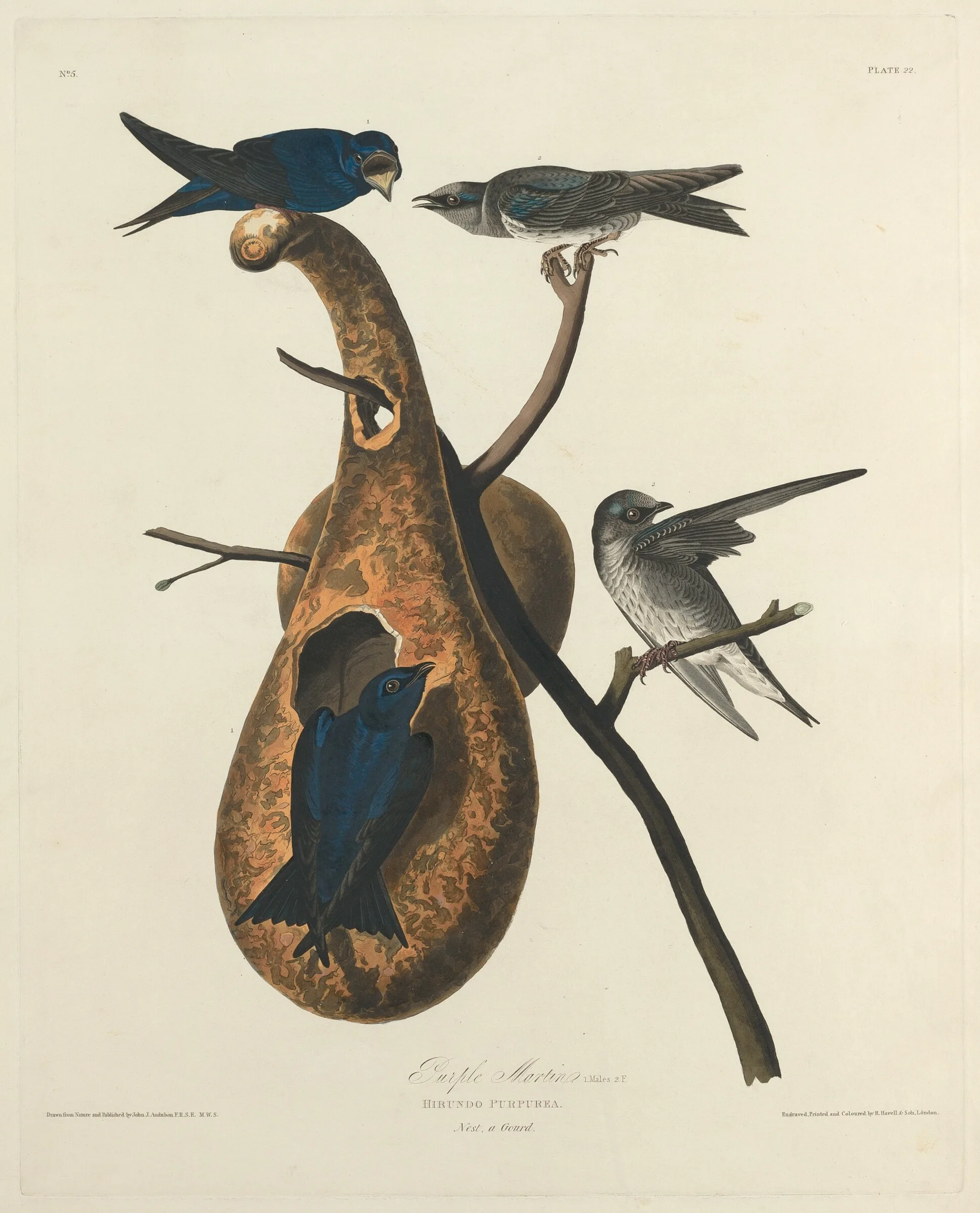
Audubon's “Purple Martin”, The Birds of America, plate XXII
Click or press Enter to enlarge
Open the full-resolution image (3290 px, National Gallery of Art)
| Plate | 22 (XXII) |
|---|---|
| Audubon's name | Purple Martin |
| Modern name | Purple Martin |
| Scientific name | Progne subis |
| Status | Least Concern |
| Engraved by | Robert Havell, after Audubon's watercolor |
| Date | 1827 |
| Medium | Hand-colored engraving and aquatint on Whatman wove paper |
| Plants and setting | A hanging gourd used as a nest site |
| Collections | Songbirds |
| This impression | National Gallery of Art, Washington, 1945.8.22; Gift of Mrs. Walter B. James |
About this plate
Plate 22 shows a male and female Purple Martin at a hollow gourd hung up as a nest site. The male is glossy blue-black all over. The female is duller, with a grey breast. The practice of hanging gourds for martins was learned from Native Americans and is still common in the South. The plate was engraved by Robert Havell in 1827.
Audubon wrote that martins reached New Orleans between the 1st and 9th of February. On 4 February 1821 he walked for more than two miles along the river below the city under a loose flock about a mile and a half long, moving no faster than four miles an hour, while passers-by stared at him. He described the birds as fierce defenders of their boxes, chasing hawks, crows and even eagles, and told of his own martin house near his home.
The name is unchanged: Purple Martin, Progne subis. It is the largest swallow in North America. Audubon called it Hirundo purpurea.
Purple Martins breed across eastern North America and locally in the West, and winter in South America, especially Brazil. In the East nearly all pairs now nest in houses and gourds put up by people, a dependence that began before European settlement. The species is listed as Least Concern.
In Audubon's words
I have had several opportunities, at the period of their arrival, of seeing prodigious flocks moving over that city or its vicinity, at a considerable height, each bird performing circular sweeps as it proceeded, for the purpose of procuring food. These flocks were loose, and moved either eastward, or towards the north-west, at a rate not exceeding four miles in the hour, as I walked under one of them with ease for upwards of two miles, at that rate, on the 4th of February 1821, on the bank of the river below the city, constantly looking up at the birds, to the great astonishment of many passengers, who were bent on far different pursuits. My Fahrenheit's thermometer stood at 68°, the weather being calm and drizzly. This flock extended about a mile and a half in length, by a quarter of a mile in breadth.
John James Audubon, Ornithological Biography, vol. 1 (1831), “The Purple Martin”. Read the full chapter.



