Green Heron (Plate 333)
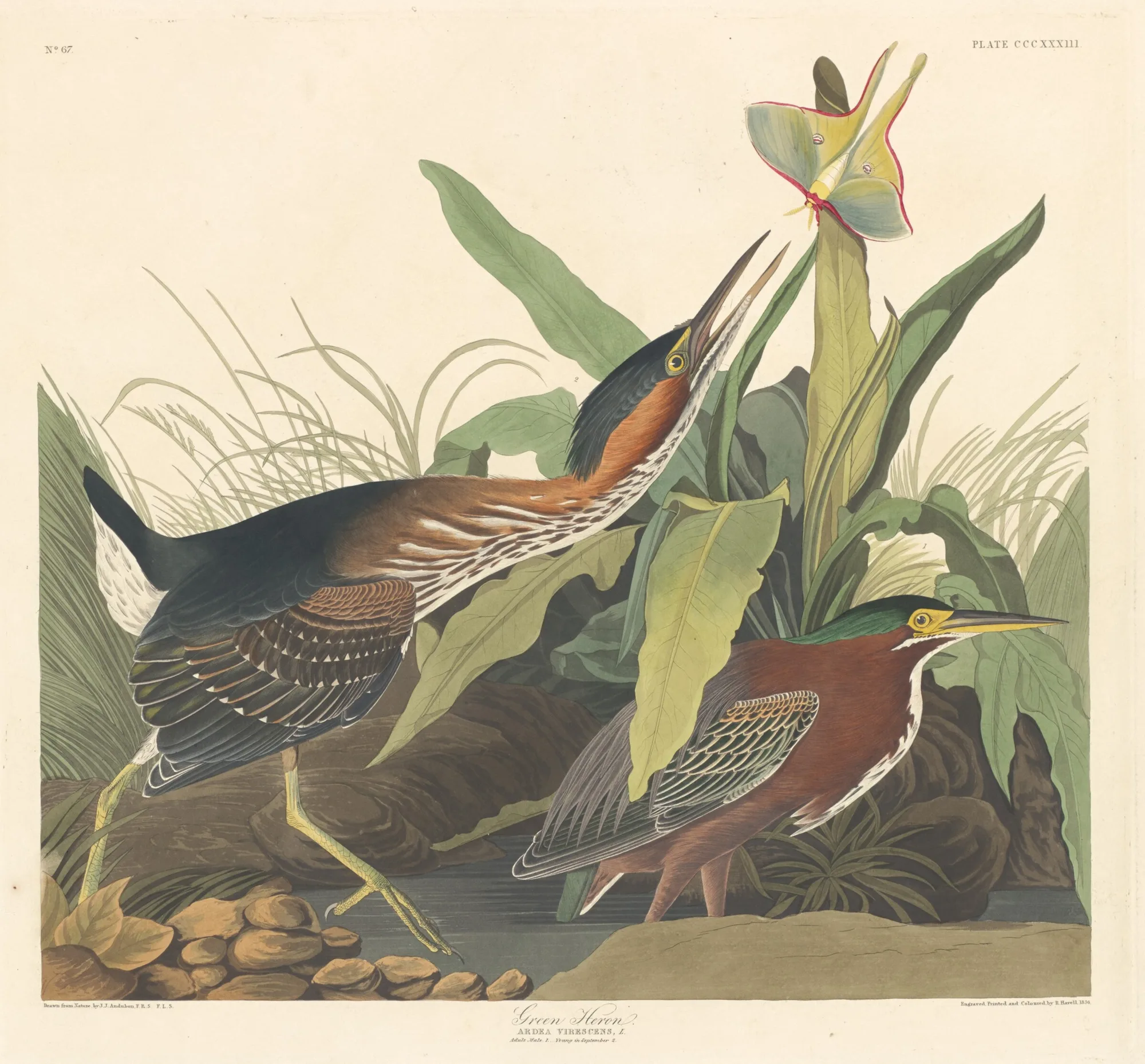
Audubon's “Green Heron”, The Birds of America, plate CCCXXXIII
Click or press Enter to enlarge
Open the full-resolution image (3184 px, National Gallery of Art)
| Plate | 333 (CCCXXXIII) |
|---|---|
| Audubon's name | Green Heron |
| Modern name | Green Heron |
| Scientific name | Butorides virescens |
| Status | Least Concern |
| Engraved by | Robert Havell, after Audubon's watercolor |
| Date | 1836 |
| Medium | Hand-colored engraving and aquatint on Whatman wove paper |
| Collections | Herons and Egrets |
| This impression | National Gallery of Art, Washington, 1945.8.333; Gift of Mrs. Walter B. James |
About this plate
Plate 333 shows two Green Herons: an adult male in full plumage and an immature bird. The adult has a dark green back, a chestnut neck and a dark cap. The young bird is browner, with heavy streaks down the neck. Audubon said he paired them so readers could see how easily age differences mislead naturalists.
The modern name and the scientific name, Butorides virescens, match Audubon's Ardea virescens. For some years it was lumped with the Striated Heron of the Old World as Green-backed Heron, but the two are now treated as separate species again.
Green Herons breed across the eastern and western United States, Mexico and Central America, and winter from the Gulf coast southward. They hunt alone at the edges of ponds, streams and marshes. They are one of the few birds known to use bait, dropping insects or bread onto the water to lure fish. The species is listed as Least Concern.
Audubon wrote that the bird was tame enough to nest in town gardens. In the suburbs of Charleston he saw several nests in one live oak on the grounds of Joel Poinsett. He also described spring flocks of twenty to fifty that rested by day and migrated at night.
In Audubon's words
I have observed their return in early spring, when arriving in flocks of from twenty to fifty individuals. They would plunge downwards from their elevated line of march, cutting various zigzags, until they would all simultaneously alight on the tops of the trees or bushes of some swampy place, or on the borders of miry ponds. These halts took place pretty regularly about an hour after sun-rise. The day was occupied by them, as well as by some other species, especially the Blue, the Yellow-crowned, and Night Herons, all of which at this period travelled eastward, in resting, cleansing their bodies, and searching for food. When the sun approached the western horizon, they would at once ascend in the air, arrange their lines, and commence their flight, which, I have no doubt, continued all night.
John James Audubon, Ornithological Biography, vol. 4 (1838), “Green Heron”. Read the full chapter.