Wood Stork (Plate 216)
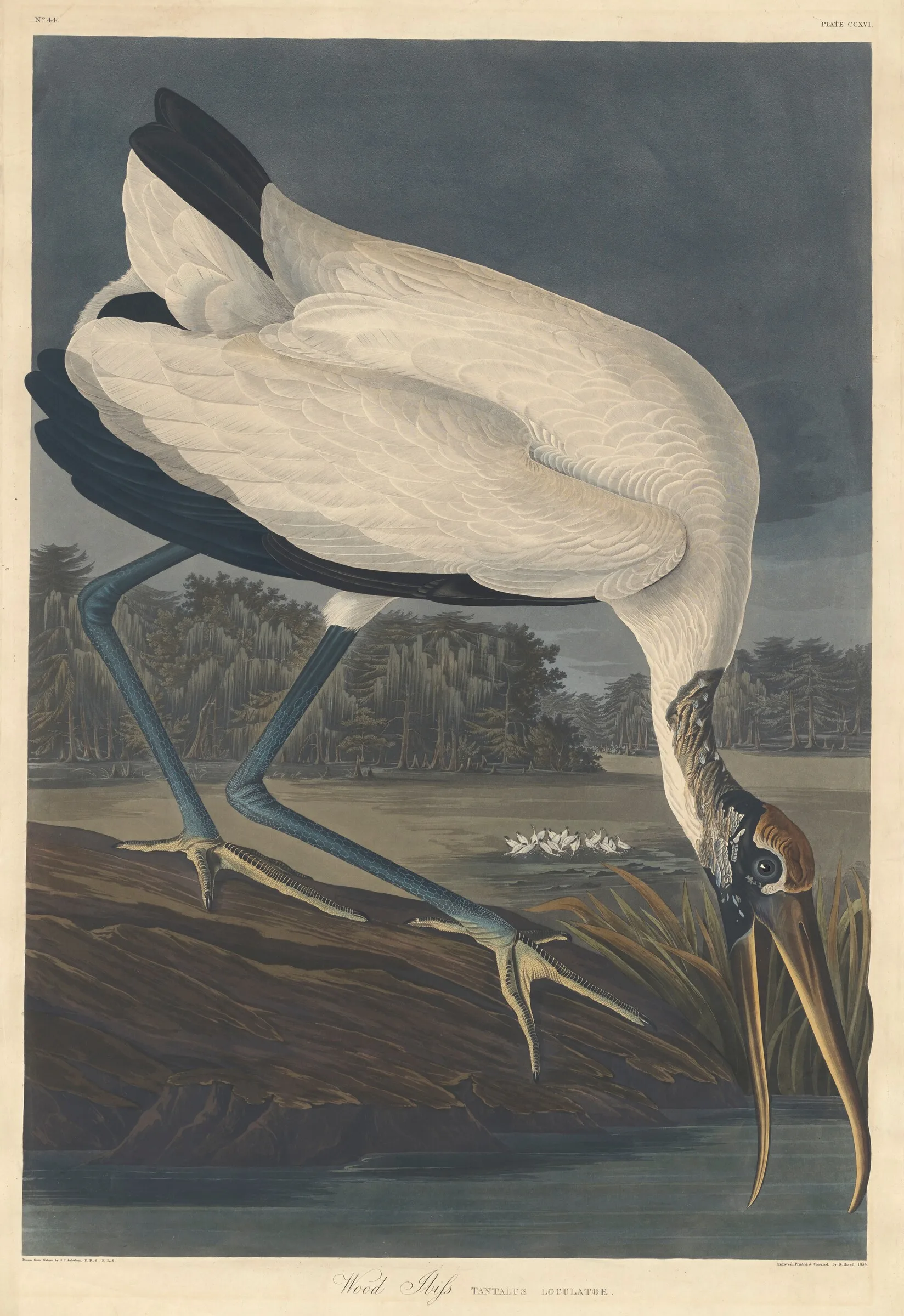
Audubon's “Wood Ibis”, The Birds of America, plate CCXVI
Click or press Enter to enlarge
Open the full-resolution image (5542 px, National Gallery of Art)
| Plate | 216 (CCXVI) |
|---|---|
| Audubon's name | Wood Ibis |
| Modern name | Wood Stork |
| Scientific name | Mycteria americana |
| Status | Least Concern |
| Engraved by | Robert Havell, after Audubon's watercolor |
| Date | 1834 |
| Medium | Hand-colored engraving and aquatint on Whatman wove paper |
| Collections | Florida and Wading Birds |
| This impression | National Gallery of Art, Washington, 1945.8.216; Gift of Mrs. Walter B. James |
About this plate
Plate 216 shows a single male Wood Stork, which Audubon knew as the Wood Ibis. It is a large white wading bird with black flight feathers and tail, a bare, scaly grey head and neck, and a thick, down-curved bill. Despite the old name, it is a stork, not an ibis.
Audubon called it Tantalus loculator. It is now Mycteria americana, the only stork that breeds in the United States. It nests in colonies in cypress swamps and mangroves in Florida, Georgia and South Carolina, and ranges south through Mexico, the Caribbean and Central and South America to Argentina. It feeds by touch, sweeping its open bill through shallow water and snapping it shut on fish in a fraction of a second. It is listed as Least Concern globally. The U.S. population fell sharply with the draining of Florida wetlands and was federally listed as endangered in 1984, then reclassified as threatened in 2014 after recovering.
Audubon used the chapter to contradict William Bartram, who had called the bird solitary, a claim Wilson repeated. Audubon wrote that it was rare to see one alone and easy to see a hundred together, and that he had seen flocks of several thousand.
He described it as extremely wary. One autumn near Bayou Sara, Louisiana, collecting skins for Charles Lucien Bonaparte, Prince of Musignano, he and two expert woodsmen took three days to shoot fifteen birds, mostly on the wing with rifle balls, although they saw many hundreds.
In Audubon's words
In treating of the bird now under your notice, Mr William Bartram says, "This solitary bird does not associate in flocks, but is generally seen alone." This was published by Wilson, and every individual who has since written on the subject, has copied the assertion without probably having any other reason than that he believed the authors of it to state a fact. But the habits of this species are entirely at variance with the above quotation, to which I direct your attention not without a feeling of pain, being assured that Mr Bartram could have made such a statement only because he had few opportunities of studying the bird in question in its proper haunts. The Wood Ibis is rarely met with single, even after the breeding season, and it is more easy for a person to see an hundred together at any period of the year, than to meet with one by itself. Nay, I have seen flocks composed of several thousands, and that there is a natural necessity for their flocking together I shall explain to you.
John James Audubon, Ornithological Biography, vol. 3 (1835), “The Wood Ibis”. Read the full chapter.