Common Yellowthroat (Plate 23)
Audubon's “Maryland Yellow Throat”, The Birds of America, plate XXIII
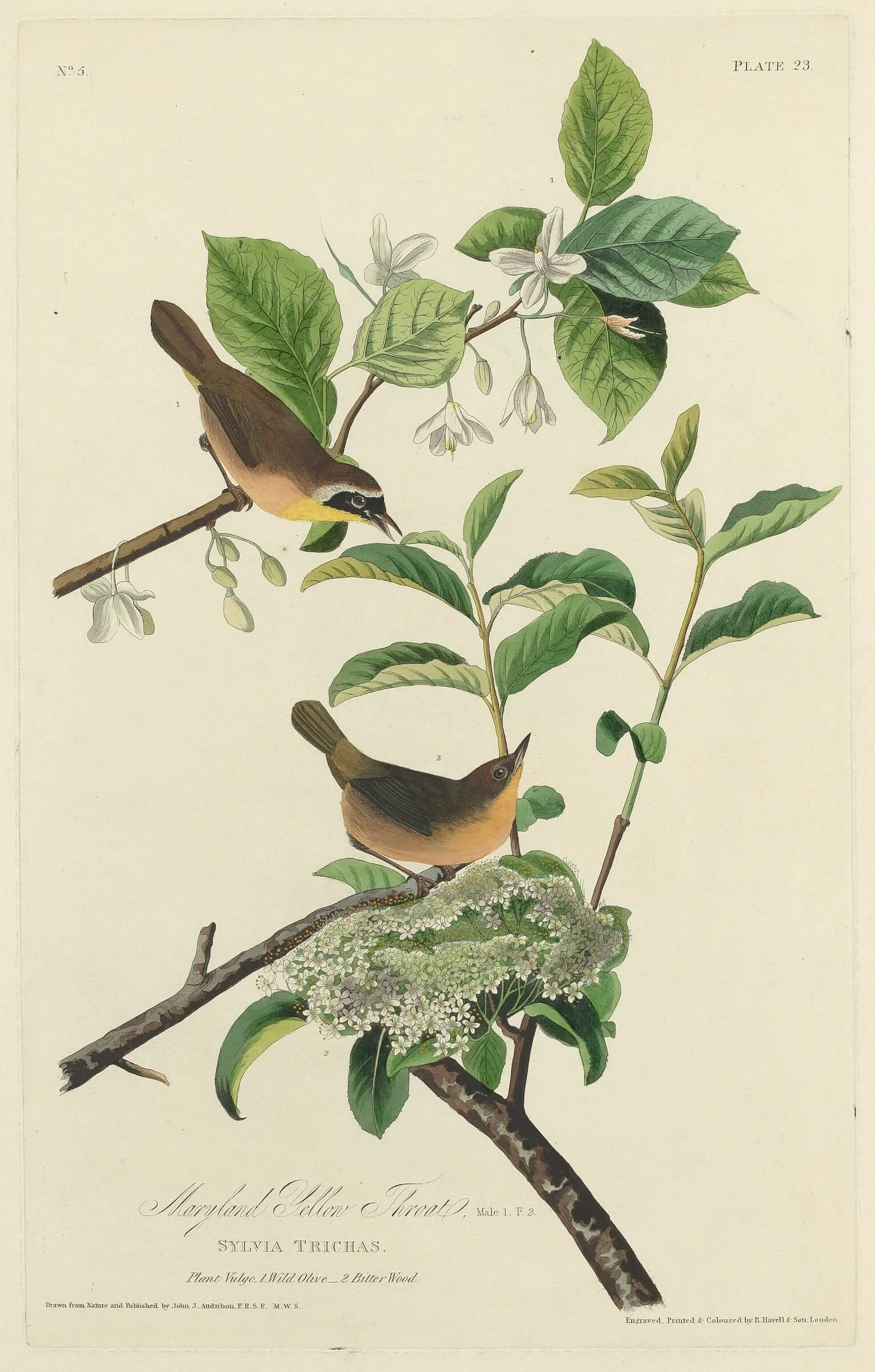
Click or press Enter to enlarge
Open the full-resolution image (2485 px, National Gallery of Art)
| Plate | 23 (XXIII) |
|---|---|
| Audubon's name | Maryland Yellow Throat |
| Modern name | Common Yellowthroat |
| Scientific name | Geothlypis trichas |
| Status | Least Concern |
| Engraved by | Robert Havell, after Audubon's watercolor |
| Date | 1827 |
| Medium | Hand-colored engraving and aquatint on Whatman wove paper |
| Plants and setting | Wild Olive (male) and Bitter-wood Tree (female), as named by Audubon |
| Collections | Songbirds |
| This impression | National Gallery of Art, Washington, 1945.8.23; Gift of Mrs. Walter B. James |
About this plate
Plate 23 shows a male and female Common Yellowthroat on two different small trees. Audubon wrote that the male is on a twig of what Louisianans called the Wild Olive, a small brittle tree with an acid fruit sometimes pickled. The female sits on a twig of the Bitter-wood Tree, which grew along fences among briars. He said he had seen both trees only in Louisiana. The plate was engraved by Robert Havell in 1827.
Audubon described the bird's call as a whitititee repeated every few minutes from briars along fences. He noted that it dives into thick bushes when approached and soon sings again a few feet away. He also recorded that its ground nest was often used by the Brown-headed Cowbird, which he called the Cow Bunting and compared to the European Cuckoo.
The bird is the Common Yellowthroat, Geothlypis trichas. Audubon's chapter title gives two names, the Yellow-breasted Warbler and the Maryland Yellow-throat. Wilson and Audubon used Sylvia trichas. Audubon noted correctly that young males look like females for several months before getting the black mask.
The Common Yellowthroat breeds in marshes, wet thickets and weedy fields across most of North America and winters from the southern United States to Central America and the Caribbean. It is one of the most widespread warblers on the continent and is listed as Least Concern.
In Audubon's words
The notes of this little bird render it more conspicuous than most of its genus, for although they cannot be called very musical, they are far from being unpleasant, and are uttered so frequently during the day, that one, in walking along the briary ranges of the fences, is almost necessarily brought to listen to its whitititee, repeated three or four times every five or six minutes, the bird seldom stopping expressly to perform its music, but merely uttering the notes after it has picked an insect from amongst the leaves of the low bushes which it usually inhabits. It then hops a step or two up or down, and begins again.
Although timid, it seldom flies far off at the approach of man, but instantly dives into the thickest parts of its favourite bushes and high grass, where it continues searching for food either along the twigs, or among the dried leaves on the ground, and renews its little song when only a few feet distant.
John James Audubon, Ornithological Biography, vol. 1 (1831), “The Yellow-breasted Warbler, or Maryland Yellow-throat”. Read the full chapter.



