Roscoe's Yellow-throat (Plate 24)
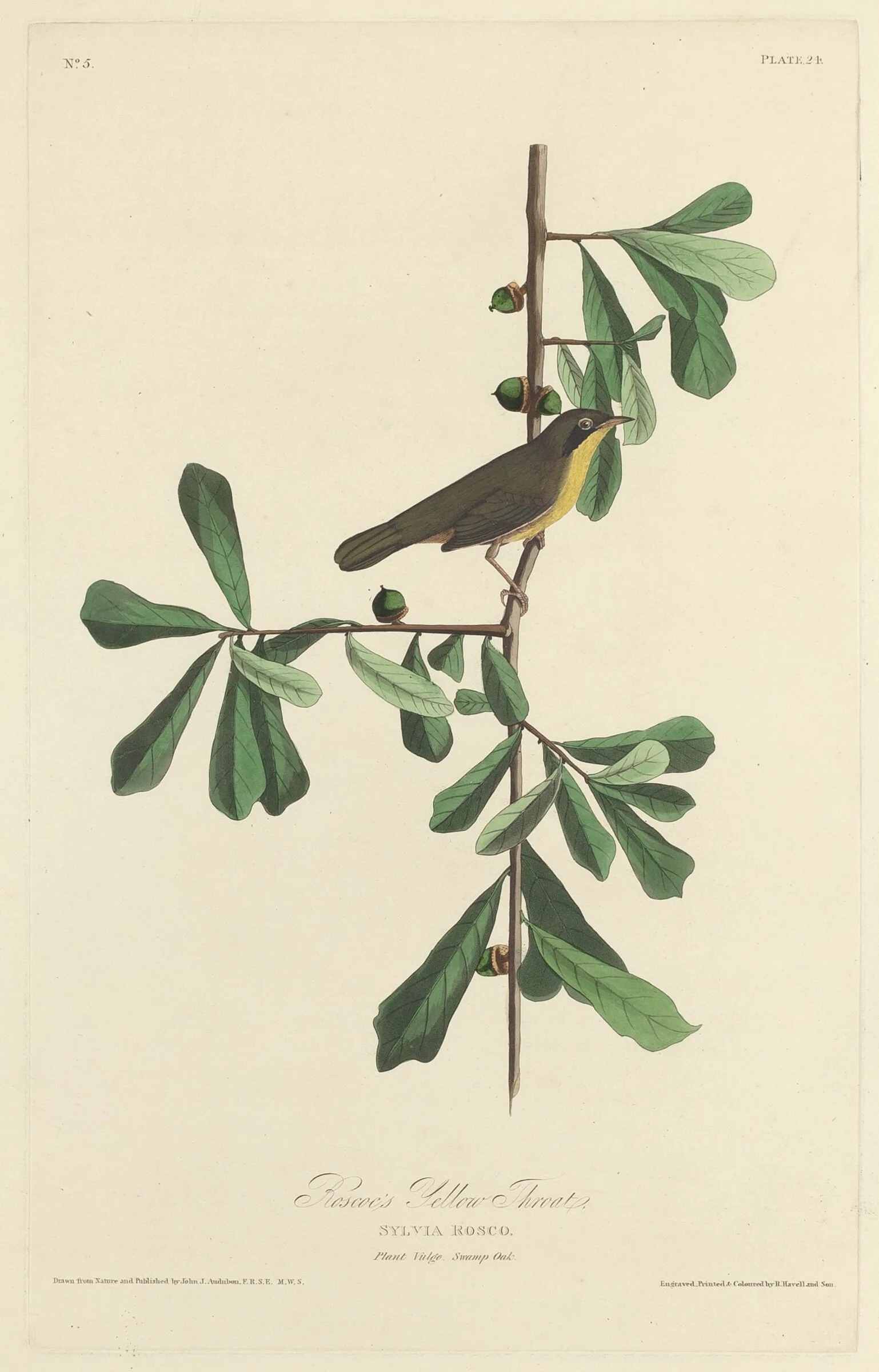
Audubon's “Roscoe's Yellow Throat”, The Birds of America, plate XXIV
Click or press Enter to enlarge
Open the full-resolution image (2490 px, National Gallery of Art)
| Plate | 24 (XXIV) |
|---|---|
| Audubon's name | Roscoe's Yellow Throat |
| Modern name | Common Yellowthroat (aberrant individual or mystery bird) |
| Scientific name | Geothlypis trichas |
| Status | Least Concern |
| Engraved by | Robert Havell, after Audubon's watercolor |
| Date | 1827 |
| Medium | Hand-colored engraving and aquatint on Whatman wove paper |
| Plants and setting | Swamp Oak, as named by Audubon |
| Collections | Songbirds |
| This impression | National Gallery of Art, Washington, 1945.8.24; Gift of Mrs. Walter B. James |
About this plate
Plate 24 shows a single male yellowthroat with a black mask, perched on a twig of the tree Audubon called the Swamp Oak. He described it as a large oak of damp ground with very hard, heavy wood that sinks in water. The plate was engraved by Robert Havell in 1827.
Audubon named the bird after William Roscoe of Liverpool, the historian and author of the Life of Leo the Tenth, who had given him advice and help when he arrived in England in 1826. He shot the only specimen he ever saw in September 1821 in a deep swamp near the Mississippi River, in the state of Mississippi. It was feeding high in a cypress, then flew to a tree of the kind shown in the plate, where he shot it. He returned to the swamp for several days but never found another.
Audubon admitted the bird looked very like the Maryland Yellow-throat of Plate 23, but believed its habits made it a separate species. No such species is recognized. Roscoe's Yellow-throat is generally treated as an unusual Common Yellowthroat, Geothlypis trichas, perhaps a variant individual or a hybrid. It is one of several birds in the work known only from Audubon's single specimen and drawing.
The Common Yellowthroat is widespread in marshes and thickets across North America and is listed as Least Concern.
In Audubon's words
I shot it in a deep swamp not far from the River Mississippi, in the State bearing the same name, in September 1821. It was flitting amongst the top branches of a high Cypress, when I first observed it, moving sideways, searching for insects, and occasionally following one on the wing. It uttered a single twit repeated at short intervals. It having unexpectedly flown to a distant tree of the species on a branch of which you now see it, I followed it and shot it. It was the only one of the kind I have ever seen, although I went to the same swamp for several days in succession. It proved a male, and was to all appearance in perfect plumage. The gizzard was nearly filled with very minute red insects, found on Cypresses and Pines, the wings of different flies, and the heads of red ants.
John James Audubon, Ornithological Biography, vol. 1 (1831), “Roscoe's Yellow-throat”. Read the full chapter.



