Black-crowned Night Heron (Plate 236)
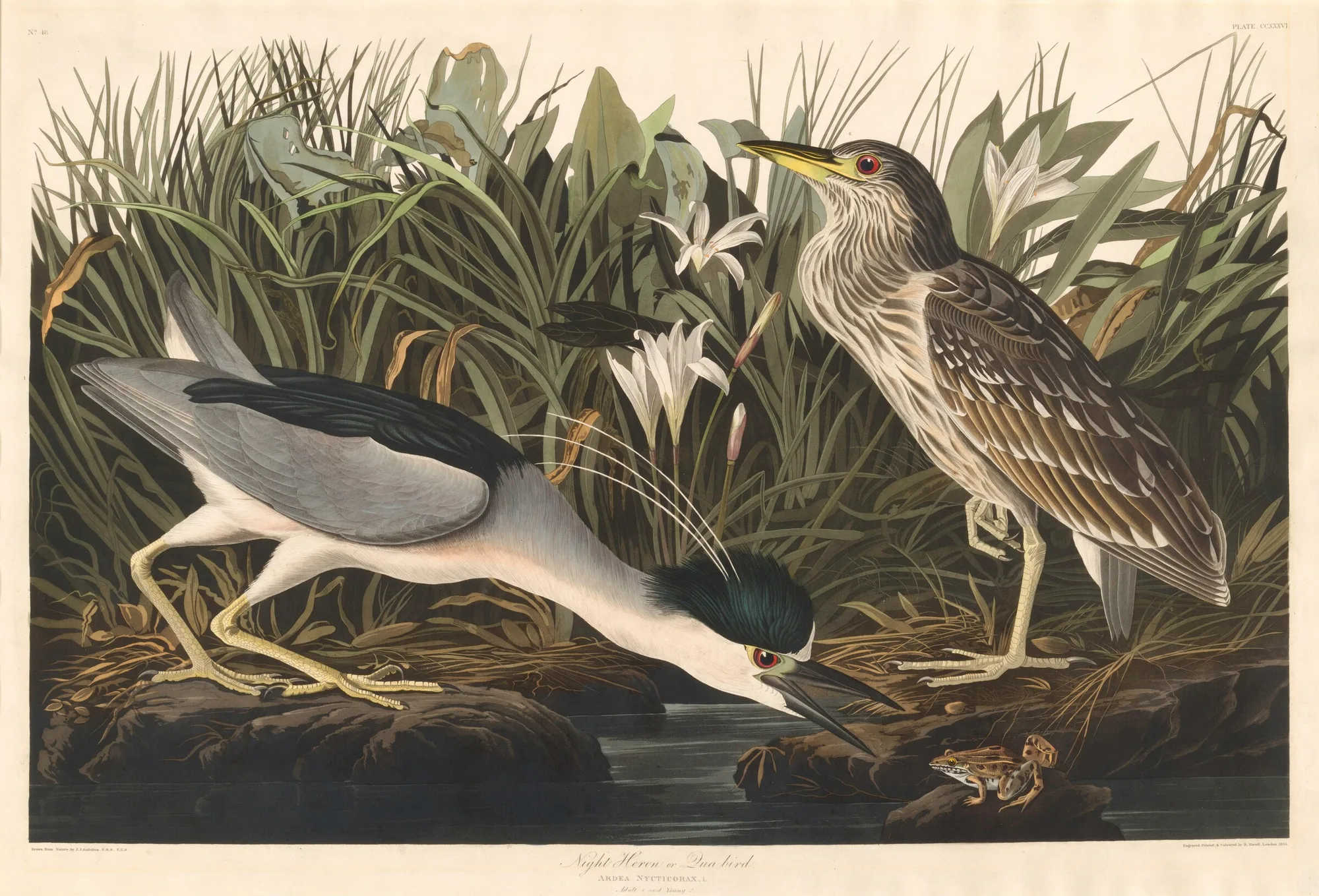
Audubon's “Night Heron or Qua bird”, The Birds of America, plate CCXXXVI
Click or press Enter to enlarge
Open the full-resolution image (5096 px, National Gallery of Art)
| Plate | 236 (CCXXXVI) |
|---|---|
| Audubon's name | Night Heron or Qua bird |
| Modern name | Black-crowned Night Heron |
| Scientific name | Nycticorax nycticorax |
| Status | Least Concern |
| Engraved by | Robert Havell, after Audubon's watercolor |
| Date | 1835 |
| Medium | Hand-colored engraving and aquatint on Whatman wove paper |
| Size | plate: 64.5 x 96.5 cm (25 3/8 x 38 in.) sheet: 67.3 x 100.7 cm (26 1/2 x 39 5/8 in.) |
| Collections | Herons and Egrets |
| This impression | National Gallery of Art, Washington, 1945.8.236; Gift of Mrs. Walter B. James |
About this plate
Plate 236 shows an adult male Black-crowned Night Heron, with black crown and back, grey wings, red eyes and long white head plumes, beside a young bird streaked brown and spotted with white.
Audubon listed the bird's local names: Indian Pullet in South Carolina, Gros-bec among the Creoles of Louisiana, Indian Hen in East Florida and Qua Bird in the Eastern States, after its flat call. In January, on his winter journey through East Florida, he found a large roost about six miles below the plantation of his friend John Bulow on a bayou of the Halifax River, where several hundred pairs were already mated. John Bachman told him of a winter roost of about fifty young birds in live oaks on the Ashley River near Charleston, with never an adult among them. Audubon thought the species seldom went more than about a hundred miles inland.
Audubon's Ardea nycticorax is now Nycticorax nycticorax. It is one of the most widespread herons in the world, found on every continent except Australia and Antarctica. It feeds mostly at dusk and by night and nests in colonies, often with other herons.
In North America it breeds well inland as well as on the coasts, including the Great Lakes and the western marshes, a wider range than Audubon knew. It is listed as Least Concern.
In Audubon's words
In the course of my winter rambles through East Florida, I met with several of the large places of resort of Night Herons, and, in particular, one remarkable for the vast number of birds congregated there. It is about six miles below the plantation of my friend John Bulow, Esq., on a bayou which opens into the Halifax River. There several hundred pairs appeared to be already mated, although it was only the month of January; many of the nests of former years were still standing, and all appeared to live in peace and contentment.
John James Audubon, Ornithological Biography, vol. 3 (1835), “The Night Heron”. Read the full chapter.