Mountain Plover (Plate 350)
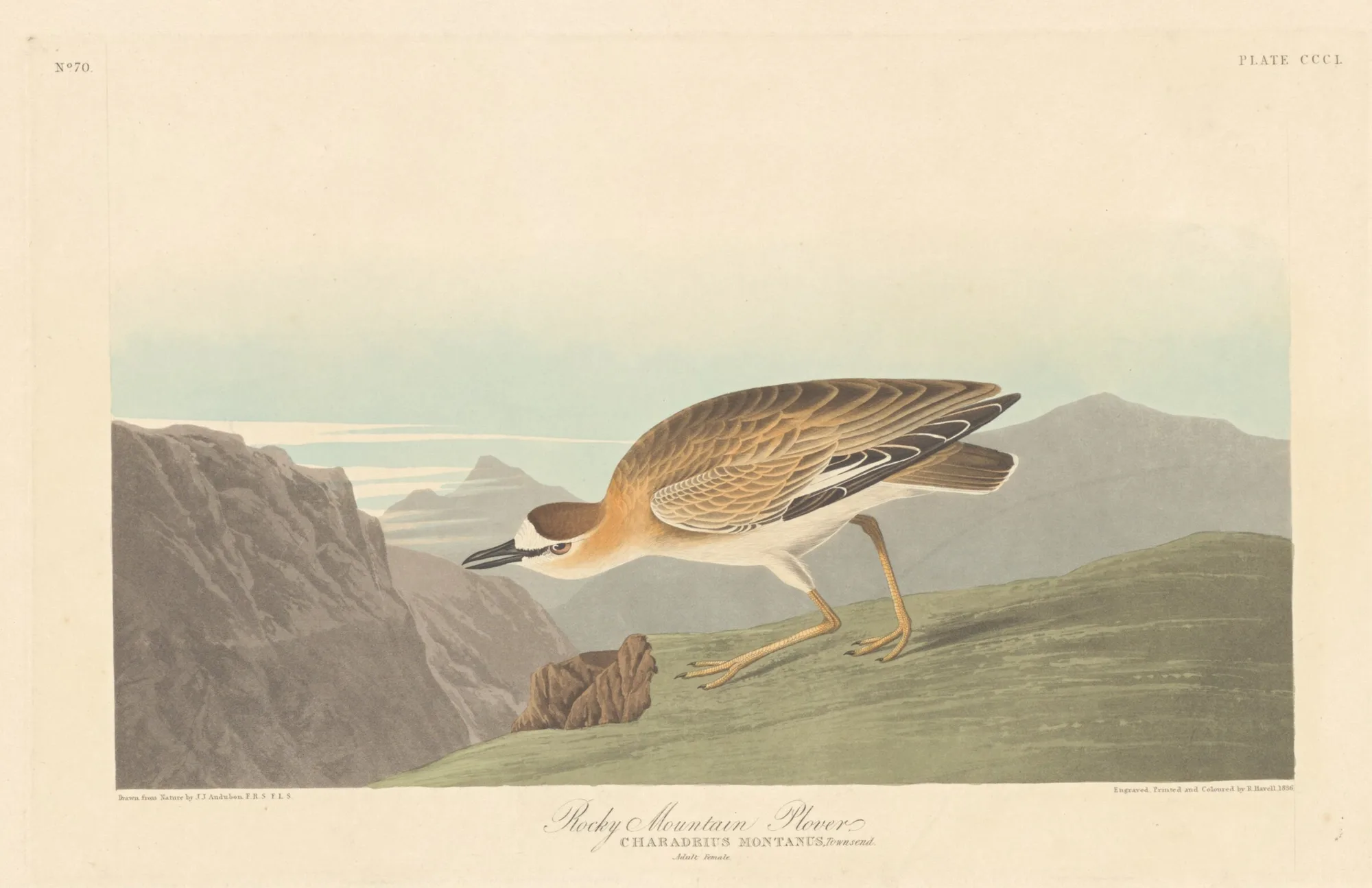
Audubon's “Rocky Mountain Plover”, The Birds of America, plate CCCL
Click or press Enter to enlarge
Open the full-resolution image (2806 px, National Gallery of Art)
| Plate | 350 (CCCL) |
|---|---|
| Audubon's name | Rocky Mountain Plover |
| Modern name | Mountain Plover |
| Scientific name | Anarhynchus montanus |
| Status | Near Threatened |
| Engraved by | Robert Havell, after Audubon's watercolor |
| Date | 1836 |
| Medium | Hand-colored engraving and aquatint on Whatman wove paper |
| Collections | Shorebirds, Rails and Cranes |
| This impression | National Gallery of Art, Washington, 1945.8.350; Gift of Mrs. Walter B. James |
About this plate
Plate 350 shows a single female Mountain Plover. It is a plain sandy brown plover with a white forehead, a thin dark line from bill to eye and no breast band. Audubon expected that the male, when found, would be more boldly marked. In fact the sexes look alike.
The bird was described by John Kirk Townsend as Charadrius montanus from specimens collected on the 1834 overland journey to the Columbia River with Thomas Nuttall. Recent classifications move it to the genus Anarhynchus. Despite its name it is a bird of dry shortgrass prairie rather than mountains, and it is rarely found near water.
Mountain Plovers breed on the high plains from Montana to New Mexico, often on prairie-dog towns and heavily grazed ground. They winter in California, Arizona, Texas and northern Mexico. Conversion of prairie to cropland has reduced numbers, and IUCN lists the species as Near Threatened.
Audubon never saw the bird alive and drew it from a skin. For its habits he printed a note from Nuttall. Nuttall saw only a few, for a day or two in July on the central plateau of the Rockies near the last streams of the Platte. They hid among sagebrush and froze to blend with the grey soil.
In Audubon's words
This remarkable species, so much allied to the Charadrius Wilsoni, was scarcely seen by us for more than one or two days, and then on the central table-land of the Rocky Mountains, in the plains near the last of the streams of the Platte, pursued in our western and northern route. It being the month of July when we saw it, there is little doubt but that it was breeding in this subalpine region. The only individual shot, was seen skulking and running through the wormwood bushes which so generally clothe those arid and dry wastes. After running some time, it would remain perfectly still, as if conscious of the difficulty of distinguishing it from the colour of the grey soil on which it stood. All that we saw were similar to the present individual, and none, however flushed, took to the wing. We do not recollect hearing from it the slightest complaint or note of any kind, being intent probably on concealing its young or eggs by a perfect silence.
John James Audubon, Ornithological Biography, vol. 4 (1838), “Rocky-Mountain Plover”. Read the full chapter.



