Hudsonian Whimbrel (Plate 237)
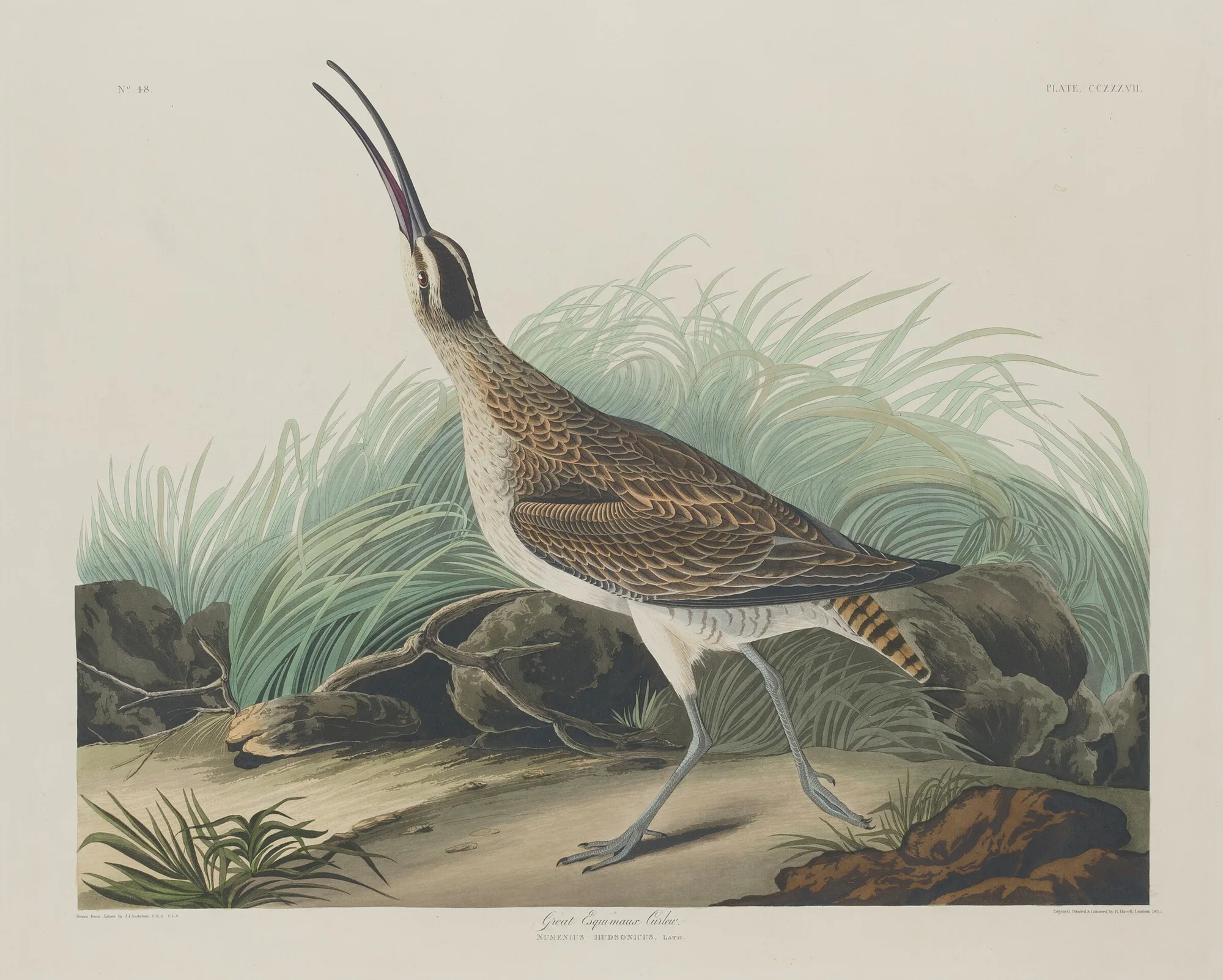
Audubon's “Great Esquimaux Curlew”, The Birds of America, plate CCXXXVII
Click or press Enter to enlarge
Open the full-resolution image (3167 px, National Gallery of Art)
| Plate | 237 (CCXXXVII) |
|---|---|
| Audubon's name | Great Esquimaux Curlew |
| Modern name | Hudsonian Whimbrel |
| Scientific name | Numenius hudsonicus |
| Status | Least Concern |
| Engraved by | Robert Havell, after Audubon's watercolor |
| Date | 1835 |
| Medium | Hand-colored engraving and aquatint on Whatman wove paper |
| Collections | Shorebirds, Rails and Cranes |
| This impression | National Gallery of Art, Washington, 1945.8.237; Gift of Mrs. Walter B. James |
About this plate
Plate 237 shows a single male of the bird Audubon engraved as the Great Esquimaux Curlew and described in the Ornithological Biography as the Hudsonian Curlew. It is a large grey-brown shorebird with a striped crown and a long, down-curved bill. The engraved name reflects how long it had been confused with the smaller Eskimo Curlew, which Audubon drew separately.
Audubon admitted that he knew little of its habits. In Labrador in 1833 he asked the settlers about it, but even Mr Jones and his sons at Bras d'Or, who had killed thousands of Eskimo Curlews, had never seen it. He had found it on the New Jersey shore in May, seen a large flock near Charleston in December and bought specimens in the Boston market in September. Because he had little to add, he filled out the chapter with long quotations from Alexander Wilson and Thomas Nuttall.
The American Ornithological Society now treats this bird as the Hudsonian Whimbrel, Numenius hudsonicus, separate from the Eurasian Whimbrel. It breeds on subarctic tundra in Alaska and around Hudson Bay and winters on coasts from the southern United States to Chile and Brazil, feeding largely on fiddler crabs.
Satellite tracking has shown that some individuals fly nonstop for several thousand miles between the Arctic and South America. The Hudsonian population has declined, and hunting on Caribbean islands remains a threat.
In Audubon's words
During my visit to Labrador, I made diligent inquiry respecting it and the Esquimaux Curlew, but I obtained no information farther than that the latter is extremely abundant for a few weeks in early autumn, and that the present species was entirely unknown. Even Mr Jones and his sons, who had probably killed thousands of the species just mentioned, had never seen it in the course of their long residence at Bras d’Or. Nor is our information respecting their winter retreats much better, for scarcely any of them are ever seen in the colder months within the limits of the United States, and their movements during their migrations are more rapid than those of most water birds. In short, I am unable to present you with such an account of them as I could have wished.
John James Audubon, Ornithological Biography, vol. 3 (1835), “The Hudsonian Curlew”. Read the full chapter.