Marbled Godwit (Plate 238)
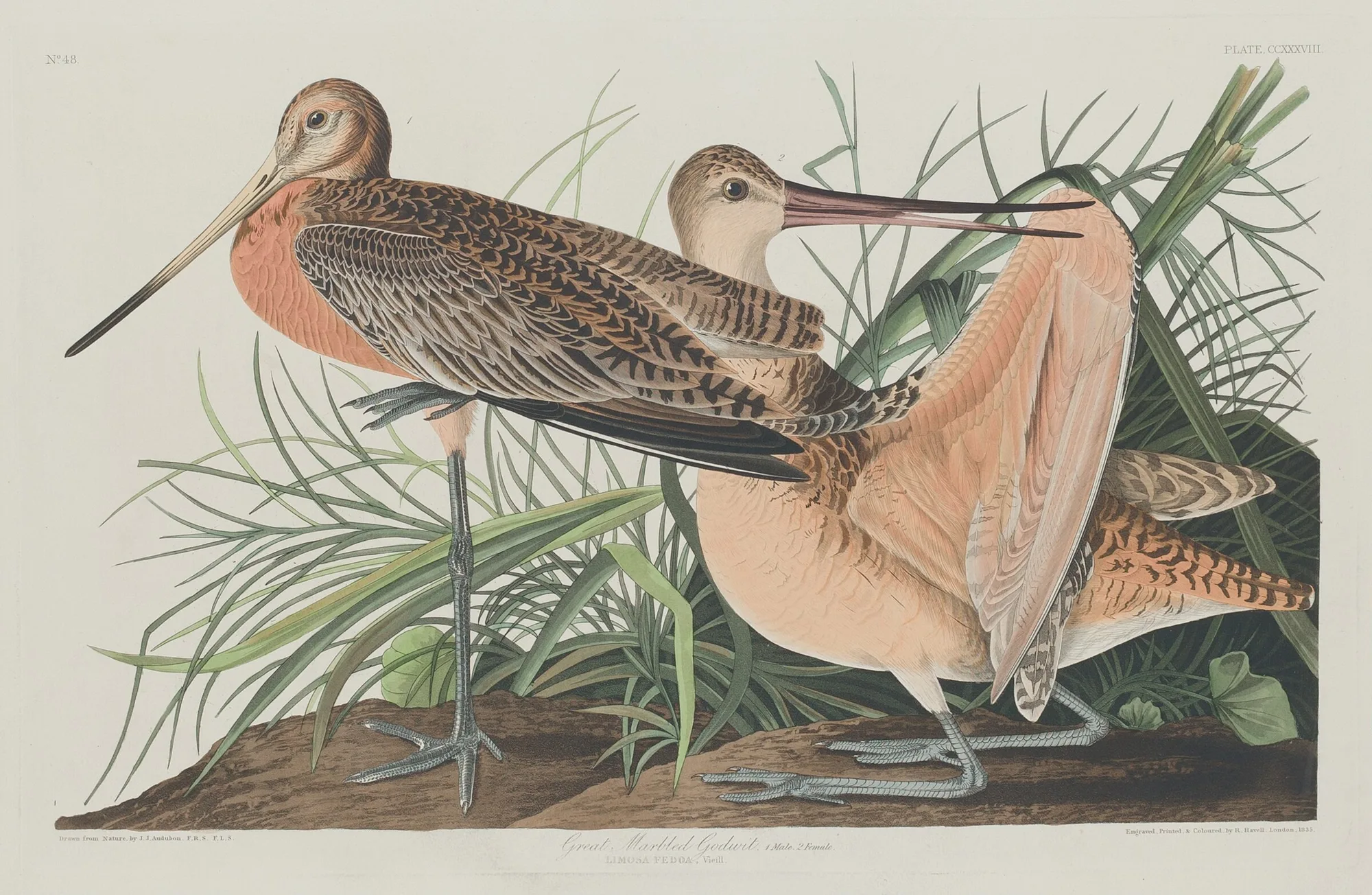
Audubon's “Great Marbled Godwit”, The Birds of America, plate CCXXXVIII
Click or press Enter to enlarge
Open the full-resolution image (2598 px, National Gallery of Art)
| Plate | 238 (CCXXXVIII) |
|---|---|
| Audubon's name | Great Marbled Godwit |
| Modern name | Marbled Godwit |
| Scientific name | Limosa fedoa |
| Status | Least Concern |
| Engraved by | Robert Havell, after Audubon's watercolor |
| Date | 1835 |
| Medium | Hand-colored engraving and aquatint on Whatman wove paper |
| Collections | Shorebirds, Rails and Cranes |
| This impression | National Gallery of Art, Washington, 1945.8.238; Gift of Mrs. Walter B. James |
About this plate
Plate 238 shows a male and female Marbled Godwit, large cinnamon-brown shorebirds barred and mottled above, with very long, slightly upturned bills that are pink at the base.
Audubon described the bird as a winter resident of the Florida coast, feeding on mudflats mixed with beds of raccoon oysters in flocks of five or six, together with Willets, yellowlegs, Long-billed Curlews and White Ibises. It probed mud and sand to the full length of its bill, chased fiddler crabs along the edges of the marshes and waded until the rising tide forced it ashore. At midday the flocks gathered on sand bars to preen and rest on one leg. He found it very wary but noted that gunners could kill many at once when large flocks bunched together.
The scientific name, Limosa fedoa, is unchanged. The Marbled Godwit is the largest godwit in North America. It breeds mainly in the mixed-grass prairies and wetlands of the northern Great Plains, with small outlying populations around James Bay and in Alaska, and winters on coasts from California and the Carolinas south to Central America.
Market hunting greatly reduced its numbers in the late nineteenth century, and the ploughing of native prairie later took much of its breeding habitat. It is listed as Least Concern, but it is a species of conservation concern on the Great Plains.
In Audubon's words
Towards the middle of the day, the separate flocks come together, assembling on some large sand-bar, where they remain for hours, trimming their plumage, after which many of them continue some time motionless, standing on one leg. Suddenly, however, they are all seen to stretch their wings upwards, their bleating notes are heard, and the next moment the flock rises, and disperses in small parties, each of which proceeds in a different direction in search of food. Few birds are more shy or vigilant than the Great Marbled Godwit. It watches the movements of the gunner with extreme care, particularly while in small flocks, in which case it rarely happens that one can approach them, and they are more commonly shot by coming unawares over the concealed sportsman. When in large flocks I have known them to be neared, and killed in great numbers. On such occasions, they walk towards each other, until they are quite close, when they stand still.
John James Audubon, Ornithological Biography, vol. 3 (1835), “The Great Marbled Godwit”. Read the full chapter.