American Coot (Plate 239)
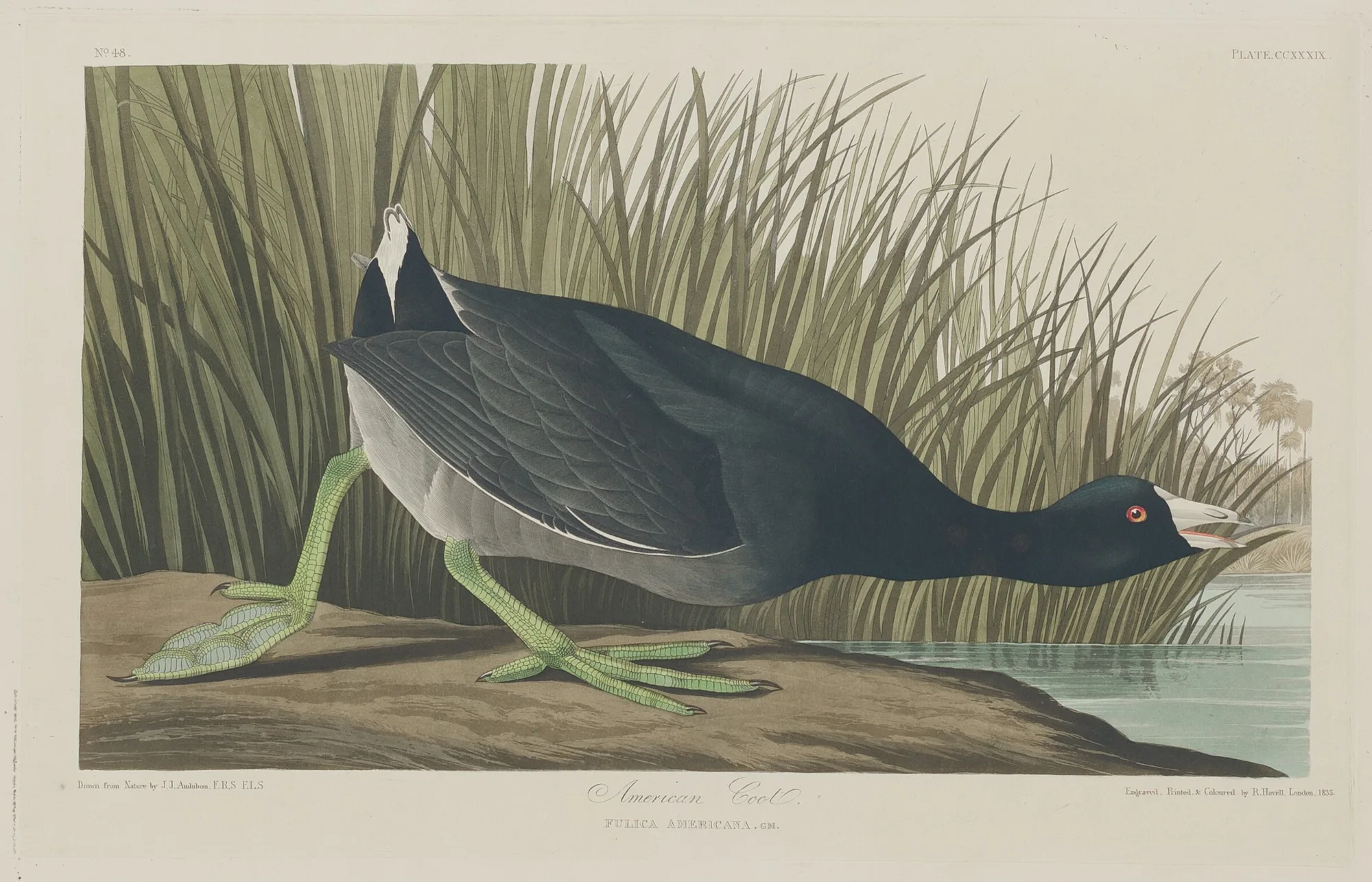
Audubon's “American Coot”, The Birds of America, plate CCXXXIX
Click or press Enter to enlarge
Open the full-resolution image (2400 px, National Gallery of Art)
| Plate | 239 (CCXXXIX) |
|---|---|
| Audubon's name | American Coot |
| Modern name | American Coot |
| Scientific name | Fulica americana |
| Status | Least Concern |
| Engraved by | Robert Havell, after Audubon's watercolor |
| Date | 1835 |
| Medium | Hand-colored engraving and aquatint on Whatman wove paper |
| Collections | Shorebirds, Rails and Cranes |
| This impression | National Gallery of Art, Washington, 1945.8.239; Gift of Mrs. Walter B. James |
About this plate
Plate 239 shows a male American Coot, slate grey with a blackish head, a white bill marked with a dark ring near the tip, a small white shield on the forehead, a red eye and greenish feet with lobed toes.
Audubon described huge winter flocks in southern Florida and lower Louisiana between November and mid-April. He saw coots in every ditch and pond at General Hernandez's plantation in East Florida in December 1831 and in great flocks near John Bulow's plantation the next month. Because none stayed to breed there, he concluded that William Bartram had mistaken the Common Gallinule for the coot. His most vivid memory came from the Mississippi about fifty miles above New Orleans on 21 March 1822, when he saw six or seven hundred coots grazing on a riverside savannah and at first took them for a flock of guinea fowl.
The scientific name, Fulica americana, is unchanged. Despite its duck-like habits the coot is a rail, related to gallinules and cranes. Its toes carry broad lobes rather than webs, which help it swim and walk on soft mud.
The American Coot breeds in marshes and ponds across much of North America and winters south to Central America. It is one of the most abundant waterbirds on the continent and is listed as Least Concern.
In Audubon's words
While ascending the Mississippi, being about fifty miles above New Orleans, on the 21st of March 1822, the weather cloudy, I had the pleasure of seeing about six or seven hundreds of these birds feeding on the grass of a savannah bordering the river. I took them while at some distance, for a great flock of Guinea Fowls. Their movements were brisk, they often struck at each other in the manner of the domestic fowl, and ran with surprising celerity. As I approached nearer, I plainly saw them nibble the tender grass, in the same manner as poultry; and having found a place of concealment behind a rise of the ground, I laid myself flat, and observed their motions at leisure; but during twenty minutes spent in that situation, I did not hear a single note from the flock.
John James Audubon, Ornithological Biography, vol. 3 (1835), “The American Coot”. Read the full chapter.



