Song Sparrow (Plate 25)
Audubon's “Song Sparrow”, The Birds of America, plate XXV
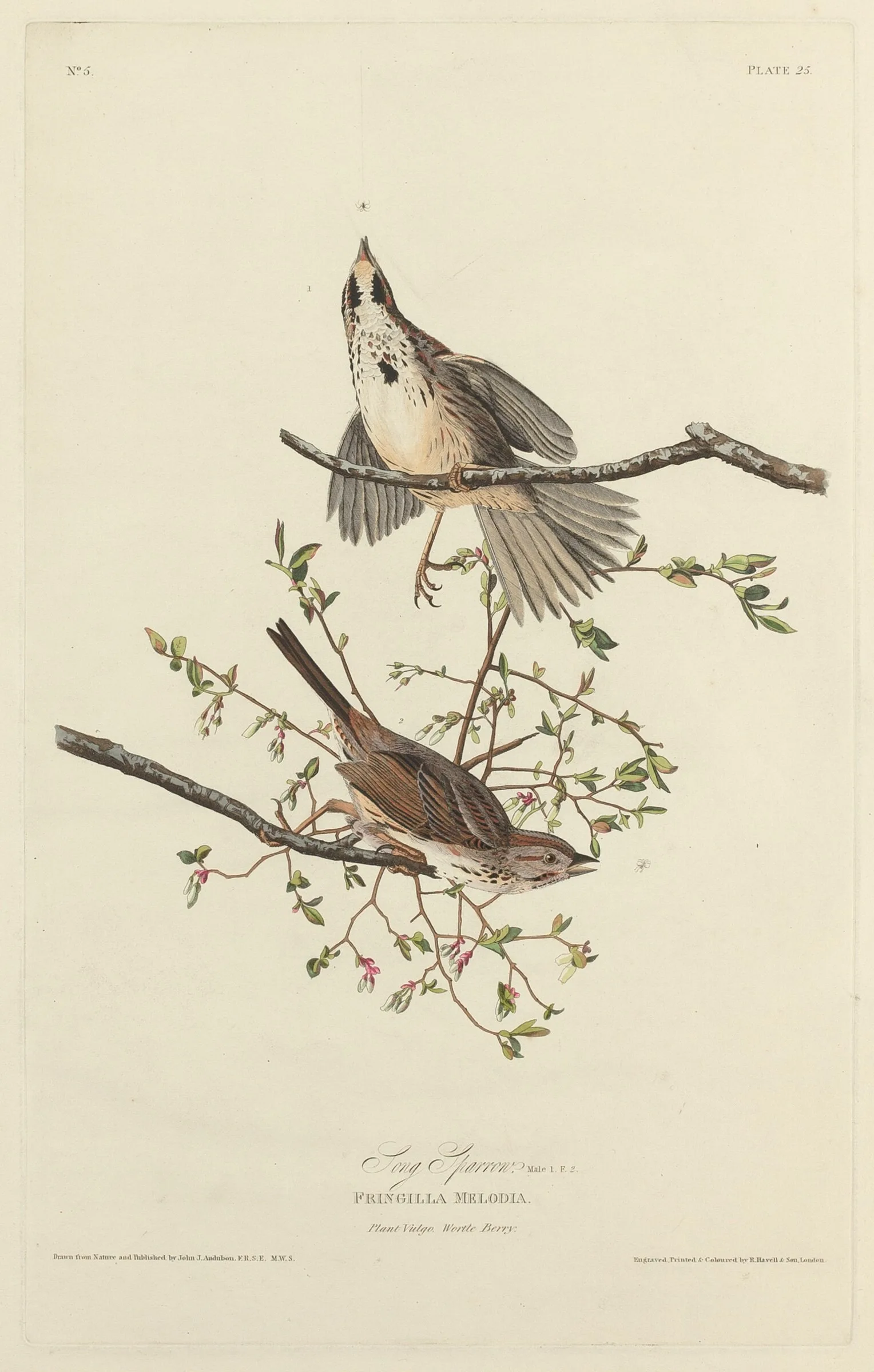
Click or press Enter to enlarge
Open the full-resolution image (2508 px, National Gallery of Art)
| Plate | 25 (XXV) |
|---|---|
| Audubon's name | Song Sparrow |
| Modern name | Song Sparrow |
| Scientific name | Melospiza melodia |
| Status | Least Concern |
| Engraved by | Robert Havell, after Audubon's watercolor |
| Date | 1827 |
| Medium | Hand-colored engraving and aquatint on Whatman wove paper |
| Plants and setting | Huckleberry bush in blossom |
| Collections | Songbirds |
| This impression | National Gallery of Art, Washington, 1945.8.25; Gift of Mrs. Walter B. James |
About this plate
Plate 25 shows a pair of Song Sparrows on a twig of Huckleberry in blossom. Audubon wrote that this huckleberry could grow six or seven feet high and bore fruit in great abundance. Women and children picked the berries for sale in eastern markets, and he preferred them fresh to baked in tarts. The plate was engraved by Robert Havell in 1827.
Audubon opened by explaining the bird's abundance in Louisiana in winter. He counted three broods a year of six, five and three young, fourteen in all from one pair. He also wondered why the Song Sparrow builds a new nest for each brood while Ospreys and swallows reuse theirs. He described birds singing from low bushes along streams, feeding on grass seeds and grasshoppers, and wading leg-deep across shallow water.
The name is unchanged: Song Sparrow, Melospiza melodia. Wilson gave it the scientific name Fringilla melodia, which Audubon used. It is one of the most variable birds in North America, with more than twenty described subspecies ranging from pale desert birds to large, dark forms in the Aleutian Islands.
The Song Sparrow breeds across most of Canada and the northern and central United States and in the West south to Mexico. Northern birds move south in winter. Its song, a few clear notes followed by a trill, is one of the best known in North America. It is listed as Least Concern.
In Audubon's words
The Song Sparrow is one of the most abundant of its tribe in Louisiana, during winter. This abundance is easily accounted for by the circumstance that it rears three broods in the year:—six, five, and three young at each time, making fourteen per annum from a single pair. Supposing a couple to live in health, and enjoy the comforts necessary for the bringing up of their young families, for a period of only ten years, which is a moderate estimate for birds of this class, you will readily conceive how a whole flock of Song Sparrows may in a very short time be produced by them.
John James Audubon, Ornithological Biography, vol. 1 (1831), “The Song Sparrow”. Read the full chapter.
Other impressions of this plate: The Metropolitan Museum of Art.



