Wilson's Snipe (Plate 243)
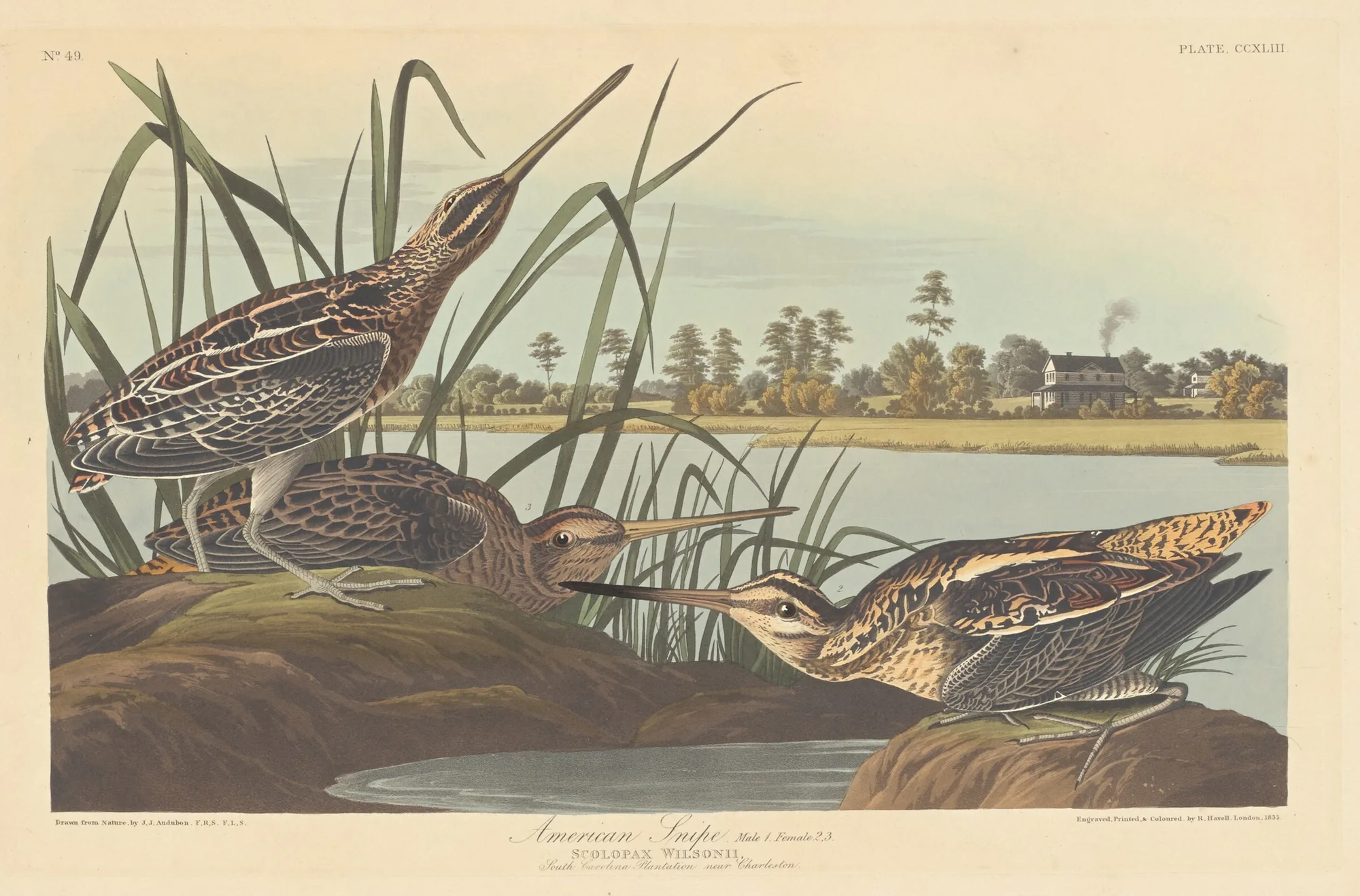
Audubon's “American Snipe”, The Birds of America, plate CCXLIII
Click or press Enter to enlarge
Open the full-resolution image (2777 px, National Gallery of Art)
| Plate | 243 (CCXLIII) |
|---|---|
| Audubon's name | American Snipe |
| Modern name | Wilson's Snipe |
| Scientific name | Gallinago delicata |
| Status | Least Concern |
| Engraved by | Robert Havell, after Audubon's watercolor |
| Date | 1835 |
| Medium | Hand-colored engraving and aquatint on Whatman wove paper |
| Collections | Shorebirds, Rails and Cranes |
| This impression | National Gallery of Art, Washington, 1945.8.243; Gift of Mrs. Walter B. James |
About this plate
Plate 243 shows Audubon's American Snipe, a stocky, long-billed bird striped buff and brown on the head and back, which hides in wet grass and flushes with a harsh call and a zigzag flight. The figures line of the chapter lists a male, a female and young birds in autumn.
Audubon wrote that the snipe bred mainly to the north, in Maine and especially Nova Scotia, where it laid four eggs in a hollow in the moss of upland bogs in early June. He knew of pairs breeding near Mill Grove on the Perkiomen in Pennsylvania, his first American home, but never found a nest there. He described the soft bills of the young and how they learned to probe the mud. In the West the birds arrived in October; Louisiana Creoles called them cache cache, and they wintered by the thousand in the rice fields of South Carolina.
Audubon called it Scolopax wilsonii, after Alexander Wilson. The American Ornithological Society long treated it as a race of the Common Snipe of Eurasia, but in 2002 restored it as a separate species, Gallinago delicata, keeping Wilson's name in its English name.
Wilson's Snipe breeds in wet meadows and bogs across Canada, Alaska and the northern United States and winters south to Central America. In spring the male makes a winnowing sound in display flight with its outer tail feathers. It is listed as Least Concern.
In Audubon's words
In the Western Country this bird arrives from the north early in October, alighting in the low meadows watered by warm springs, and along the borders of ponds and small secluded rivulets, sometimes in the corn fields after a continuance of rainy weather, but never in the woods or any place from which it cannot easily make its escape when approached. In Kentucky it often remains all winter, and is at times very abundant. Farther south, it is more plentiful, especially in the lower parts of Louisiana, where it is named “cache cache” by the Creoles, and over the whole country between that State and the Carolinas.
John James Audubon, Ornithological Biography, vol. 3 (1835), “The American Snipe”. Read the full chapter.