Red Phalarope (Plate 255)
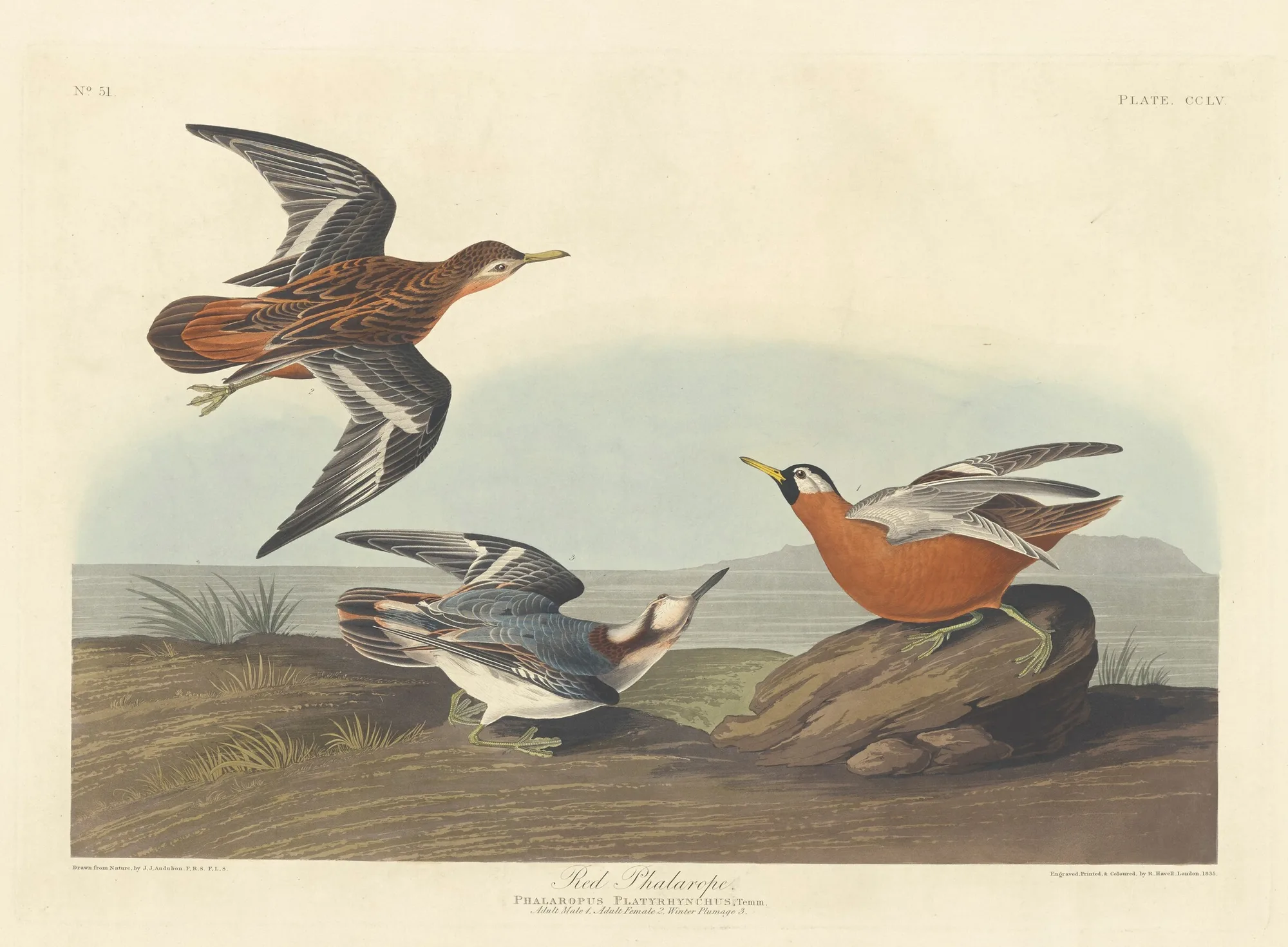
Audubon's “Red Phalarope”, The Birds of America, plate CCLV
Click or press Enter to enlarge
Open the full-resolution image (3458 px, National Gallery of Art)
| Plate | 255 (CCLV) |
|---|---|
| Audubon's name | Red Phalarope |
| Modern name | Red Phalarope |
| Scientific name | Phalaropus fulicarius |
| Status | Least Concern |
| Engraved by | Robert Havell, after Audubon's watercolor |
| Date | 1835 |
| Medium | Hand-colored engraving and aquatint on Whatman wove paper |
| Collections | Shorebirds, Rails and Cranes |
| This impression | National Gallery of Art, Washington, 1945.8.255; Gift of Mrs. Walter B. James |
About this plate
Plate 255 shows Red Phalaropes in two dresses: an adult male and female in brick-red breeding plumage with white faces and yellow bills, and an adult in grey and white winter plumage. Audubon wrote that the summer figures were drawn from specimens given to him by Captain James Clark Ross, the Arctic explorer.
His first drawing of the species dates from 1808, a few weeks after he moved to Louisville, Kentucky. Returning from the house of a friend, he saw a large flock swimming along the Ohio, ran ahead through the woods, and fired both barrels as they waded onto a sand bar. He picked up seventeen. They were in grey autumn plumage and, he wrote, capital eating. He showed that drawing to Alexander Wilson when Wilson visited Louisville. The next day he found more walking on floating moss near the mouth of Bear Grass Creek.
The name Phalaropus fulicarius is unchanged. In Britain the bird is called the Grey Phalarope after its winter plumage. As in other phalaropes, the female is the brighter bird and the male incubates the eggs.
The Red Phalarope breeds on high Arctic tundra and spends the rest of the year at sea, often far offshore, feeding on plankton brought to the surface. Inland records are rare and usually follow storms, so a flock on the Ohio was unusual even then. It is listed as Least Concern.
In Audubon's words
My first drawing of the Red Phalarope was made at Louisville in Kentucky, a few weeks after my removal to that place, in 1808. One afternoon, while returning from the house of my hospitable friend General Croghan, I observed a large flock of birds proceeding along the shores of the Ohio. They were quite unknown to me, and therefore extremely anxious I was to procure some of them. I therefore ran through the woods until I got ahead of them, went to the margin of the river, and concealed myself at some distance from them. They swam beautifully, played about, picked up substances floating on the water, now dispersed, and again came close together, until at length coming opposite to a small sand-bar stretching out from the shore to the distance of a few yards, they directed their course towards it, and waded out. When just landing, they were so close to each other that I could not withstand the temptation, and so levelled my gun, pulled both triggers, and saw that I had made considerable havock among them.
John James Audubon, Ornithological Biography, vol. 3 (1835), “The Red Phalarope”. Read the full chapter.